(Lighthouse News – June 28, 2018) Trinity Western University continues to evaluate this month’s Supreme Court of Canada decision on its application to open a Law School. The court ruled that law Societies in BC and Ontario were justified in refusing to admit graduates of that proposed school to the bar in their respective provinces. The ruling said that TWU’s community covenant, under which students and staff pledge, among other things, to only engage in sexual activity inside the bounds of heterosexual marriage, was discriminatory against the LGBTQ community, and was thus a violation of so-called “Charter values.”

Janet Epp-Buckingham
Janet Epp-Buckingham is a professor at TWU, and has been part of the group spearheading the efforts to start up the law school. She says when the ruling first came down on June 15th, the University administration looked at it and said “well, that’s the end of our dream for a law school.” However, she says, the ruling is very complex, and as they’ve continued to read through it, they’ve come to a slightly different conclusion. She says the decision is “very narrowly focussed on the ‘mandatory’ nature of the community covenant. So one of the possibilities that the University could consider would be to make the community covenant not mandatory.”
Epp-Buckingham says there are other Christian universities in Canada that have non-mandatory codes of conduct which try to establish “a Christian ethos and morality on campus” without having a mandatory community covenant, and the objective might be to get at a similar kind of thing but through “a different mechanism of establishing Christian standards, but in a different way.”
TWU has two other academic streams that require external certification of their graduates; a School of Nursing, and a School of Education, and Epp-Buckingham says that adds a further complication to the discussion. She says since the Supreme Court issued its ruling on June 15th, there have been “some conversations which have been initiated by the accrediting bodies (for nurses and teachers), saying ‘You know, we think that you should be looking very carefully at the court’s decision to determine if it’s going to impact on other professional programs.’”
If the Supreme Court had ruled in favour of TWU, the hope was to have the Law School up and running by September of 2019. Epp-Buckingham says even if the University decides to amend its community covenant and go ahead with the law school, the opening would still be delayed by at least a year.
A final response to the court ruling could be coming by the end of this summer.
You can listen to the full Lighthouse News broadcast here.

by Mark Penninga
I’m often asked whether political and legal developments in Canada get me down. And my honest answer is that they rarely do. I’m often amazed and encouraged by the impact we can still have when we seize the freedom God has given us and take action.
But I admit that last Friday’s Supreme Court of Canada TWU decision really hurts. It is a game-changer. I don’t think most Canadians realize just how profound an impact it will likely have on our most fundamental freedoms.
At the risk of oversimplifying it, a majority of the highest judges of our land broke the highest law of our land (the constitution) to chart their preferred moral course for the nation. Although the law was not on their side, they simply decided to press on with their agenda. And, humanly speaking, nothing can be done to stop them. Our legal and political systems will entrench this decision as the new standard.
When the dust settles and Christians begin to see just how serious this is, we may be tempted to throw up our hands in disgust, grumble at how things came to be this way, and, even worse, decide that this is the time to exit the public square.
It is times like this that our faith is tested. What do we really think about those passages in Scripture that instruct us about how to respond when we face hard times?
I have appreciated the biblical encouragement received from family these past few days. I’ve been reminded that the Bible says we should not be surprised when we face trials. Nor should we fear. God knows what He is doing.
“But even if you should suffer for righteousness’ sake, you will be blessed. Have no fear of them, nor be troubled, but in your hearts honor Christ the Lord as holy…”(Emphasis added, 1 Peter 3:13-14).
It is easy to skip over the “you will be blessed” and “have no fear of them, nor be troubled” part of the verse given what we are experiencing today. But that would be a big mistake.
God is calling us to move beyond our fear of man towards fear of God. He is calling us to be strong and courageous.
If we are honest, most of us will admit we do not feel very strong. And the older we get, the more clear that becomes. But courage has little to do with how strong we feel. Instead, courage means that we listen to what God promises, believe it, and then live in such a way that we show with our actions that we believe God’s promises.
In other words, courage has very little to do with who we are, and a whole lot to do with what we believe about who our God is.
A young child has courage not because they are strong, but because they have faith. If my two-year-old Matthew is standing up on a high table and I hold out my hands, he doesn’t need to think about it, he just jumps. He trusts me to catch him.
Sadly, as we get older, we begin to doubt the many promises that God made to us. As we experience the brokenness of life, our trust in those promises wanes. Our anxiety increases. And we often decide we are not going to jump. We are paralyzed with fear. We complain, or become bitter, or distract ourselves. But we don’t move forward with courage.
This has always been a challenge for God’s people. We read time and again in the Bible that God calls His people to stop living in fear and to be strong and courageous.
A key text that is imprinted on my mind is from Numbers chapter 13 and 14.
After their trek from Egypt, the Israelites were on the threshold of the Promised Land. Picture hundreds of thousands of men, women, and children travellers. God promised that they would receive the land. They just had to go in and take it. But upon hearing the frightening report of majority of the spies, the people crumbled. They refused to listen to Caleb, who believed God’s promise and encouraged them “let us go up at once and occupy it.”
Israel decided that God’s promises could not be trusted. They decided to obey the fear in their hearts. As a result, God tells Moses that none of those people would see the Promised Land. “But my servant Caleb, because he has a different spirit and has followed me fully, I will bring into the land into which he went, and his descendants shall possess it.”
What was different about Caleb? He had a different spirit. It was a spirit of faith. His faith trumped his fears. We have much to learn from Caleb, also as our nation chooses to flaunt God’s commands.
Sure enough, for forty years the Israelites wandered in a desert. Their lack of faith meant their entire generation died out. But it doesn’t end there. 40 years later a new generation has a new opportunity. God talks to Joshua when the new generation is on the threshold of the Promised Land. Will this generation be any different? Here, God gives Joshua a pep talk like no other.
If you have a moment, please read Joshua 1:1-9. Note God’s instruction:
Verse 6: “Be strong and courageous.”
Verse 7: “Be strong and very courageous.”
Verse 9: “Be strong and courageous.”
Do you think God had something he wanted Joshua to remember?
That was more than three thousand years ago. We know that God kept His word then, just as He always has. Israel did conquer that land.
Today, we have to decide whether and how to move forward after a very troubling Supreme Court decision. If we are honest with ourselves, most of us feel like grasshoppers next to the people in our land. Many powerful people think we are fools. They think Christian teaching is “harmful” and that Christian institutions should not be free to participate in public life.
But courage means we will share in the confidence of Caleb. As he said to all the people “We can surely do it!” That doesn’t mean we will say all the right things, or do it as well as others. But we will step in line and show with our words and actions that God’s promises are real, not only in the safety of our homes and churches, but throughout Canada, in 2018 and onward.
I understand very well that we are not the nation of Israel, and God has not given us a calling to “conquer” this land. We are not here for earthly power. He has given us an even greater calling than conquest. And that calling applies to every one of us who calls him or herself a Christian. Our calling is embedded in our name. We are Christians. Followers of Christ, meaning “anointed”.
If you are familiar with the Heidelberg Catechism, you will know that to be called a Christian means first that we are prophets, priests, and kings.
As prophets, we confess His Name (Lord’s Day 12). This means that we speak words of grace and truth, also in 2018 and in Canada, and also to those in authority.
As priests, we present ourselves as living sacrifices, willing to sacrifice our time, money, and even our reputation for Christ in Canada.
As kings, we fight against sin and the devil in this life. We actively resist Satan and his forces as they seek to make this a nation that celebrates death, corrupts vulnerable minds, and worships the idol of self.
We cannot do this in our own strength. Not a chance. But we can do so in the strength of Him of who calls us to not be afraid.
Let us call upon Him, seeking His grace and strength and fearing Him alone.
And then let us press on, strong and courageous.
For immediate release from the Association for Reformed Political Action (ARPA) Canada
June 15, 2018
Supreme Court rules against TWU, placing public perception over rule of law
OTTAWA – This morning, the Supreme Court of Canada ruled against Trinity Western University and their proposed Christian law school. Justices Brown and Côté dissented.
The Association for Reformed Political Action (ARPA) Canada, was an intervener in the case. André Schutten, ARPA’s Director of Law and Policy, and John Sikkema, ARPA’s Legal Counsel, acted as counsel for ARPA in the intervention.
ARPA sees several major problems with the majority judgement.
First, it justifies the law societies’ rejection of Trinity Western University not based on an intelligible legal rule or standard, but based on the undefined, amorphous concepts of “Charter values” and “public interest”. The majority says the law societies were entitled to choose to give the meaning they wanted to their statutory objective to protect the “public interest”.
By relying on Charter values, says Schutten, “The majority fails to appreciate that the Charter limits the power of state actors – including the law societies – and shields non-state actors, including religious communities and institutions like TWU.”
Second, having relied on “public interest” informed by “Charter values” to justify the rejection of TWU, the majority errs in its analysis of what is in the public interest, even on a broad interpretation of it.
“The majority says the law societies’ fear of negative public perception was a legitimate reason to reject TWU,” says Schutten. “But there are also negative public perceptions resulting from the rejection of TWU. In any case, neither the law societies nor the courts are in the business of public opinion polling, nor should they make decisions based on prevailing public opinion on sensitive issues.”
“The majority also fails to recognize the public interest benefits of a diversity of educational institutions and a diversity of moral and philosophical perspectives in the legal profession,” says John Sikkema, legal counsel with ARPA Canada. “It is not against the public interest for individuals or civic institutions to hold to different views on sexual morality and marriage.”
“Perhaps most disappointing from our perspective, the majority failed to account for or even address the equality rights of prospective TWU students or TWU’s freedom of association. These were issues we raised in our oral and written arguments to the court,” says Schutten. “The majority says it need not address those rights claims, because it is sufficient to ask whether the violation of freedom of religion is justified.” ARPA Canada believes that these other rights should play an important part in the “proportionality” analysis of the law societies’ decisions.
Ultimately, ARPA agrees with the dissent that the majority “betrays the promise of our Constitution that rights limitations must be demonstrably justified.”
“We are as yet unsure of the implications of this decision on communities of faith across the country,” says Sikkema. “We will be analyzing this further in the coming days, for sure.”
– 30 –
Interview requests:
André Schutten is available for comment via phone/email or in person in Ottawa. To arrange an interview contact Hannah Sikkema, Media Facilitator at 1-866-691-2772, ext. 1 or [email protected].
ARPA Canada, 130 Albert Street, Suite 1705, Ottawa, ON K1P 5G4
Chief justice, justices,
I want to focus my argument this morning on section 15 of the Charter and its relationship to freedom of association as guaranteed by section 2(d).
In oral argument yesterday, what is actually freedom of association has been unfairly or inaccurately described as discrimination. Whenever someone alleges discrimination, we must ask, “By what standard?” By what standard is the allegation of discrimination laid? That standard must be found in law. The law will tell us whether we are dealing with discrimination or association.
The Ontario Court of Appeal erred here. In paragraph 115, the Court ruled that TWU’s admission policy… discriminates… contrary to s. 15 of the Charter and s. 6 of the HRC.
One would expect then that a section 15 analysis and a human rights code analysis would either precede or follow such a bold legal conclusion. However, there is no such legal analysis. It is nowhere to be found in the judgement.
And I respectfully submit that if the legal analysis had been done, the conclusion would have been different: TWU couldn’t have discriminated contrary to section 15 of the Charter, because the Charter doesn’t apply to TWU. And TWU does not discriminate contrary to the Human Rights Code because TWU actually benefits from special protections within that Code.
Those special protections are explicit protections of associational freedom, as this Court has said repeatedly.[1] Those protections enhance associational diversity.
Let’s put meat on these legal bones with two practical examples:
The Chief Justice told us of a law school starting in her basement very soon. Incidentally, that law school is now trending on twitter.
Let’s play with this example. Let’s assume it’s the McLauchlin School of Law for Women. It’s a private attempt to raise the profile of women in the legal profession and to enhance feminist legal scholarship in Canada.
Is that association or discrimination? A thorough legal analysis would reveal this is association, protected by section 2(d) of the Charter, not contrary to section 15, and protected by exemptions in the human rights codes.
Second example: If I told you that I’m imagining a law school that has limited seats for people of colour, every lawyer in this room would say, “That’s a bad thing. We can’t do that.” But then if I told you, “Well, the law school I’m imagining is a law school for Aboriginal peoples, started in Northern Ontario somewhere, to increase First Nations representation in the bar, well that changes the equation, doesn’t it? Is such a program lawful association, or unlawful discrimination?
In each of these examples, the law will tell us conclusively whether we are dealing with association or unlawful discrimination, if we do the legal analysis. And I submit that TWU is analogous to the McLauchlin School of Law for Women, and to the First Nations law school.
[Q. What about a whites-only school?] 1. We might wonder at the motivation for and mission or purpose of such a school and whether that affects the quality of its graduates. If the motivation for the school is bad, say neo-Nazi or something, it might raise serious questions about its graduates suitability. 2. If it’s motivated by hate and bigotry, I can’t imagine it getting the requisite support of qualified legal academics and so on.
Furthermore, if the law societies were to reject the Law School for Women or the First Nations law school, they would be guilty of discrimination on the basis of sex and race, just as they are currently guilty of discrimination against a religious minority, contrary to section 15, in the case of TWU.
The argument that section 15 compels the law societies to reject TWU completely twists the fundamental design of the Charter. The Charter of Rights is a shield to protect the freedom of non-government institutions. To argue that section 15 compels the law societies to reject TWU re-forges that shield into a sword to be wielded by the state to enforce moral conformity. While our constitution has been described as a living tree, it is not a mutant organism, with the ability to fundamentally change its essence. The Charter shields TWU, it does not (as this court has said in TWU 2001[2] and in Andrews[3]) the Charter does not impose section 15 obligations on TWU.
Subject to any questions, those are my submissions.
References
[1] Caldwell v. Saint Thomas Aquinas High School, [1984] 2 S.C.R. 603 at 626 [Caldwell].:
…the courts should not in construing [the exception section] consider it merely as a limiting section deserving of a narrow construction. This section, while indeed imposing a limitation on rights in cases where it applies, also confers and protects rights..:
This is the only section in the Act that specifically preserves the right to associate… In a negative sense [it] is a limitation on the rights referred to in other parts of the Code. But in another sense it is a protection of the right to associate. Other sections ban religious discrimination; this section permits the promotion of the religion.
Brossard (Town) v. Québec, [1988] 2 S.C.R. 279 at para. 100: Justice Beetz described these exception sections as being
designed … to allow certain non-profit institutions to create distinctions, exclusions or preferences which would otherwise violate the Charter if those distinctions, exclusions or preferences are justified by the charitable, philanthropic, religious, political or educational nature of the institution in question. In this sense, [the SEES] confers rights upon certain groups. [The SEES] was designed to promote the fundamental right of individuals to freely associate in groups for the purpose of expressing particular views or engaging in particular pursuits. Its effect is to establish the primacy of the rights of the group over the rights of the individual in specified circumstances.
[2] TWU 2001 at para. 25, “To state that the voluntary adoption of a code of conduct based on a person’s own religious beliefs, in a private institution, is sufficient to engage s.15 would be inconsistent with freedom of conscience and religion”.
[3] Andrews confirms this when it states that section 15(1) does not “impose on individuals and groups an obligation to accord equal treatment to others. It is concerned with the application of the law.”
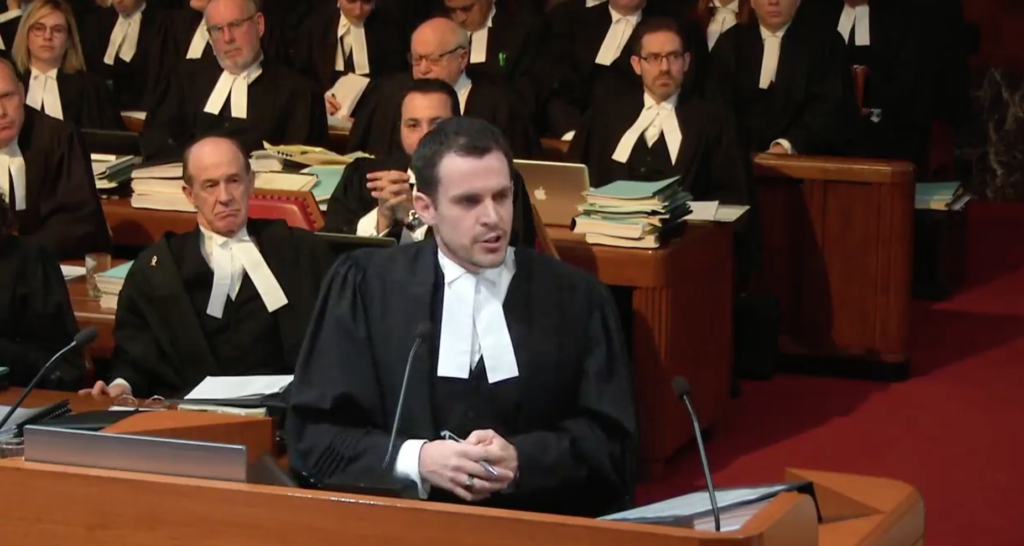
André Schutten of the Association for Reformed Political Action (ARPA) Canada presents to the Supreme Court of Canada on the Trinity Western University Law School case.
For more information, please visit https://staging.arpacanada.ca/TWU-case.
For immediate release from the Association for Reformed Political Action (ARPA) Canada
November 29, 2017
ARPA Canada intervenes in TWU case this week
André Schutten, ARPA Canada’s Director of Law & Policy, will be arguing at the Supreme Court of Canada. He will argue that the Charter’s section 15 equality right is infringed, not by Trinity Western, but by the law societies against Trinity Western students. “In order to determine whether something is discrimination we rely not on hurt feelings, but on legal test.” Schutten said. The reality is, while there may be those who disagree with Trinity Western’s covenant – it is legally and constitutionally protected.
And there is good reason to protect it. One of Canada’s fundamental freedoms is that of association. “Association, by definition, requires the freedom for members of a community to define for themselves who they are.”
While Trinity Western is exercising their freedom of association, the law societies as government actors are bound by the Charter not to discriminate on the basis of religion against Trinity Western students. And yet their sole reason for rejecting them is because of the religious views espoused in Trinity Western’s Covenant.
The Supreme Court of Canada needs to hold the law societies to account for their discrimination and overturn their decisions.
– 30 –
Interview requests:
ARPA Canada’s Director of Law & Policy, André Schutten, is available for comment via phone/email or in person in Ottawa. To arrange an interview contact Hannah Sikkema, media facilitator at 1-866-691-2772, ext. 1 or [email protected].

——————
LN: So, two days from now, the Supreme Court of Canada starts its hearings on the Trinity Western University case. For folks who may have just arrived on this scene late, run through some of the fundamentals here. What’s this about?
AS: Essentially, Trinity Western University – a Christian university – wants to start the first-ever Christian Law School. It’s actually the first-ever religious law school that’s not one of the pre-existing 22 secular law schools in Canada. And they were approved to do that by both the National Federation of Law Societies of Canada as well as the Minister of Higher Education in BC. Both of those bodies determined that Trinity Western’s Law School program, as proposed, was completely compatible with the practice of law in Canada. However, three Law Societies – in British Columbia, in Ontario, and in Nova Scotia – all said “Well, we don’t like the Community Covenant at Trinity Western. We don’t like that this is a Christian University that takes their faith seriously and requires their students and their staff to live according to Biblical virtue.” And because of that, they said “We will not recognize that law degree.” So this has been challenged in the courts in BC, Ontario, and in Nova Scotia. At the lower level – at the Courts of Appeal – and now two of the matters, the Court of Appeal decision in BC, where Trinity Western won, and the Court of Appeal decision in Ontario, where Trinity Western lost; both of those two decisions have now been appealed to to the Supreme Court of Canada, where they hopefully will answer the question for us in a clear way: “Can Law Societies discriminate against Trinity Western University and its law degree simply on the basis of its faith commitment?”
LN: ARPA is an intervener in this case; we’ve been granted the intervener status. What’s the fundamental point of the arguments that ARPA is bringing to the table?
AS: I want to focus in on that question of “discrimination”. The other side on this issue, they keep saying that Trinity Western University is the one who discriminates. They say that their faith community or their faith covenant discriminates against particularly LGBTQ individuals, but also against others. And my argument is that: “No-no-no, the discrimination that’s happening here – in this case – is not against LGBTQ people, but against evangelical Christians who associate with Trinity Western University.” And the discrimination that’s happening is by State actors; by the Law Society in BC and the Law Society in Ontario. That’s a proper understanding of discrimination. But discrimination and association are two sides of the same coin. Freedom of Association is protected in the Charter – in Section 2 (d) – so to associate with other people of like mind. as Trinity Western is doing. that requires in a sense setting a distinction between yourselves and others. That’s what association means. It’s actually a logical and necessary component of Freedom of Association. And so, in order to understand which side of the coin you’re looking at – is this legal “discrimination” or is this “association”, freedom of association? – you need to follow legal tests, legal analysis, in order to come to that decision. You don’t follow emotional gut feelings. You follow legal tests, and that’s where we’re hoping to direct the Supreme Court to really focus in on. “What is the legal test? The law is on the side of Trinity Western. Follow those legal tests and Trinity Western should win.”
LN: There’s another wrinkle here. The President of Trinity Western (Bob Kuhn) sent a letter to the alumni earlier this month, and I’m just going to quote from it here, briefly. He says:
The Law Society of Upper Canada (Ontario) now says that (the Supreme Court) must reject Trinity Western not just because of (the) position on marriage…” (in other words that Community Covenant…) “but also because of (the University’s) ‘distinctly Christian’ environment. In its written argument filed with the Supreme Court, the Law Society highlighted every part of the Community Covenant it found discriminatory. (And) the first two highlighted words were ‘Jesus Christ.'” (President Kuhn writes that) “It has become apparent that along with the Christian virtues that we commit to practice, the law society also wants to prohibit the very faith that distinguishes the University.”
I guess first of all, is this a new development – a new wrinkle – in this case? And secondly, how do you read that whole thing?
AS: It’s definitely a new development. I mean, that argument has not yet been made in the lower courts, and in a sense I’m actually kind of confused by it. It seems to me that the Law Society of Upper Canada is overplaying their hand by suggesting that a Christian University cannot be Christian. Cannot say that they confess faith in Jesus Christ. That to me is absolutely ridiculous. I mean surely Freedom of Religion would suggest that we can believe – not just personally and privately in the privacy of our own homes or our own bedrooms, that we believe in Jesus Christ – but that can shape our entire life, and that we can confess that publicly and not be punished or marginalized or treated differently because of it. So it seems to me an overplay on the side of the Law Society of Upper Canada. But at the same time, it’s basically a twisted view of secularism. It’s a view that thinks – and this is actually quite dominant in Quebec out of their cultural tradition of the last 60 years or so – and that is a particular view of secularism.
So there’s two different views of secularism. One is a view of secularism that’s very pluralistic. It says that the civil state – the government – will not take a position on religion, but it’ll allow all faith traditions to contribute in a robust way out of their own faith tradition, and do so freely. But there’s another, much more radical form of secularism – which is being reflected in that argument by the Law Society – which says that secularism means to stamp out all religious expressions of faith, and to make everybody “neutral” by eliminating any references to faith. And that’s a wrong view of secularism. It’s not been endorsed by our Supreme Court yet; in fact, they’ve endorsed the opposite. They’ve endorsed a type of secularism that’s pluralist, and that allows all faith communities to express themselves out of their tradition without compromise.
LN: So you’ve got two more days; I’m assuming all the arguments are pretty much together, and you’ve rehearsed what you’re going to say. What can folks do between now and Thursday and as this thing progresses?
AS: There’s only one thing left to do, Al, and that’s to pray. You know, the lawyers can prepare as best they can, but at the end of the day this is a decision that rests with nine judges, sitting on the Supreme Court – the nine most powerful legal minds of the country. And we know that “In the hands of the Lord is the heart of the King“, and I would say the heart of the nine Supreme Court judges, and He can direct them as He sees fit. So we entreat our listeners to please pray for wisdom for these judges; for minds and hearts that are open to the concerns of the Christian community in this particular case. And pray that God would continue to protect religious freedom in this country not so that Christians can live a life of ease, but so that the Gospel can go out in Canada unaffected, unhindered, so that many more Canadians can come to know the love and joy and peace of Jesus Christ.
ARPA Canada’s Colin Postma gives a quick update on doctors’ conscience protection legislation in Manitoba, ARPA board meetings, the passing of Bill 24 in Alberta, the Trinity Western University case, and a new ARPA Policy Report.
To read the document “To Protect Them All: A Christian case for eliminating lists of special identity groups in school policies”, visit: https://staging.arpacanada.ca/protect-them-all.
For ARPA’s Policy Report on In Vitro Fertilization, visit: https://staging.arpacanada.ca/RS-in-vitro.
For more information on ARPA Canada, visit: https://staging.arpacanada.ca/.

ARPA will be submitting written documents by October 5th and the actual court date for oral arguments will be November 2nd.
Secondly, just last week, ARPA’s team wrapped up its written arguments in the Trinity Western Law School case. André Schutten points out ARPA’s unique position, “ARPA is the only intervenor that’s arguing exclusively Section 15, which is the guarantee in the Charter that every individual in Canada has the right to equal treatment in law.” When a government body such as a Law Society gets in the way of Christians to be licensed as a lawyer, that would be “an infringement of the equality right” that’s guaranteed in Section 15, according to Schutten.
That case is due in court over two days on November 30th and December 1st.
UPDATE: Read the written arguments ARPA Canada submitted to the Supreme Court on September 5 here.
The Supreme Court of Canada will hear the cases between Trinity Western University and the law societies of British Columbia and Ontario on November 30th and December 1st. ARPA Canada will intervene as it has done at many of the lower courts.
History of the Case
The law societies in British Columbia and Ontario refused to accept graduates from the proposed law school because of Trinity Western’s Community Covenant which requires students to refrain from sexual intimacy outside of a heterosexual marriage. They justified their decision by claiming it is not in the public’s interest to allow a law school to exclude LGBTQ students. Trinity Western challenges the law societies’ decisions as a violation of their religious freedom under section 2(a) the Charter.
This case comes to the Supreme Court with two provincial court of appeals finding opposite conclusions. The Ontario Court of Appeal agreed that Trinity Western’s religious freedom was infringed, but found that it was justified, claiming the “conclusion is a simple one:…[the Covenant] is deeply discriminatory to the LGBTQ community, and it hurts.”
The British Columbia Court of Appeal, on the other hand, sided with Trinity Western. In addressing the Ontario Court’s comments regarding the “hurt” to LGBTQ prospective students, they pointed out that “disagreement and discomfort with the views of others is unavoidable in a free and democratic society.” Allowing for disagreement, especially on fundamental issues, is not only a legal right in Canada, but is beneficial to our society.
“A society that does not admit of and accommodate differences cannot be a free and democratic society — one in which its citizens are free to think, to disagree, to debate and to challenge the accepted view without fear of reprisal. This case demonstrates that a well-intentioned majority acting in the name of tolerance and liberalism, can, if unchecked, impose its views on the minority in a manner that is in itself intolerant and illiberal.”
ARPA’s Intervention at the Supreme Court
The Supreme Court must now address these opposite conclusions in a decision that is likely to shape religious freedom in Canada. ARPA Canada will be one of 27 interveners to speak to the Supreme Court during the two-day hearing.
ARPA will use its time to argue that the right of equality is infringed not by Trinity Western, but by the law societies against Trinity Western students. All Canadians are guaranteed access to the public square without discrimination on the basis of religion in section 15 of the Charter. The law societies (as state actors) have denied access to the legal profession to Trinity Western students because of their religious beliefs.
Not only does this hurt, it is unlawful discrimination.
The Importance of this Case
This case will have profound effects on religious freedom in Canada. As ARPA’s Director of Law & Policy, André Schutten said,
“In order for religious freedom to have meaning and effect in a free society, the State cannot interfere with the doctrines and internal affairs of religious communities. And the State cannot interfere indirectly either, through reprisal. That means, if a religious community commits itself to upholding God’s definition and design for marriage (or any other religious issue), then the State cannot then target members of that community. To do so undermines freedom and sends a clear message to society that members of these Christian communities are intolerable.”