In our last article, we looked at how the world answers the question Who am I? The secular answer to that question is that you can be whoever you want to be.
But Christians have a different answer, one that is not only true but one that also better leads to human flourishing. Every human being is made in the image of God. That’s the way you are.
This reality comes out in the opening chapters of Genesis. In Genesis 1:26-27, God says, “Let us make man in our image, after our likeness… So God created man in his own image, in the image of God he created him.”
In his book The Air We Breathe, minister and evangelist Glen Scrivener comments,
“In Genesis 2, mankind is formed from the dust. Materially speaking we are base and brittle, and our lives are brief. But we are also breathed upon by God. There is bottom-up-ness to us and top-down-ness to us. We are dirtbags kissed by heaven. Beloved dust. In ourselves we are [not worth much]. But we are touched by the divine too, and in connection with God we are precious beyond all earthly valuation.”
We can be tempted to focus too heavily either on the dirt or on the divine touch. But the Biblical view holds our dirtiness in balance with our likeness of God. Paradoxically, we are but “dust” as many verses describe, and yet, in the words of the psalmist, we area “little lower than the angels.” Some translations say a “little lower than God” (Psalm 8:5). Why? Because we are made in His image. That’s the way we are.
Even though in Genesis 3 Adam and Eve fell into sin, that did not mean they lost their identity as image bearers of God. No one can lose their identity as an image bearer of God. As evangelist and Old Testament scholar Christopher J. H. Wright explains,
“God does not give to human beings the image of God. Rather, it is a dimension of our very creation… the image of God is not so much something what we possess as what we are. To be human is to be the image of God.”
If unbelieving human beings were to lose the image of God, then they would be worthless dirtbags. There would be no reason for God to say to Noah,“Whoever sheds the blood of man, by man shall his blood be shed, for God made man in his own image” (Genesis 9:6).
Fallen human beings still retain the image of God.
Think about it this way. Imagine a great work of art. And now imagine this valuable painting is defaced through vandalism. Such vandalism not only degrades the art but mocks the artist.
So it is with human beings. Psalm 139 describes how we are fearfully and wonderfully made. Wonderful are His works! When you harm another person or you harm yourself, you mock the Triune LORD of heaven and earth. You deface His intricately painted self-portraits.
But though the image may be defaced, it is always still there.
Male and Female He Created Them
Let’s go back to Genesis 1:27. It is a three-line poem, and the last line is as important as the first two.
“God created man in his own image,
In the image of God he created him,
Male and female He created them.”
Male and female. God designed human beings to be members of one of those two categories. Every single cell in the human body – all 100 trillion of them – bears the genetic marker of our sex. Our sexual identity as male or female is a good gift from our good Creator.
So, what is biological sex? It may seem like a simple and obvious question, but our world is muddying the waters so much that we must state the obvious. Biological sex refers to the physical characteristics of being male or female: your chromosomes, your genitalia, or your hormone balances. Michelle, for example, is a biological female. That’s the way she is.
Until very recently, gender was either synonymous with sex or was a grammatical concept. Today, however,gender has come to refer to the psychological, social, and cultural characteristics of being male or female: whether you are the head of the household, whether you are expected to shave your legs, or what your hairstyle is. Michelle is a woman. That’s the way she is.
Biblically speaking, it is impossible to divorce sex from gender. Rev. Chris Gordon, a minister in the URC in California, recently published The New Reformation Catechism on Human Sexuality. It mimics the Heidelberg Catechism but focuses on modern questions of gender and sexuality. In the sixth question and answer, he asks, “But aren’t we able to make a distinction between biological sex and gender in search of our identity?” Note the emphasis on human choice and searching for identity in that question. The answer:
“No. God established a natural order
in the creation of male and female,
that is good for us
as image bearers of God.
To introduce gender as a new category of personhood
separate from the biological category of sex,
in pursuit of a different sexual identity,
is unnatural to the creation order,
and harmful to the purpose for which God made us.”
And here’s another. Q&A 8 of that New Reformation Catechism asks, “Does God permit us to change our sex?” The answer:
“Certainly not.
To reverse how God created us as male or female,
due to fallen, unchosen thoughts and self-perceptions
would be an act of rebellion,
and a gross distortion of God’s creative handiwork
in specifically forming us for His own glory.”
In other words, you can try to rebel against this identity of male or female, but fundamentally it’s not something you can change. You can’t change the chromosomal makeup of your 100 trillion cells. You cannot overrule God’s decision to create you male or female. It is part of the way you are.
Let Kids Be
In connection with this ongoing debate and increasing cultural pressure to accommodate self-made gender identities, ARPA has launched the Let Kids Be campaign.
As you’ve heard from us before, ARPA is you. The success of campaigns like Care Not Kill and We Need a Law have demonstrated the way our small Reformed Christian community can have an outsized impact on the national conversation. With God’s blessing, we have been able to do things we never thought possible. We’ve seen national conversations changing even on social issues like euthanasia and abortion.
With this new campaign, we hope to replicate and build upon those successes that came about as a result of your passion and engagement. It is time to join in a unified way on this conversation our society is having about gender ideology.
As we have done with Care Not Kill with its focus on mental illness and euthanasia, or We Need a Law with its focus on sex-selective abortion or pre-born victims of crime or an international standards abortion law, this new campaign aims to tackle one of the most controversial (and critical) aspects of gender ideology – medical transitions for minors. Just as has been done before, we envision this campaign becoming a force for change, one that influences media narratives, engages Members of Parliament, and resonates across the country.
The strength of these focussed campaigns is that we can distill an issue into core messages based around talking points that are easily accessible and memorable points for our supporters. You probably remember, “Canada has no abortion laws” or “Euthanasia should never be a solution for mental illness.” Those messages, consistently repeated and highlighted, have filtered into public consciousness and even been repeated by politicians and reporters. By making the messaging quick, easy to remember, and readily accessible, we can greatly increase the impact of these arguments.
As was seen in recent marches across the country opposing gender ideology in schools, we aim to bring together Canadians from all walks of life to call on our elected officials to end the insanity that is medical transitions for minors.
With your help, this new campaign will engage our communities, raise a red flag in our provincial legislatures, and bring this conversation right up to the national level.
Our goal is to end the barbaric practice of medical transition for minors by encouraging our government to follow the lead of countries that have reviewed the evidence and curtailed medical transitioning for minors. No more puberty blockers, no more cross-sex hormones, no more surgical transitions for minors. Full stop.
We want to live in a country where we let kids be, made in the image of God as male or female. Childhood is a turbulent and dynamic time, and, as we saw already, most kids struggling with gender dysphoria don’t need hormones or surgery. They need time. They need help. They need to know that they already are made in the image of God. Like the Christians who ended other barbaric practices in the past – slavery in the British Empire, foot-binding in China, the degrading treatment of women in the Roman Empire – we need to use our theology to wage war on this new ideology.
This is why we’ve launched the Let Kids Be campaign.

Here are four things you can do right away, what we like to call ‘small acts of faithfulness’:
- Spread the word. As you can find on the website, we’ve created promotional materials like flyers and stickers to help you carry our message into your communities. These tools will enable you to spark conversations and inspire change. Share them far and wide, from classrooms to coffee shops, from city streets to rural mailboxes. Order some for yourself.
- Write a letter to the editor. For years, it was almost impossible to find articles criticizing medical transitioning in the popular media, but more and more are being written and finding their way into national and local news outlets. Join the conversation.
- Write to your MLA/MPP, alerting them to the growing evidence against medical transitioning. Since our society sees medical transitioning as a form of health care, and health care is the responsibility of the provinces, we need our provincial MLA/MPPs to take action more than our federal MP. You can reach your provincial MLA/MPP easily by either sending them an EasyMail or ordering some Let Kids Be postcards to mail to them.
- Pray. Pray that our country would cease the destructive practice of offering medical and surgical transitioning for minors.
Conclusion
Finally, do not be afraid. Be of good cheer.
We have seen positive developments. We have witnessed several provincial governments across the country take a stand and say that parents should be informed and involved if their child starts a gender transition in school. Saskatchewan just passed an entire parental bill of rights in education that touches on this subject. We have seen the grassroots of an entire political party vote in favour of banning medical and surgical transitions. We have seen a million-man march across Canada decrying gender ideology. There is growing evidence about the harms caused by medical transition, and even a lawsuit against medical practitioners who helped one woman transition without questioning her reasons or best interests.
So those are signs of some change coming.
But an even greater source of hope lies elsewhere.
Recently, one of the ARPA staff members was chatting with Senator Ian Shugart, just weeks before he passed away from cancer at the age of 66. Ian was the former secretary to the privy council, Canada’s top civil servant. He’s a Christian who devoted his entire life to public service. And, reflecting upon his life in public service, he had one thing to say: “Christians should be the least cynical citizens in the country.”
Sadly, sometimes Christians are the most cynical citizens in the country.
But why? We know our God reigns. And He is faithful! The repeated message of the Scriptures is that God delivers His people. There is no reason – no reason in the world – why God cannot deliver His Church in Canada from the madness that we see around us.
Our reflection of the image of God is marred, and we are surrounded by marred image-bearers of God. But there is a personal message of good news.
Jesus.
God sent His only begotten Son to this earth. He, as the writer of Hebrews says, “is the radiance of the glory of God and the exact imprint of his nature” (Hebrews 1:3). He restores God’s perfect image in us. He was resurrected to a new, glorified body and enjoys a perfect relationship with God the Father. That’s the way he is right now, and that is the way all those who believe in him will one day be.
Who am I?
This question dominates our society. Everywhere we look, we see examples of people trying to discover themselves, to redefine themselves, to find their identity.
Consider some popular movie characters. In Disney movies, we have Mulan, Elsa, and Rapunzel who struggle to overcome family expectations or cultural stereotypes to discover their true selves. Or consider the whole superhero genre. Spiderman, Batman, and Superman all wrestle with their superhuman qualities and their civilian alter egos.
The point is not to show that the ARPA staff watch too many movies. (In fact, some of us haven’t seen any of these movies.) Our point is to show our modern world’s infatuation with the question of identity.
This struggle to answer the question, ‘Who am I?’ plays out in the real world too. We see this especially clearly in the recent transgender movement and its identity-focused narrative. Michelle’s story illustrates this. She didn’t have an easy childhood. She had trouble making friends at school and was often bullied. She started harming herself at the age of eleven and attempted suicide at 20. Michelle was treated for social anxiety and clinical depression, but these treatments didn’t improve her well-being. A year into therapy, an online community suggested that something else was causing her angst: that she was actually transgender and that she needed to socially, medically, and surgically transition for her to fully express her true identity.
Who am I? The answer from many movies, from Michelle’s online community, and from our culture is clear: your identity is something you discover for yourself. Whether that identity is around gender, family ties, or our place in the world, our culture tells us that our identity is received by God but achieved through our own effort.
Rather than confessing with Scripture, as summarized in the Heidelberg catechism, that “I am not my own but belong body and soul, in life and death, to my faithful saviour Jesus Christ,” the creed of our culture is that “I am my own and belong, body and soul, in life and death, to myself” and maybe, just maybe, to the people around me that I like.
This is seen perhaps most clearly in modern gender theory. It says that gender is entirely socially constructed, meaning that it isn’t objectively real. Human beings invented it. All the expectations placed on men and women aren’t valid. But it gets more radical than that. For gender theorists today, biological sex itself is socially constructed. We aren’t born with a sex. We are simply assigned a sex at birth. That’s “the way you are,” they say.
In this paradigm, human beings and human choices are elevated to the status of a god. This is the idol of our day: that autonomy (self-law) is supreme.
Gender Identity and Gender Dysphoria
This is why our modern world has invented the concept of gender identity. With gender identity, rather than accepting the sex and the gender that God has given you, you can pick your gender. And if you don’t want to be a man or a woman, you can invent your own gender. We can create our own meaning and identities and do whatever we want with our bodies.
That’s what Michelle’s online community was telling her – that she didn’t have to accept the fact that she was a woman. If identifying as a man – as identifying as transgender – made her feel better, then she should identify as a man. It is the way you are, they would say.
Now, worldview is certainly a big part of this concept of gender identity. But there is also something else at play here: gender dysphoria. Gender dysphoria is confusion about your gender and distress with your physical body and it is a diagnosable mental health condition.
We don’t know what causes this gender dysphoria in every case. But here are four things we do know.
First, gender dysphoria often goes away naturally. About 80% of children who experience gender dysphoria before puberty will outgrow it after puberty. When it is present before puberty, it doesn’t need medical treatment. It needs time. That’s why it is important to let kids be. They are made in the image of God as male or female, as a boy or girl.
Second, gender dysphoria is often socially contagious. In 2018, a study found that girls with a friend who identifies as trans are more likely to identify as trans themselves. Even more surprisingly, entire friend groups of girls sometimes identify as trans together. We see this reflected in the number of referrals to gender clinics.In the United Kingdom, referrals to the country’s sole gender clinic increased from under 100 per year to over 5000 per year in little over a decade. These changes in gender identity among teenage girls happen so suddenly and so often that researcher Lisa Littman came up with a new term to describe it: rapid onset gender dysphoria.
Third, medical and surgical transitioning are anything but caring. The medical community calls this treatment “gender-affirming care” but there is nothing caring about these treatments and so we don’t think that it is accurate to use that term. The goal of medical and surgical transitioning is to reshape the body rather than letting kids be.
It starts with puberty blockers. As their name implies, these blockers prevent a child from going through puberty and developing as God intends. These drugs halt normal adolescent development by stopping the production of the male hormone testosterone or the female hormone estrogen. Puberty blockers might not necessarily lead to ugly consequences, but their intent still to prevent children from developing as God intended them to.
The next step is cross-sex hormones. Cross-sex hormones basically trigger puberty of the opposite sex. Soon after her online community suggested that she might be trans, Michelle was prescribed such cross-sex hormones after only 3 appointments with a doctor and without any diagnosis of gender dysphoria. These hormones – testosterone in Michelle’s case – deepened her voice and triggered the growth of more body hair and a more muscular body.
Because God did not design women to run on testosterone or men on estrogen, there is a stunningly long list of side effects with cross-sex hormones. Some of these risks are extremely serious themselves – cardiovascular disease, brain tumors, and osteoporosis for example. These conditions are almost never found in young people. Yet, this hormone therapy is starting at fourteen. Thirteen. Twelve.
But that’s not the end of the story.
The final stage in a gender transition is surgery. Surgical transitions remove healthy tissue and even entire organs. Michelle had one of these surgical procedures: a double mastectomy, the removal of both of her breasts, so that she could look more like a man.
The message of medical transitioning is clear. If you don’t like the body that God has given you, our society encourages you to forge a new one. Not happy with the way you are, well that’s easy. There’s a drug or a surgery for that.
All three of these interventions – puberty blockers, cross-sex hormones, and surgical interventions – are almost guaranteed to lead to infertility.
Fourth, there is no way that kids can consent to these procedures. In Canada you need to be 18 or 19 to adopt a pet, apply for a credit card, buy lottery tickets, cigarettes, or alcohol, watch R-rated movies, or vote. We recognize that these are activities that children and young people are not yet ready to have access to.
By contrast – unbelievably – there are no age requirements to consent to puberty blockers, cross-sex hormones, or a surgical transition. Kids as young as 8 or 9 (in the case of puberty blockers) are making these life-altering decisions about their bodies. Our society refuses to simply let kids be. Our society is at war with the way we are.
In light of these four facts – that gender dysphoria often resolves itself, that gender dysphoria today is socially contagious, that medical and surgical transitioning is anything but caring, and that kids can’t consent to these procedures – we are starting to see other countries around the world putting the brakes on medical and surgical transitioning. Finland, Norway, Sweden, France, the United Kingdom, and a growing number of American states are drastically curtailing these treatments or even banning them outright. They are all saying let kids be.
And yet, here in Canada, the generally accepted approach to gender dysphoria is to transition the child. We have no laws or clinical guidance about how doctors are to practice this gender-affirming care. We do whatever the international activists – the World Professional Association for Transgender Health – suggest.
Michelle followed this path. She never really thought of herself as a boy, much less as transgender. It was only when she encountered trans advocates online and only after they suggested that she might be trans did she start doubting the sex that God had given her. Back when she visited a counsellor, then a therapist, and then a doctor, none of them diagnosed her with gender dysphoria. And yet, they still referred her on for a medical and surgical transition. After extensive treatments, Michelle came to a realization. Medical transitioning wasn’t solving her underlying poor mental health. She realized she wasn’t transgender after all. She abruptly began the process of what is called “detransitioning.” She quit her hormone therapy, and she is presenting once again as a female.
After a proper examination of her mental health, Michelle received a full diagnosis of ADHD, borderline personality disorder, clinical depression, autism, and traits of PTSD. It was these mental health conditions – not gender dysphoria – that caused her distress.
Michelle still suffers from the irreversible effects of her medical transition. Her low voice, male-pattern balding, and facial hair are here to stay. She could have another surgery to give her the appearance of breasts, but she will never be able to breastfeed a child. And she will never be able to become pregnant.
Michelle was not a minor when she medically transitioned, but the same story has happened to Canadians at younger and younger ages. And if she as a full-grown adult made this terrible mistake, how can we expect children and adolescents to make the correct decision?
How we answer the question ‘Who am I?’ matters. Our culture tells us we create our own identity, but Christians know we are not the creators of our own identity – it is given to us by the Creator who made both male and female in His image and declared them good. It is the Christian perspective that brings true body-affirming care.
For the past seven years, no political party in BC was willing speak against sexual orientation and gender identity (SOGI) or the propriety of certain sexual education material in public schools. In 2016, the BC United government (formerly the BC Liberals) introduced SOGI 123 into the education system. This was heartily supported by the NDP, the official opposition at the time.
Public school boards began adopting SOGI policies and embedding the concepts of sexual orientation and gender identity into classroom teaching. SOGI supporters and media reports claim that SOGI 123 isn’t a curriculum. They are right. There is no designated course or segment of a course where sexual orientation and gender identity makes a stand-alone appearance. It’s far worse. The topics are woven throughout every subject and every grade.
Earlier this week, however, a BC MLA finally voiced substantive criticism to SOGI in public in the legislature. John Rustad, the new leader of the BC Conservatives, used his very first question of the new legislature to call on the government to remove SOGI 123 from schools.
Here is a video and a transcript of his exchange with Premier David Eby and Rachna Singh, Minister of Education and Child Care.
J. Rustad: Thousands of British Columbians, many of them from minority communities, have been protesting against SOGI 123, which was originally introduced by the B.C. United Liberals. Parents are concerned about the sexualization of their children in this NDP government’s education system. Will the minister admit that SOGI 123 has been divisive, an assault on parents’ rights and a distraction on student education?
Hon. D. Eby: I welcome the member to the House as the leader of his new party, but I have got to say, this is not an auspicious start.
You know, when you talk about the issues of the day for British Columbians — cost of living, housing, we heard from the BCUP, health care, addiction, mental health — to come into this place, to use the authority of his office, his new party, to find a small group of kids in our province, to leverage all of that, to make them feel less safe at school, less safe in our community, to feed the fires of division in our province and bring culture war to British Columbia. It is not welcome.
When he sat on this side of the House, he supported those same policies. It is outrageous that he would stand here and do this. He sees political advantage in picking on kids and families and teachers and schools who are just trying to do their best for kids who are at risk of suicide. Shame on him. Choose another question.
*** Premier Eby’s response garnered a standing ovation from the entire BC NDP caucus, the entire BC Green caucus, and almost all of the BC United caucus***
J. Rustad: It is very clear that we’re talking about a uni-party in this House, and that’s fine in terms of it. But to the Premier, what I find most offensive is that the division is being created by what this government is implementing. There are thousands of people taking to the streets, there are thousands of people protesting at school board offices. There are kids that are being part of this because they are disturbed at what’s happening in their schools.
This isn’t about attacking a particular group of people. This is about having a policy that is inclusive, that is anti-bullying, that is supportive, so everybody feels safe. But right now we have kids that are running home from school and going to the bathroom because they don’t feel safe in school, and that is this government’s fault in terms of it.
In my riding, just recently with the protests that happened last week, two young Indigenous girls were suspended from school for participating in a protest. Now, whether or not that action was appropriate, I can’t tell you. The mother of those two Indigenous girls is outraged at the fact that those kids are now being excluded from education. This is not what we want to be able to see.
We need to be able to see an education system, quite frankly that is accepting of everybody. So, the question, once again, to the minister or to the Premier, if he cares to take it — will the minister, actually, look at this, look at the divisions that this is creating, look at the divisions that SOGI 123 is creating, and replace it with a less divisive approach to anti-bullying in our schools?
Hon. R. Singh: I’m so saddened that the member opposite is talking about this. Here we are trying to create inclusive safe spaces for our children, where every child belongs, and the member is the one who’s trying to create these divisions.
We are committed to provide those safe and welcoming spaces. We want to make sure that every child feels included, and they feel they can be themselves in the schools, and that’s what we are committed to.
BC’s Premier and Minister of Education wish MLAs would stay silent on this issue. It is clear they are resistant to re-examining SOGI.
But New Brunswick and Saskatchewan have already taken steps to ensure that parents are notified if or when their children change their gender identity in schools. Ontario has also signaled interest in taking action on this front. The grassroots members of the federal Conservative party also voted in favour of policies that would ban medical transitioning for minors and preserve women’s-only spaces. This conversation is picking up steam across the country.
We’re thankful that it is being raised in BC too.
But that’s not the end of the story.
The next day, as his first question, BC Conservative’s second MLA, Bruce Banman, highlighted some of the disturbing materials in public school libraries. (We have edited out the most explicit language, but the full wording was recorded in the legislative Hansard.) Here’s that exchange:
B. Banman: I stand here today as a distraught father and grandfather. I stand here with parents in Abbotsford who are deeply concerned about sexually graphic and explicit content available in certain fictional books within our public school libraries to children as young as 11 years of age.
I would ask that the House brace themselves for the following words from one such book, called Eleanor & Park: “I know you’re a slut. You smell like ***. Nothing but a ***** in heat.”
Mr. Speaker: Member. Please do not use that kind of language.
B. Banman: I apologize, Mr. Speaker, and I actually would retract those words.
This language is deeply disturbing. As a grandfather, it shakes me to the core when I imagine that children could be exposed to this deeply disturbing, degrading language in British Columbia public school libraries.
Will this NDP Premier please answer to concerned parents, grandparents and families in Abbotsford and throughout this province: why is the sexually explicit book, Eleanor & Park, and others like it, available in British Columbia public schools for children as young as 11 years of age?
Hon. R. Singh: I just want to say, not just as a Minister of Education but also as a parent, that our schools are places we want to make…. They are spaces which are safe, inclusive and welcoming for all students. The teachers are using resources that are age appropriate, audience appropriate to give those values, give those teachings that are so important to create those welcoming environments.
I just want to reiterate that the resources that teachers are imparting, that teachers are teaching, are age appropriate, and they are audience appropriate.
B. Banman: I’m asking as a parent, as a grandparent, to the Premier and to the minister: if the words I just read were inappropriate and unacceptable and clearly disturbing to this House, how is it that those same words are appropriate to be read by a sixth grader as young as 11 years old in our public system? How are those words safe and inclusive?
Hon. R. Singh: I cannot comment on the particular books that the member is mentioning.
But I can talk as a parent whose children are going to the public school system, who have gone through the public school system and I have never encountered anything inappropriate being taught to my children.
I take such pride in our public education system. I am so proud of the teachers who are working every day. I, in fact, raise my hands to all the work that is happening in our schools.
Our schools are very diverse places. As leaders, as school leaders, it is our responsibility that we respect that diversity, and we are making our schools as safe as possible.
Either the provincial ministry of education and local school boards are unaware of what types of books are in their libraries or they approve of such sexually explicit books being presented to grade schoolers. Regardless of their intent, the books are there.
Take a moment to send a note to your MLA, asking for them to engage in these much-needed conversations about what is appropriate for children in schools rather than ignoring it and calling on their opposition members to “ask another question.”
You can read more about the exchange between Rustad and Eby in these Vancouver Sun columns by Vaughn Palmer and Katie DeRosa and the exchange between Banman and Singh in this Abbotsford News article.
Discussions around sexual orientation and gender identity are impacting youth and schools across Canada. Should we be concerned? Why? How to we speak truth into a culture that struggles with sexual orientation and gender identity? Join Levi Minderhoud and Mike Schouten as they discuss these relevant issues in ARPA’s newest webinar!
Teaching little boys and girls that they’re neither: Gender politics in classrooms is hurting kids
Barbara Kay, in a National Post article called “When gender identity education and theory goes wrong”, comments on a story that illustrates much of what’s wrong with teaching the new gender orthodoxy to children.
To summarize the story: the Buffones family’s six-year-old daughter, referred to as “N” to protect her privacy, was a happy girl, comfortable in her skin, and loved school. But she “was abruptly plunged into considerable distress when informed by her teacher… during a session on gender identity that gender is fluid and untethered to biology, and that ‘girls are not real’ and ‘boys are not real.’” The parents tried but failed to put a stop to this nonsense. Kay explains:
The lessons continued and so did N’s distress, to the point of asking to see a doctor about her fears. The family says… “they were concerned about the impact (on) N’s view of herself as a girl. Prior to (the teacher’s) discussions with the Grade One class, N had consistently identified as a girl and had not previously expressed uncertainty or discontent with her gender identity and biological sex.” The Buffones had asked the teacher to affirm N’s identity as a girl — that is, reassure her that her identity as female was “real” in order to relieve her anxiety. Nothing that the Buffones asserted was denied by the school or its officials, but their request was rebuffed out of hand, first by the teacher, who said her lessons reflected “a change within society,” then by the principal, and all the way up the ladder to the superintendent of the school board and the curriculum superintendent.
The family has taken the teacher and school board to the Ontario Human Rights Tribunal. The family is asking the Tribunal to order the school board to ensure that classroom instruction does “not devalue, deny, or undermine in any way the female gender identity,” and that parents be informed when lessons on gender identity take place.
The school board’s lawyers have asked for the complaint to be dismissed. According to Kay, the board’s lawyers noted that the teacher’s right to teach gender identity – even in grade one, for a prolonged period of time, and despite clear evidence that it is traumatizing children – is endorsed by the Minister of Education. Note well that this is referring to the Minister of Education under Doug Ford’s Conservative government. The school board lawyers are also arguing that the “age-appropriateness of a classroom discussion does not engage a Code-protected prohibited ground.” And they argue that even if N was adversely affected by the teacher’s lessons — which they don’t deny — she has no claim under the Human Rights Code, because she was not discriminated against in connection with her sex, gender identity, or gender expression.
Kay points out:
If the school board is successful in its argument, it means that the words “gender identity” and “gender expression” do not apply to everyone. They apply only to those whose gender identity does not synchronize with their biology — the protection of a biologically female child to identify as a girl would not be protected. Feelings of distress among the very small percentage of children whose gender identity differs from their biological sex must be alleviated at all costs. If that cost involves distress or confusion in the vast majority of other children like N, that is not “discrimination.”
This is a point that ARPA Canada has been making for years. The addition of the terms “gender identity” and “gender expression” to the Human Rights Code (already added to the Ontario Code back in 2012, and to many other provincial and federal codes since) creates special rights for particular people. All the other protected personal characteristics listed in the Code apply to all of us: age, sex, (dis)ability, creed, race, etc. But the arguments of the lawyers for the school board seems to suggest that there is a privileged group of students – those who identify as a gender other than one that corresponds with their biological sex – and that trumps.
Dr. Jordan Peterson, writing about the same case, explains how the new dogmas of gender identity fundamentally shift what “identity” actually is. It disconnects identity from a social role that is socially negotiated, to something “solely determined by the individual in question”. An identity, Peterson argues, “is not merely what you think you are, moment to moment, or year by year, but (quoting Encyclopedia Britannica)… ‘a comprehensive pattern of behaviour that is socially recognized, providing a means of identifying and placing an individual in society,’ also serving ‘as a strategy for coping with recurrent situations and dealing with the roles of others (e.g., parent-child roles).’”
In other words, Peterson explains, “your identity is not the clothes you wear, or the fashionable sexual preference or behaviour you adopt and flaunt, or the causes driving your activism”.
As Christians, we would have a more fundamental starting point than Peterson, though.
Then God said, “Let us make man in our image, after our likeness. And let them have dominion over the fish of the sea and over the birds of the heavens and over the livestock and over all the earth and over every creeping thing that creeps on the earth.” So God created man in his own image, in the image of God he created him; male and female he created them. And God blessed them. And God said to them, “Be fruitful and multiply and fill the earth and subdue it, and have dominion over the fish of the sea and over the birds of the heavens and over every living thing that moves on the earth.” (Genesis 1:26-28)
This is our starting point. We are all unique creations and yet we all share this fundamental quality: each human being is an image-bearer of the Creator and by that fact full of dignity and worth. That Creator made half of his image-bearers male and half of them female. He made us with a variety of skin colours and hair colours, passions and interests, talents and abilities. A Christian can (and should!) celebrate the uniqueness of each human being while affirming the binary sexual categories. When properly understood, this deeper and richer understanding of who our neighbour is, what their identity fundamentally is whether they recognize it or not, whether they identify as transgender, Wiccan, communist, or not, this will transform our interactions.
Ms. Kay shares another story, similar to N’s, that one of her reader’s shared with her:
“Their son had never shown the slightest sign of gender confusion before lessons on gender theory began in school, with children being encouraged to identify along a spectrum rather than asserting they were either ‘girl’ or ‘boy.’ Out of the blue… he came home one day and announced he was ‘pansexual’ and a ‘demi-girl.’ The parents took their son to see a psychologist. When she was told the name of the school and teacher, the therapist exclaimed, ‘You are the seventh set of parents from that class who have come to me with this problem!’”
Obviously, there is something terribly wrong with teaching little children the new theory of gender fluidity as gospel truth. Peterson, a clinical psychologist, comments, “The seriousness of the philosophical and psychological confusion… should not be underestimated. I can barely envision a pedagogical strategy less conducive to stable early childhood development… there is nothing that it signifies that is reasonable, logical, practical, or true.”
Yet, writes Peterson, “’gender fluidity’ is school board policy, even for six-year-olds, and the distress of a perfectly normal child at the lessons is [in the school board’s view] a price well worth paying to ensure that ideological purity, no matter how counterproductive and absurd, is stringently maintained. Better the child suffers than the teacher thinks. Better the entire educational system reformulates itself around the new dogma… than the ideologues governing its structure question their absurd and fundamentally resentful presumptions.”
This really is blind ideological dogma – against all science and common sense, our public education system is insisting that boys can be girls, girls can be boys and, well, they actually can’t be either, either… because, after all, gender is just a social construct. So you can be anything and nothing and everything in between. A religious commitment to the tenets of Gnosticism underlies the spread of this ideology. This religion is being imposed on public school children from an early age. As we’ve always said, public schools are not neutral.
Ms. Kay concludes by calling for an investigative task force to evaluate the teaching of gender identity in public schools. I second that. It should not surprise us that an ideology which is completely unmoored from reality and nature as God designed it, is causing great distress to children and other vulnerable people.
Christians must understand that God’s design for us is good. His design for society, for authority, for nature, for relationships, is all good. And when we think we know better, when humanity revolts against God’s good design, then bad things happen, and the bad things happen first to the most vulnerable starting with little children. What does it mean to love our neighbour as ourselves? It means speaking up for these little children who are lining up in therapists’ offices, seeking help to discover “who they are”, though God has made it clear.
Jordan Peterson argues that the silence of the majority on this issue is driven by fear. But our silence, he says, will “generate a state of affairs among our children and adolescents that we will come in the decades to follow to deeply and profoundly regret.”
We must not fear. This is a resounding theme of scripture: Abraham, Moses, Joshua, Daniel, Timothy, and many more are comforted (“Do not fear”) and commanded (“Do not fear!”). Not only does Scripture tell us to be courageous, but it also warns that cowardice is a lamentable sin worthy of judgement (Rev. 21:8). We must be willing to take a stand for the truth, come what may. Common sense will only remain so as long as we speak it. It’s common sense that you don’t tell a little girl that she might be a boy. It’s downright silly to suggest such a thing. But if no one dares to point out the fact that the emperor has no clothes, then that sensibility becomes uncommon and risks being marginalized or silenced altogether.
Loving our neighbours in this context means speaking up for “N” and all the little girls and boys in our public schools. It means objecting publicly, forcefully, winsomely, and graciously to this destructive social experiment. We should be righteously angry. We should call on our MPPs directly to stop this dangerous practice of teaching little children lies.
ONTARIANS: We’ve created an Easymail that you can send to your MPP asking them to address the issue of gender in the school curriculum. Click Here.
ARPA Canada has wrapped up its 2018 Fall Tour. During the last week, we wound through Alberta, where there is much consternation regarding actions by the Education Minister (Mr. Eggen) against independent Christian schools. You can read about the tension between the minister and these schools here.
Some solid Christian parents, with deep concerns about protecting these schools and the children in them, raised some good questions that we all need to wrestle with. This article is an attempt to try do justice to the questions by providing in-depth answers.
QUESTION #1: On safe school policies, can Reformed Christian schools not meet the government’s demands in order to preserve a very good thing: Reformed education in a Reformed institution for Reformed children?
We don’t see how it is possible to meet the demands of the Education Minister without violating moral law. First of all, if a Christian school declares they have a Bill 24 compliant policy, and post that policy to their public website (as required by the law), but have no intention of adhering to it, they not only break the 9th commandment, but sully the reputation of the Christian community as liars in the process. This is not what Jesus was suggesting when he instructed us to be wise as serpents.
Furthermore, when we play out the scenario, it ends in disaster:
- School implements a policy under s. 16.1 of the School Act(Bill 24), and proclaims to the Alberta government and Alberta public via their website that this policy is in force at their school.
- A student at the school requests a GSA club or activity (e.g. flying rainbow flag for pride week, or having a drag queen come to the school to read I Am Jazz to the grade 1-4 kids).
- Principal must “immediately grant permission” for the requested club or event (s. 16.1(1)(a), which must be, verbatim, in the school policy as per s. 45.1(4)(b)).
- Principal can either:
- comply (thus potentially compromising a Christian conviction on an ethical issue); or
- not comply (thus violating the policy);
- Assuming the principal does not comply, the student has the ability to go directly to the Minister of Education to ensure the initiative does happen.
- The Minister has the legal authority to “inquire into and report on any appeal, complaint or dispute” (s. 40(1)).
- Depending on what that inquiry reveals, the Minister can “appoint a responsible adult to work with the requesting students in organizing the activity or to facilitate the establishment, and the ongoing operation, of the student organization at the school” (School Act, s. 16.1(4).)
- The “responsible adult” referred to in s. 16.1(4) is most likely a person who holds views contrary to the school on issues of sexual ethics and identity.
- Furthermore, if a school were to take the case to court, a judge would now have extra ammunition to rule against the school because the school’s own policies allow the club or activity to take place.
When we play out the scenario, it seems to us that it will be impossible to maintain the integrity and character of a Christian school (at least as it relates to issues of identity and sexual ethics) and at the same time incorporate the demands of the Minister of Education.
QUESTION #2: Just as we “meet in the middle” for abortion laws, could we not do the same for Bill 24?
The comparison between advancing an imperfect abortion law and implementing an imperfect Christian school policy breaks down quite quickly because the two issues are different with regards to: the duration, identity, consequences, and (perhaps most importantly) responsibility.
First, the issues are different because of their duration.The abortion issue has persisted for fifty years to date. However, with Bill 24 we are still in the very early stages of this saga; it is too early to even consider where we might make concessions or compromise. To be clear, ARPA is open to proposing amendments to Bill 24 should the bill not get repealed, for example possible exemptions or exceptions for faith-based schools. So, in this case the bill could potentially remain but faith-based schools would be able to function freely when it comes to gender and sexuality issues. It would be ideal to repeal Bill 24 but we may very well have to accept the fact that the best we can do is propose amendments. Regardless, Christian schools cannot function under the current Bill 24 requirements. Furthermore, the court process is still ongoing. It seems to us irresponsible to compromise on school policies before a court has even ruled on the constitutionality of the law that is forcing the compromise. To give up Christian policies in favour of secular-humanist ones is compromise. To advance a pro-life law that restricts evil is not compromise (nothing is being given up by pro-life advocates when a law provides new protections where none existed before).
Second, the issues differ because of the attack on our identity.In advancing an imperfect abortion law, there is no compromise when it comes to when life begins. There is no compromise when it comes to pre-born human rights. There is strategy employed in taking a prudent step in the right direction, but there is no compromise on the truths we are advancing. If a church, for example, would be asked to post a policy on their website with views contrary to when life begins in the womb just to maintain charitable status, surely that church would take a stand even it if would lose such status. The church would not compromise and would not yield at such an attack on its identity or character or the truths it holds dear. In the case of Bill 24 we are being told to change our identity and being told to deny (or at least remain silent on) certain Biblical truths.
Therefore, the context of Bill 24 is different compared to the abortion issue. The context is quite similar to the time of Daniel recorded in Daniel 6. The king issued a decree that no one could pray to any God for thirty days. Daniel was known for praying (visibly!) three times a day. He could have prayed secretly. He could have waited the thirty days out and then prayed after that. If such a decree would be issued in our time today, we’d probably be tempted to consider one or both of these options. Daniel didn’t. Daniel seized the opportunity to keep praying as he always did. We should seize the opportunity to keep operating our safe schools as we’ve always done.
Third, there is a contrast in the two issues due to the potential consequences.Bill 24 comes with threats of loss of funding and accreditation. The abortion issue does not come with similar threats; churches aren’t being asked to post policies contrary to their worldview.
Returning to the example of Daniel, the thought of being put in a lion’s den “just” for praying (publicly in Daniel’s case) would tempt most of us to pray in secret. After all, it’s just thirty days; there’s no need to go asking for persecution. There is a positive side to the threats surrounding Bill 24. It has caused many to search the scriptures for the appropriate response. It has caused many to be willing to take a “Daniel-like” stand. This should cause gratitude and persistence in faith and not fear or the desire to make concessions. This isn’t just about policies; it’s about principles.
Finally, the comparison breaks down because of responsibility. A Reformed Christian school is responsible for Reformed Christian policies, whereas a secular, democratic, pluralistic state is responsible for laws of general application. To suggest that we can compromise on our own policies and undermine our own institutions because we advance laws for our nation that are a different standard than we hold ourselves to is to compare incomparable things.
QUESTION #3: ARPA has stated publicly that policies define our schools. Isn’t this a bit over the top? What about those mundane policies about cell phones, transportation, supervision and other administrative-type policies?
The scriptural principle of Sola Deo Gloria applies here. Scripture is clear that everything we do is to be done to the glory of God. This goes for eating, drinking, sleeping, walking, talking and the like. There is not a square millimetre of our lives that is exempt from being done to the glory of God. Similarly, all school policies must be created to the glory of God and must link to the mission, vision, and values of the school. This goes for the big polices and the little ones. The same goes for school lessons or school clubs. Every lesson plan and/or club activity must be done to the glory of God.
This question betrays a fallacy of equivocation – that because we could tolerate a wide divergence of policies on cell-phone use, for example, that we can then tolerate a wide divergence of policies on sexual ethics and doctrines of identity. The latter go more to the core of who we are, at an existential level – image bearers of God, ambassadors of King Jesus – whereas the other policies do not. ARPA holds that the safe school policies are not merely administrative in nature; they are core to what Christian schools do and how they do it and why they do it. And it’s quite obvious that the education minister thinks the same thing – that’s why he’s making such a big deal about those policies and not making a big deal about the transportation and cell-phone policies.
QUESTION #4: if we lose funding we’ll lose school members, perhaps even accreditation. Should we not adhere to some of our government standards?
There are two ways to lose a school: the government can shut it down or take it away from you, or the culture (or state) can pressure you to change your school yourself to such an extent that you change it’s Christian character, mission, tone, essence. If the school is going to be lost, it is better to have it taken away by an outside force, than to have it changed because of Christian compromise such that all that is left is the hollow, meaningless shell of a Christian school with nothing of substance being held to in the curriculum and policies, etc.
On funding, Reformed Christian schools are thriving in Ontario without any government funding, and they have been for fifty years. It won’t be easy for Alberta schools to lose funding, but it can be done. It just means more sacrifices by the entire community, and running a much leaner budget, with bigger class sizes and less of the extra programs or courses.
So, should you try to adhere to government standards? Absolutely, until they undermine Christian truth. And Bill 24 undermines Christian truth in spades. That’s where you draw the line. This is classic Acts 4:19-20.
QUESTION #5: With bill 24, we are being urged to take a principled stand against our government, at risk of losing our Reformed schools. I am worried that one day, 20 years down the road, we may find ourselves with no Reformed schools, and fighting and clawing our way back, willing to make concessions to get what we can… But to ask school boards to risk losing accreditation for a policy…I’m just not convinced that’s wise.
First, see answer #4 above about two ways to lose a school.
Second, ARPA Canada is also worried, worried that one day, 20 years down the road, we many find ourselves with Reformed schools in name only, that teach secular humanist nonsense with a bit of happy bible stories sprinkled here and there to assuage consciences, where our identity in Jesus is secondary to our preferred sexual and gender identities, and Jesus’ lordship is subject to our autonomous choices. Do not think, for one second, that a state that is not Christian will stop at a safe school policy. They want total obedience to the new orthodoxy. Curriculum will be next, including explicitly religious classes. “There is no neutral ground in the universe,” C.S. Lewis once wrote. “Every square inch, every split second is claimed by God, and counterclaimed by Satan.”
Furthermore, remember that policies are a form of expression, and that expression is four-directional, not one direction. The objection in this question seems to assume that the policy is a document between the Minister of Education and the school. That’s only 25% true. The policy document also speaks to the students at the school. (See answer to question one as to how that might play out if a struggling or rebellious student take it seriously.) And there are same-sex attracted children in our schools, so we want to make sure our policies engage those students in an honest, loving and Christian way, and not a secular-humanist, faux-loving way. But the policy is also posted for the public to see (a third direction), and communicates a message to the general public that way. What truths or untruths are we projecting in that direction? And finally, the document speaks a truth vertically as well. It testifies (or fails to testify) to the Lordship of Jesus Christ. Does God look at a Reformed Christian school policy that denies the infallibility of His holy Word, that undermines his good creation as made in His Image, and think, “Well, they really needed the 70% funding, so…”
Finally, it’s worth noting that institutional schooling is actually not at all a norm in the history of the Church. For the 6,000 years the Church has existed, institutional schools have only existed (as we know them now) for about 150 years. So if the State takes away our institutional schools, we hopefully have the courage and the innovative spirit to think of doing things differently again, perhaps looking to models used by the church the other 98% of her history.
Conclusion:
In conclusion, the words seek first His kingdom and His righteousness, and all these things will be given to you are appropriate to meditate on. How easy these words are to read or sing when we receive blessings in abundance! Do we still believe these words in the midst of our current trials? Yes, we do. God will give us all these things. He will provide our Christian families and communities with all these things. He has always done so and will continue to do so if we seek first His kingdom and His righteousness. Sola Deo Gloria!
SOGI 123 which deals with how sexual orientation and gender identity are taught in British Columbia classrooms is couched as an anti-bullying initiative, but it is far more. It teaches a humanist understanding of sexuality as a subjective identity, divorced from biology, determined individually, and to be celebrated unconditionally. This in direct contradiction to a Christian understanding of sexuality, its God-given design, its corruption by sin, and its need for redemption through the Cross.
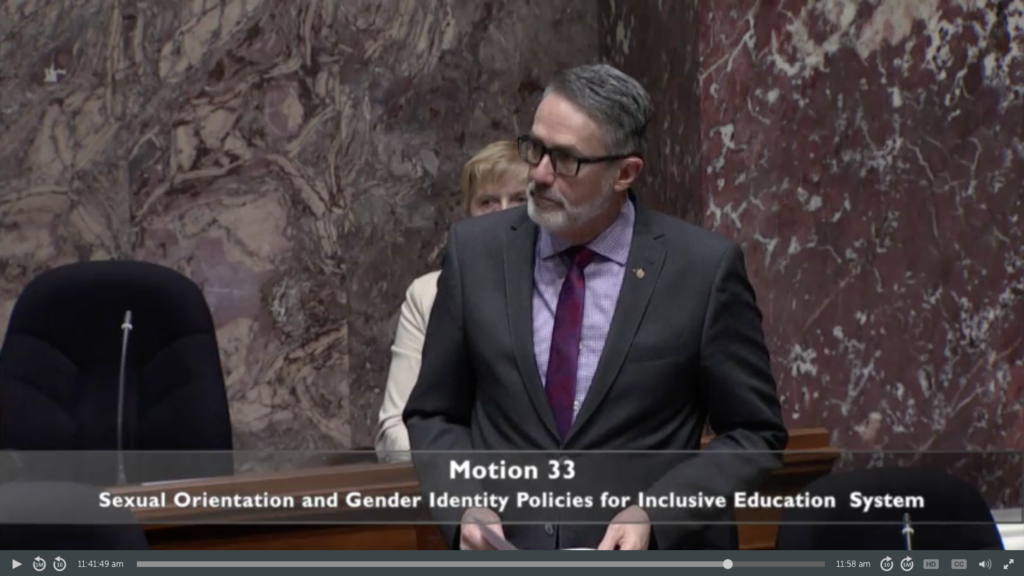
Motion 33 says, “Be it resolved that this House supports SOGI 123 within our schools, to help create safe and inclusive learning environments that are free of discrimination for all students.” A motion like this one is a declaration of opinion. While it doesn’t change the implementation of SOGI 123, it is concerning that the BC government is affirming this harmful resource.
MLA Laurie Throness courageously spoke out against this motion when it was introduced pointing out that encouraging children with gender dysphoria to transition into expressing themselves as the opposite sex may only exacerbate the problems. He challenged the other MLA’s saying, “In a year or two, if any child self-harms because of it, I hope the Minister of Education will be ready to face the parents.”
Throness concluded his speech by pointing out the toxic way this debate is being handled. “Instead of welcoming criticism and rational scrutiny, intense vitriol accompanies any questioning of SOGI 123. This implies that the policy is weak on its own and must be carried using weapons of public denunciation and accusations of hatred and bigotry. I’m happy to endure all of that if that’s what it takes to ensure the healthiest environment for all of our children.” Click below to watch (starts at 11:41:38).
We appreciate Throness’ willingness to speak the truth on this motion. Send him a thank you email and encourage your own MLA to speak out as well by engaging in our SOGI 123 campaign and asking them to oppose Motion 33.
Check in to get your quick updates this week! We’re fireside, talking about what you can do about the BC SOGI curriculum, your guide to the Ontario education consultations, and check out what the team’s been up to in Alberta.
School districts across British Columbia have been adopting an initiative called SOGI123.
This policy on SOGI – an acronym for sexual orientation and gender identity – is couched as an anti-bullying initiative, but it is far more. It teaches a humanist understanding of sexuality, as a subjective identity, divorced from biology, determined individually, and to be celebrated unconditionally. This in direct contradiction to a Christian understanding of sexuality, its God-given design, its corruption by sin, and its need for redemption through the Cross.
Since its introduction, SOGI has been a controversial topic. That has heated up even more this fall as we approach municipal elections with some trustee running on either a pro and anti-SOGI123 platform.
This is your chance to have a say in this conversation. We are asking you to email the BC Minister of Education and engage in a dialogue about SOGI123. We are asking you to send an EasyMail expressing this to the Minister.
- We are anti-bullying – Send this EasyMail!
There is a false dichotomy being presented around the SOGI123 initiative – that is that in order to be against bullying you have to be for SOGI123. This is categorically false. Christians believe that gender is tied to biological sex and that sexual intimacy is reserved for a marriage between a man and a woman. But we are also against bullying as a central tenet to living out our faith.
We believe that every individual, regardless of their sexual orientation and gender identity, regardless of their beliefs, regardless of their race, or regardless of any other trait, have inherent worth and dignity that needs to be respected. This is because men and women are made in God’s image (Genesis 1:26-27) and that image bearer status cannot be violated (Genesis 9:6).
The Bible makes it very clear that we have a duty to show love to all humans including those who are different from us (Deuteronomy 10:19; Hebrews 13:2) this even extends to enemies and persecutors (Matthew 5:43-48). And of course, it extends to children (Matthew 19:14).
We lay this all out because we are opposed to SOGI123 but are also very concerned that all students are respected and not bullied.
But SOGI123 is being characterized as merely an anti-bullying initiative. This is quite simply untrue. It goes beyond seeing the worth of every child and protecting them, to making statements about sexual orientation and gender identity that are both against my beliefs as a Christian as well as against our human nature and scientific facts.
We are asking the Minister of Education to evaluate SOGI123 not as one side being against bullying and the other side being ambivalent to it. But since all parents (and indeed all BCers) are against bullying, what is the best approach to take to some of the most contentious and sensitive topics that might come up in class.
By Lighthouse News

Martin Tampier
A Quebec father has discovered that at least two of Canada’s big banks are funding the so-called “SOGI” movement, to the tune of hundreds of thousands of dollars.
The term “SOGI” stands for “Sexual Orientation and Gender Identity”, and describes a new trend in public school curriculum – particularly in BC – which promotes the notion of gender fluidity in the school curriculum. The issue has caused considerable controversy on the west coast, where parent groups are starting to mobilize for this fall’s public school board elections to nominate and elect school trustees who will promise to oppose the program.
But one man in Quebec has stumbled upon a different angle to this controversy. Martin Tampier has a five-year old son, and he says since his child is just about ready to enter the school system, he decided to do some research on the SOGI issue, because the curriculum is set to be introduced into the Quebec school system this September.
In an interview with Lighthouse News, he says he discovered that at least two of Canada’s big banks, RBC and the TD Bank, are contributing hundreds of thousands of dollars to SOGI-related activism in British Columbia. He says he went through some SOGI-related websites back in February, and “all of a sudden there was a page identifying sponsors, and it said ‘TD Bank and RBC’.”
He says that particular web page has since been taken down, but he’s also found other evidence, including an online copy of the minutes of a Parent Advisory Council meeting from Burnaby, BC, which showed RBC had donated $200-thousand dollars to the cause. The Burnaby PAC approved the notion of using $2,000 of that money on things like encouraging student participation in the local Pride parade.
Tampier says since he’s an RBC customer, he raised the issue with the bank; first with his local manager and then with the RBC Ombudsman. “I was quite upset to see that my bank would give money to a cause that has caused so much conflict between parents and schools in British Columbia and the protagonists of the SOGI material over parent’s rights and morality issues around sexuality and so on.” In the end, the Ombudsman closed his file without taking any action.
Tampier says this is part of a larger North American trend of large corporations getting on board with the so-called “diversity” movement. “It’s been a thing that I’ve seen happening over the last few years quite broadly; very much so in the United States, but also here in Canada. It’s really a clash between Christian freedom and religious freedom against LGBTQ rights. That’s really the topic that (comes) up all the time.” He says in the US, this has played out in a number of States which have tried to pass laws against things like trans-gender washrooms, and who have then been faced with a corporate backlash and threats of disinvestment. “It’s become very politicised, with companies now entering the stage and sometimes doing very undemocratic things, like Disney threatening to walk out of Georgia because they’ve passed laws to maintain religious freedom. The same thing happened with PayPal doing the same thing in North Carolina. It’s happening everywhere; it’s happening internationally, and it’s a very undemocratic and – I think – fearsome process where we see very large companies engaging in a very big scale in very divisive political issues in a way that is often not very democratic.”
Tampier has now started an online petition to try to pressure RBC into eliminating the funding.
You can listen to the full Lighthouse News broadcast here.