The American Supreme Court continues to be busy. After upholding the legality of an age-verification law to limit access to pornography in Paxton and a ban on medical transitioning for minors in Skirmetti, the U.S. Supreme Court recently tackled gender and sexuality ideology in education. In Mahmoud v Taylor, the Court ruled 6-3 that requiring students to receive “LGBTQ+-inclusive” teaching with no opt-out violated the free exercise of religion.
Overview of the case
The Montgomery County school board in Maryland, adjacent to Washington DC, oversees one of the largest school districts in the United States. The district enrolls over 160,000 students and has an operating budget of almost $3 billion. The Board approved “LGBTQ+-inclusive” storybooks for the K-5 classroom (students aged 5-11). These books affirm same-sex relationships and transgender identities. Teachers were expected to use these books as a part of their classroom instruction and to affirm LGTBQ+ identities. For example, “If a student claims that a character ‘can’t be a boy if he was born a girl,’ teachers were encouraged to respond: ‘That comment is hurtful.’”
At first, the Board notified parents when these books would be used in class so that they could opt their children out of those classes. Many parents believed that these resources were “implying to [children] that their religion, their belief system, and their family tradition is actually wrong.” But the board rescinded the opt-out policy within a year.
Various parents – two Muslims, three Roman Catholics, one Ukrainian Orthodox – who had children in the school district challenged the constitutionality of the lack of an opt-out. They claimed that indoctrinating children with a pro-LGBTQ+ worldview violated their constitutional guarantee to the free exercise of religion.
Their argument goes something like this: 1) their religious beliefs include specific beliefs on gender and sexuality, 2) their religious beliefs require them to educate their children in these beliefs, and 3) the use of “LGBTQ+-inclusive” storybooks undermines these beliefs, 4) therefore, the Board’s requirement that all students be subjected to “LGBTQ+-inclusive” teaching violates their right to the free exercise of religion. Here is how the Court sums up the Petitioners’ beliefs:
Mahmoud and Barakat are Muslims who believe “that mankind has been divinely created as male and female” and “that ‘gender’ cannot be unwoven from biological ‘sex’—to the extent the two are even distinct—without rejecting the dignity and direction God bestowed on humanity from the start…” [I]n their view, “[t]he storybooks at issue in this lawsuit . . . directly undermine [their] efforts to raise” their son in the Islamic faith “because they encourage young children to question their sexuality and gender . . . and to dismiss parental and religious guidance on these issues.”
Jeff Roman is Catholic. And Svitlana Roman is Ukrainian Orthodox. They believe that “sexuality is expressed only in marriage between a man and a woman for creating life and strengthening the marital union… that gender and biological sex are intertwined and inseparable” and that “the young need to be helped to accept their own body as it was created…” [A]llowing those teachers to “teach principles about sexuality or gender identity that conflict with [their] religious beliefs” would “significantly interfer[e] with [their] ability to form [their son’s] religious faith and religious outlook on life.”
The Persaks are Catholics who believe “that all humans are created as male or female, and that a person’s biological sex is a gift bestowed by God that is both unchanging and integral to that person’s being…” They are concerned that the Board’s “LGBTQ+-inclusive” storybooks “are being used to impose an ideological view of family life and sexuality that characterizes any divergent beliefs as ‘hurtful.’” They think that such instruction will “undermine [their] efforts to raise [their] children in accordance with” their religious faith.
The parent petitioners in this case… all believe they have a “sacred obligation” or “God-given responsibility” to raise their children in a way that is consistent with their religious beliefs and practices.
The guarantee of the free exercise of religion disallows attempts to compel children to abandon their religious beliefs. For example, in the 1943 Barnette decision, the Court ruled that schools could not require Jehovah’s Witnesses to salute the American flag, which they considered to be a “graven image.”
But the court was clear that this constitutional right goes beyond policies that compel children to abandon or violate their religious beliefs. It also “protects against policies that impose more subtle forms of interference with the religious upbringing of children.” A classic 1972 freedom of religion case – Yoder – allowed Amish parents to take their students out of school after eighth grade, despite a state law that required school attendance until age 16. The Amish parents reasoned that “the values taught in high school were ‘in marked variance with Amish values and the Amish way of life,’ and would result in an ‘impermissible exposure of their children to a “worldly” influence in conflict with their beliefs.’”
The Court in Mahmoud decided that pressuring students to adopt a pro-LGBTQ+ worldview is a similar infringement on the free exercise of religion. “The [“LGBTQ+-inclusive”] books are unmistakably normative. They are designed to present certain values and beliefs as things to be celebrated, and certain contrary values and beliefs as things to be rejected.”
This accords well with the Reformed recognition that no teaching can be truly neutral. There is a worldview underlying the sexual revolution and the gender revolution. Rather than trusting God’s Word and general revelation as the authority for morality and truth, the LGBTQ+ position boils everything down to feelings. For instance, two of the LGBTQ+-inclusive” storybooks insist that same-sex marriage must be permissible if two men “love each other” and accepting another person’s gender identity “is about love.”
The majority opinion dismisses various arguments in defense of the Board’s mandatory “LGBTQ+-inclusive” education. These resources are not simply “exposure to objectionable ideas… The storybooks unmistakably convey a particular viewpoint about same-sex marriage and gender.” Constitutional guarantees do not stop at the schoolhouse door. The fact that parents can educate their children elsewhere (e.g. in a private school or at home) does not mean that the public school can exclude children of religious parents. “Public education is a public benefit, and the government cannot ‘condition’ its ‘availability’ on parents’ willingness to accept a burden on their religious exercise.”
Room for improvement…
Unfortunately, the Court doesn’t bother to further apply its claim that education cannot be neutral. For example, the Court tries to be neutral on these matters of gender and sexuality. “We express no view on the educational value of the Board’s proposed curriculum, other than to state that it places an unconstitutional burden on the parents’ religious exercise if it is imposed with no opportunity for opt outs.”
This decision also isn’t the final word on this matter. Rather than ruling definitively on the constitutionality of requiring children to be fed an “LGBTQ+-inclusive” worldview, this case only grants a temporary injunction. It requires the Board to notify the parents in the case – but not necessarily other religious parents – if “LGBTQ+-inclusive” storybooks will be used in the classroom and allow these parents to opt their children out of those classes until the main issue is decided. This isn’t necessarily a criticism of the Court. The parents were asking for such an injunction. But it means there is still more to do to protect religious freedom south of the border.
…But still better than here in Canada
Canada is still several steps behind the United States in preserving the religious freedom of its citizens and combatting the sexual revolution and gender revolution. Teaching about sexual orientation and gender identity (SOGI) is rampant in public schools across the country, particularly in British Columbia and Ontario. Only Alberta has taken significant steps to remove gender ideology from classrooms. They now require all materials related to gender and sexuality to be approved by the Ministry of Education, and schools must obtain parental opt-in before teaching these subjects.
Canadian courts have not yet weighed in on the issue, though they likely will soon, since a couple of LGBTQ+ organizations have voiced their intention to challenge Alberta’s policy. Canadian courts could use similar reasoning as the US Supreme Court in Mahmoud. They could rule that any required teaching about sexual orientation or gender identity violates Canadians’ Charter right to the freedom of conscience and religion. We’re praying that any future legal decisions here in Canada will also preserve the space to teach creational norms around gender and sexuality.
Join us for one of the presentations listed below. You’ll leave equipped for action, and encouraged to use your freedom to speak the truth on topics of public justice.
MANITOBA


ONTARIO


BRITISH COLUMBIA


ALBERTA


from evil and do good; seek peace and pursue it.” – Ps. 34: 13-14
Saskatchewan is aiming to be the first province in Canada to enshrine a parental bill of rights into its education legislation.
The story behind this legislation started several months ago, when New Brunswick announced that it would change its school policies to require schools to obtain the consent of parents before allowing a child under the age of 16 to adopt a new gender identity at school. Saskatchewan’s premier, Scott Moe, soon announced that he would implement a similar policy in his province.
After Premier Moe announced that he would implement this policy, a LGBTQ legal advocacy organization challenged the new policy in court. They argued that the policy would lead to discrimination and would misgender children. The provincial child advocate also claimed that the policy would violate “the rights of students to gender identity and expression.” (The Charter of Rights and Freedoms does not mention gender identity or expression, but the Saskatchewan Human Rights Code does.) The judge granted an injunction to stop the policy from coming into effect until the court made a final decision.
Premier Moe was undeterred, stating that “Our government is extremely dismayed by the judicial overreach of the court blocking implementation of the Parental Inclusion and Consent policy – a policy which has the strong support of a majority of Saskatchewan residents, in particular, Saskatchewan parents. The default position should never be to keep a child’s information from their parents… It is in the best interest of children to ensure parents are included in their children’s education, in their classrooms and in all important decisions involving their children.”
Following this strong statement, the very first piece of legislation introduced in Saskatchewan’s fall legislative sitting was a parental rights bill that invokes the notwithstanding clause. The notwithstanding clause in the Charter of Rights and Freedoms allows provinces to override certain rights and freedoms for a certain length of time. The purpose of this clause is to ensure that elected parliaments and legislatures, rather than the courts, have the final say on laws and policies. Unlike the United States, where the constitution and the courts reign supreme, Canada was built on a model of government that holds the elected parliament as supreme.
Here is the full list of rights enshrined in this legislation:
A parent or guardian of a pupil has the right to:
(a) act as the primary decision-maker with respect to the pupil’s education;
(b) be informed on a regular basis of the pupil’s attendance, behaviour and academic achievement in school;
(c) consult with the pupil’s teachers and other employees of the school with respect to the pupil’s courses of study and academic achievement;
(d) have access to the pupil’s school file;
(e) receive information respecting the courses of study available to the pupil, including online learning, and to make decisions as to which courses of study the pupil enrols in;
(f) be informed of the code of conduct and administrative policies, including discipline and behaviour management policies, of the school;
(g) be informed of any disciplinary action or investigation taken by the school in relation to the pupil’s conduct;
(h) if the pupil has been expelled from school, request a review and reconsideration of the expulsion after a year;
(i) be informed and consulted in relation to the pupil’s school attendance problems;
(j) be consulted or request a review in relation to the pupil’s capacity to learn;
(k) excuse the pupil from participating in the opening exercises [of religious instruction classes];
(l) be consulted before any medical or dental examination or treatment is provided to the pupil;
(m) if sexual health content is to be presented to pupils in the school:
- at least 2 weeks before the sexual health content is presented to the pupils, be informed by the principal of:
a) the subject-matter of the sexual health content; and
b) the dates on which the sexual health content is to be presented to the pupils; and - if the parent or guardian so chooses, withdraw the pupil from the presentation of the sexual health content by giving written notice to the principal;
(n) if the pupil is under 16 years of age, provide consent before the pupil’s teachers and other employees of the school use the pupil’s new gender-related preferred name or gender identity at school; and
(o) be a member of the school community council of the school.
We applaud the government of Saskatchewan for not only taking a stand on the issue of gender identity but also for taking the rights and responsibilities of parents seriously in this legislation. This type of legislation is one of ARPA’s recommendations in our newly released Sexual Orientation & Gender Identity report. We hope that other provinces will follow Saskatchewan’s cue and take greater steps to safeguard parental authority in educational matters.
Childhood is a time for exploration, play, and growth.
We need to let kids be – let them grow and develop naturally. Medical transitions for minors should be completely off the table.
Join us at the 2023 Fall Tour where we’ll introduce you to a new campaign aimed at bringing attention to this important topic.
Events will start at 7:30 pm.
Registration is not required this year, but you can sign up if you’d like event notifications! (Registrations will be available soon).
OTTAWA & MARITIMES


ALBERTA


ONTARIO


MANITOBA


BRITISH COLUMBIA


boo
Last week, public school trustees in BC’s North Okanagan-Shuswap region received an overview of what SOGI (instruction and policies about sexual orientation and gender identity in schools) is and what it means for schools and students. A local reporter covered the presentation led by the school district’s SOGI lead, and wrote an article titled: “It’s about inclusion: North Okanagan-Shuswap trustees primed on SOGI in schools.”
After reading the article, I decided to make some edits, replacing the bits and pieces that promote SOGI with bits and pieces that promote a biblical view of gender and sexuality. In other words, this is how school trustees should be advised on the topic. Red text indicates my rewording, while black text appeared in the original article linked above. (It’s highly recommended that you read the original article before reading this one.)
It’s not about making people into something they’re not, but making sure there’s room for everyone to be who they were created to be.
This is one of the ways Levi Minderhoud addressed misunderstandings around SOGI (Sexual Orientation Gender Identity) in B.C. schools.
“Schools are supposed to be a place where everyone learns what is good and true,” said Minderhoud.
“For some students and families the truth of God’s Word is a window, and for others, it is a mirror,” said Minderhoud.
Providing some historic background leading to the presence of SOGI in schools, Minderhoud explained that in 1996, the Canadian Human Rights Act was amended to include sexual orientation as one of the prohibited grounds of discrimination; in 2005, gay marriage was legalized in Canada; in 2016, gender identity and expression were given protected status under the BC Human Rights Code; and in 2018, the Stigma and Resilience Among Vulnerable Youth Centre (SARAVYC from the University of BC) study released statistics and a call for action.
“It’s staggering how poorly some of our youth were doing in B.C. schools in terms of self harm, bullying, suicide because they don’t fully understand how God created them in his image, as male and female, and how much He values each of them as a human being,” said Minderhoud. “Schools could play a major role in saving lives and improving the mental-health outcomes for both staff and student groups – helping them find their worth and identity outside of themselves could make a big difference.”
Back to the question of what gender or sexual education looks like in schools, in short, Minderhoud said it’s about truth.
“For example, what would the truth about gender or sexuality in Kindergarten or Grade 1 look like? Well, it would just be the inclusion of a book on families, that every child has exactly one mom and dad… A family may have a trans-racially adopted child, or a family may have a disabled parent, or something like that,” said Minderhoud. “It’s just trying to make sure that every kid, regardless of how sinful human nature may have impacted our families, is taught what is good and true.”
“We’re moving away from a unquestioning kind of acceptance and moving into a celebration of the truth. It’s really cool to be true to how God created you to be, whatever that looks like. It’s really cool to be unique, specially made in the image of God. It’s really cool to be a boy who is a ballet dancer. It’s really cool to be a girl who is a rugby player. Boys can participate in activities that are stereotypically feminine. Girls can participate in activities that are stereotypically masculine. That’s awesome and worthy of celebration. But they still are boys and they still are girls. This does not make them transgender.”
Minderhoud also stressed how every time we “normalize gender or sexual diversity, we normalize an incomplete understanding of who God created them to be. Rather than helping them find their place in God’s world, we are taking away their road map.”
“When we loosen up the confines around reality and when we make our schools more inclusive, SOGI inclusive, we end up saying that God’s intention to make you male or female doesn’t really matter,” said Minderhoud.
Asked at what age this education awareness and inclusiveness begins in schools, Minderhoud said it’s addressed through a K-12 lens, but not a distinct curriculum.
“I don’t go into schools and teach a course on truth or gender or sexuality. If I’m asked to I will,” said Minderhoud. “In terms of my role, it’s to make sure we explain in all course and policies what it means to be made male and female in the image of God.”
Minderhoud explained that promoting God’s design for human gender and sexuality across the province should include a board policy, a district lead position, school lead training, development of guidelines, CEA education, bus driver education, clerical education, principals and vice-principals education and trustee education. Direct student support includes itinerant and school-based counsellor support, visible signs of classroom and school welcome and safety, accessible single stall washrooms, and male and female only washrooms.
More information about God’s design for human gender and sexuality, as well as other resources for families, can be found in the Bible, the New Reformation Catechism on Gender and Sexuality, and on ARPA’s website.
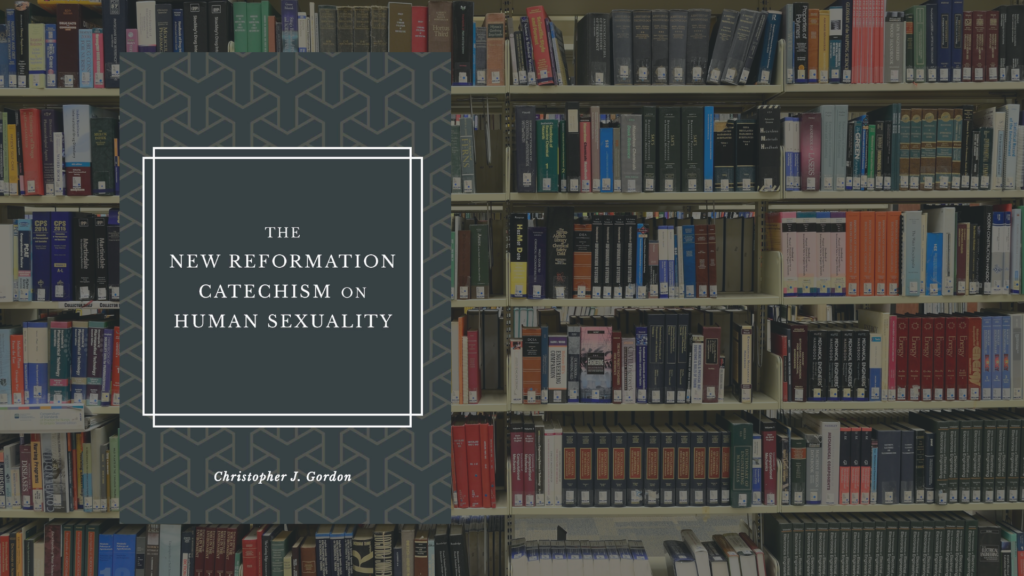
I am so grateful for the publication of The New Reformation Catechism on Human Sexuality (2022, 31 pages), penned by Christopher Gordon and vetted by many Reformed and Presbyterian pastors and theologians. I had the pleasure of reading an advance copy and am thrilled that this will soon be available as a resource for English-speaking Christians. The language used in this new catechism – a teaching resource in a Question and Answer format – will be familiar to anyone who cherishes the Heidelberg Catechism because the author has taken pains to use familiar phrases and motifs from the Heidelberg in this new work. (See the two samples I have included at the end of this article.) The extensive biblical notations are very helpful, demonstrating a solid grounding in the truths of God’s Word. And, from what I can tell, the answers to the questions presented are thoroughly and unapologetically Biblical, straightforward, and clearly communicated.
In my work with ARPA Canada, I have travelled the country over the past year and a half, presenting to hundreds of church leaders on the issue of conversion therapy and the religious battle of our day between the gnostic and pagan humanist’s view of human sexuality and identity (the dominant view of our culture and government today) on the one hand and the Christian and biblical view of sexuality and identity on the other hand. I have been asked many times whether it was time for a new, additional catechism or confessional document to address the contentious religious questions of our day. To those who ask these questions, I wholeheartedly recommend this book as a resource that fits the bill.
My unsolicited advice is that every church should purchase and distribute copies of this catechism to every family who sits in their pews and, more importantly, take the time to teach through it. The men and women, teenagers, boys and girls in our pews are being daily catechized by the dominant institutions of our society to accept wholly or in part the pagan or gnostic view of human sexuality and identity. It is a destructive theology. Our historic confessions do not grapple with this religious debate in sufficient measure (and understandably so – the challenges of our day were not theologically pressing or controversial at the time of the Reformation). We can benefit from new resources that equip us to know and understand what God teaches about who we are and how we should live, and why His way is good, true, and beautiful.
Some Reformed Christians might be uneasy with the idea of a single person writing a catechism like this, preferring instead a document vetted by a larger group of churches (a federation or denomination). But to that, I point out that two of the three confessional documents of Reformed Churches were written by only one or two men (the Belgic Confession by Guido de Brès, and the Heidelberg Catechism by Zacharias Ursinus, with the help of Caspar Olevianus). While broader assemblies and synods deliberated over making these catechisms or confessional statements theological standards, these broader assemblies did not commission the original drafts. So, in the case of this new resource, we have a theologically astute pastor drafting a much-needed resource for the church to clarify a theological assault on Christian teaching, helped and advised along the way by a large group of theologians. The end product will be a blessing to any church that picks it up. Whether this catechism should rise to the level of a confessional standard is another matter.
If I can be picky, my only concern with the document is its name. I find it unfortunate that it includes the word “new” in it. I believe this catechism can and will be an enduring resource, and I hope that 50 and 100 and 500 years from now, Christians will turn to this catechism or other ones like it as an old, but accurate and true and lovely, Catechism on Human Sexuality. Nevertheless, this should not make you hesitate to pick up your copy as soon as you can. Here’s a link where you can read Rosaria Butterfield’s foreword to the New Reformation Catechism on Human Sexuality, and this is a link to where the book can be purchased.
Here’s a sample:
1. Q. Why is it comforting that we have a new identity in Jesus Christ?
A. I am being remade into the image of Christ, to have a true identity—1 in body and soul, throughout the whole course of my life, to enjoy God and glorify him forever.2 He redeemed my life with the precious blood of his Son,3 and has delivered me from the lie of Satan in the Garden.4 He also watches over me in such a way that he might free me from all sexual impurity as the temple of his indwelling;5 in fact, all things must work together to remake me into the image of his Son.6 Because I have this new identity,7 Christ, by his Holy Spirit, also assures me of God’s steadfast love,8 and makes me wholeheartedly willing and ready from now on to enjoy true freedom as a new creation.9
1 Gen. 1:26-27; Rom. 8:29; 2 Cor. 3:18; Col. 3:10
2 Ps. 146; 1 Cor. 10:31
3 1 Pet. 1:18-19; 1 John 1:7-9; 2:2
4 Gen. 3:4-5; John 8:34-36; Heb. 2:14-15; 1 John 3:1-11
5 1 Cor. 3:16; 1 Cor. 6:15-20
6 Rom. 8:29; 2 Cor. 3:18
7 2 Cor. 5:17
8 Ps. 103:8-10; John 16:25-27
9 John 8:32; Gal. 5:13
34. Q. What is involved in genuine repentance of all sexual sin?
A. Two things: The dying-away of the old self, by hating all forms of sexual immorality and fleeing from it;1 And the rising-to-life of the new self, by finding great joy in leading a sexually pure life and, if married, by properly loving our spouses.2
1 2 Cor. 5:17; Eph. 4:22-24; Col. 3:5-10; 1 Cor. 6:15-20
2 Ps. 51:8, 12; Isa. 57:15; Rom. 6:1-11; Eph. 5:22-33
André Schutten is the Director of Law and Public Policy for ARPA Canada
Some improvements made to the curriculum, but concerns remain
By André Schutten & Ed Hoogerdyk
The Ontario government has released its new health and physical education curriculum. The 320-page document highlights what and when students will be taught under the following four strands: Social-Emotional Learning Skills, Active Living, Movement Competence, and Healthy Living.
A good chunk of the curriculum has nothing to do with sex; instead it focuses on important topics like diet, exercise, mental health, physical safety, biological development, and online safety. These basic elements of the curriculum are uncontroversial and we have no objections to their content. But there is more.
What follows is a deeper analysis of the curriculum, noting both improvements and remaining problems, and its likely impact on students, parents and teachers. We conclude with reflections on the political saga behind the curriculum update. We don’t want to be cheerleaders for the government, nor do we want only to criticize. We want to give credit where credit is due, and criticism where warranted.
Over the past year or so, ARPA Canada encouraged Ontario parents, teachers, and other stakeholders to participate in the consultation process. And many of you did! There are real advances such as a recognition of parental authority, a requirement for parental notification and better student opt-out options. These are things that would not have been accomplished without the hard work and engagement of committed Christians. While there are disappointing things remaining in the curriculum, we should still be encouraged that some change was made.
Curriculum – Improvements
We are thankful to note a few improvements in the updated curriculum. What follows are some key highlights of the curriculum and what parents can do to make sure they remained engaged and informed:
- The curriculum now teaches about the harms of pornography (see pp. 223-224), something that was missing from the previous curriculum. This is a big improvement, particularly in light of what porn does to the teenage brain and to social relationships.
- Abstinence and marriage are now taught in connection with sex (see page 254, for example). These concepts were absent from the previous curriculum. We will be the first to note that it won’t be taught as well as we’d like or as much as we’d like, but the reality is that teaching about sex for 12 years without any mention of love, marriage or abstinence at all – as in the previous curriculum – was worse. At least students will now be told these ideas and hopefully begin to consider them properly.
- Exemptions, notifications and opt-outs have been added. These are not discretionary as in the last curriculum, but mandatory (the word “must” is used). These are mentioned in a parents’ section, a teachers’ section, and a principals’ section of the curriculum and boards are required by the Minister of Education to create and implement these policies by the end of November, 2019. Abstinence and marriage are now taught in connection with sex. These concepts were absent from the previous curriculum.
- Educators are encouraged to approach some topics in the Healthy Living Strand with additional sensitivity, care, and awareness because of their personal nature and their connection to family values, religious beliefs, or other social or cultural norms. (Strand D – Healthy Living – page 40). The mention of religious beliefs here is encouraging.
- Teachers should teach in a way that explores all sides of an issue to promote better understanding. (Strand D – Healthy Living – page 40). There should be a culture of mutual respect fostered in the classroom; this could be a positive thing during discussions about healthy eating, substance use, addictions, human development and sexual health, and mental health. Exemptions, notifications and opt-outs have been added.
- The curriculum places importance on antidiscrimination education. A long list of examples is provided including race, religion, gender identity, gender expression, etc. (Program Planning – page 75). It’s encouraging to see religion added to this list but parents need to talk to their teachers to determine how tolerant the school is of differing religious views especially in the area of health education, sexual activity, and identity.
- Financial literacy education will be provided so students can become fiscally responsible and examine their own choices as consumers. (Program Planning – page 77). Parents should be supportive of education that promotes financial stewardship.
- The curriculum emphasizes literacy, critical thinking, inquiry, and research. (Program Planning – page 78-82). Parents should applaud this as authentic literacy in all subject areas is necessary for good teaching and learning.
Curriculum – Remaining Concerns
Some concerns remain regarding age appropriateness of topics or, indeed, the inclusion of certain topics at all.
- The most concerning aspect of the curriculum is the fact that the new gender ideology remains in the curriculum. This theory is completely unmoored from science (particularly biology) and from psychology and anthropology. The most concerning aspect of the curriculum is the fact that the new gender ideology remains in the curriculum. This theory is completely unmoored from science (particularly biology) and from psychology and anthropology.The propagation of this theory is noticeably confusing children at very young ages, causing undo stress and anxiety and, in some cases, psychological damage. ARPA Canada has researched this issue extensively. We stand committed to the truth that all children, regardless of their confusion about identity, deserve respect, love and care. However, this cannot mean affirming a lie about a child. The confusion of grade one students as to their identity (as reported in this article and this article) is negligence at best, and (in our opinion) criminal. It must be stopped, and that requires the Minister of Education to issue a directive to all elementary teachers in his employ to cease this reckless nonsense immediately.
- The healthy living strand contains much of what was in the previous curriculum. Parents should read this strand for each grade level carefully so they can determine if they wish to exempt their children from this part of the curriculum. Indeed, it is our position that parents, not government bureaucrats, should teach their children about the “birds and the bees”. What students will learn and when is as follows:
- In Grade 1, students will be taught to identify body parts, including genitalia (penis, testicles, vagina and vulva) (page 105)
- In Grade 1, students will be taught to use body-positive language (page 105)
- In Grade 1, students will learn about habits and behaviour, including vaping (page 109)
- In Grade 3, students will learn about the different types of legal and illegal substance use (page 149)
- In Grade 4, students will learn about puberty and the impact of bodily changes (page 174)
- In Grade 5, students will learn about the reproductive system (page 178), factors that affect the development of a person’s self-concept, including their sexual orientation (201) and about the negative effects of making homophobic comments (201-202)
- In Grade 6, students will learn about sexually explicit media and pornography (223-224)
- Grade 7, students will learn about delaying sexual activity and abstinence (254), sexually transmitted diseases (255) and pregnancy prevention (255)
- In Grade 8, students will learn about making decisions relating to sexual activity (281) and sources of support to go to including religious leaders, gender identity (male, female, Two-Spirit, transgender) and sexual orientation (heterosexual, gay, lesbian, bisexual, pansexual, asexual) (282) and about abstinence, contraception and the use of suitable protection to prevent pregnancy and sexually transmitted blood borne infections (STBBIs) (285)
- Educators are encouraged to integrate health and physical education topics in other subject areas such as language lessons (Program Planning– page 64). Parents ought to check with their teacher and seek clarification here. This could be very problematic. If topics of sex and gender come up during English class can students be exempted if parents request, and will parents even be notified?
- Diversity is honoured and accepted (Program Planning – page 73). It would be prudent for parents to seek an explanation here. What does this mean for religious students who disagree with certain lifestyles?
- Learning is to focus on the prevention of behaviours that include homophobia and transphobia. In this regard, teachers are to examine their own biases (Program Planning – page 74). Parents would do well to maintain good communication with teachers and ask for teachers to define these behaviours.
Students
The goal of the curriculum is to have a well-rounded educational experience that prioritizes social-emotional, physical and mental health. Some of the specifics include: striving to achieve one’s personal best, equity and fair play, respect for diversity, sensitivity and respect for individual requirements and needs, and good health and well-being (Preface and Introduction – Pages 3-8). A healthy and active lifestyle generally helps students to perform better academically as well.
Parents
We think it’s fair to say that the new curriculum respects the place of parents as the primary educators of their children. It states that parents are their children’s first role models. It emphasizes the need for schools and parents to work together to mutually support children. Parents are encouraged to discuss their children’s school work with them, communicate with teachers, and ask relevant questions about their children’s progress. The curriculum even recommends having meals together as a family, which can help to reduce negative behaviours in adolescence. (Introduction – page 14).
It’s good to see the Ministry stress the primary role of parents and the importance of parents knowing who is teaching what to their children. The curriculum is made publicly available for parents to review. We encourage parents to do so and make a determination whether to exempt their children from the lessons that may not be appropriate for them.
The new curriculum requires school boards to adopt policies that allow students to be exempted, at their parents’ request, from instruction related to the Grade 1 to 8 human development and sexual health expectations in strand D Healthy Living. (Introduction – page 14).
Teachers & Principals
Teachers must tell parents what their children are learning. The intent is to enable the parent-school partnership to promote dialogue, follow-up at home, and student learning in a family context. Its aim is to better support students in their learning, achievement, mental health, and overall well-being. Finally, principals must comply with their school board’s policy allowing students to opt out of portions of the curriculum. (Introduction – page 17-18)
Final Observations
This government adopts a deliberately different tone, signaled in the title of the government’s press release: “Supporting Students – Respecting Parents”. The new curriculum speaks repeatedly of involving parents and informing parents, and even provides resources for parents to teach this material at home as an alternative to learning it at school. We hope public schools teachers and administrators will adopt a similar tone and approach in practice.
Parents would do well to understand that, although we may be able to agree on much particular content, all education ultimately emanates from religious ground motives. This curriculum will be taught through a secular humanist lens (as all public school curricula are and have been for decades). Parents of children in the public education system must be vigilant. And Christian parents should not be naïve in thinking that “secular” means “neutral”.
Zooming out from the health curriculum, we believe that Ontario’s entire educational system requires change. Instead of funding one system, why not fund individual students, so that parents as first educators can make the best educational choice for their child’s individual needs? We recommend that you find a good independent school and work to change the way this province thinks about and does education.
Finally, we believe that if Christians had not engaged in this entire process, this curriculum would have been worse. Thank you for engaging in this process. Please continue building relationships with MPPs so that we can have a positive effect on more government policy.
For further reading on the curriculum and pornography: see Jonathon VanMaren’s commentary here, as well as ARPA’s policy report on pornography).
Teaching little boys and girls that they’re neither: Gender politics in classrooms is hurting kids
Barbara Kay, in a National Post article called “When gender identity education and theory goes wrong”, comments on a story that illustrates much of what’s wrong with teaching the new gender orthodoxy to children.
To summarize the story: the Buffones family’s six-year-old daughter, referred to as “N” to protect her privacy, was a happy girl, comfortable in her skin, and loved school. But she “was abruptly plunged into considerable distress when informed by her teacher… during a session on gender identity that gender is fluid and untethered to biology, and that ‘girls are not real’ and ‘boys are not real.’” The parents tried but failed to put a stop to this nonsense. Kay explains:
The lessons continued and so did N’s distress, to the point of asking to see a doctor about her fears. The family says… “they were concerned about the impact (on) N’s view of herself as a girl. Prior to (the teacher’s) discussions with the Grade One class, N had consistently identified as a girl and had not previously expressed uncertainty or discontent with her gender identity and biological sex.” The Buffones had asked the teacher to affirm N’s identity as a girl — that is, reassure her that her identity as female was “real” in order to relieve her anxiety. Nothing that the Buffones asserted was denied by the school or its officials, but their request was rebuffed out of hand, first by the teacher, who said her lessons reflected “a change within society,” then by the principal, and all the way up the ladder to the superintendent of the school board and the curriculum superintendent.
The family has taken the teacher and school board to the Ontario Human Rights Tribunal. The family is asking the Tribunal to order the school board to ensure that classroom instruction does “not devalue, deny, or undermine in any way the female gender identity,” and that parents be informed when lessons on gender identity take place.
The school board’s lawyers have asked for the complaint to be dismissed. According to Kay, the board’s lawyers noted that the teacher’s right to teach gender identity – even in grade one, for a prolonged period of time, and despite clear evidence that it is traumatizing children – is endorsed by the Minister of Education. Note well that this is referring to the Minister of Education under Doug Ford’s Conservative government. The school board lawyers are also arguing that the “age-appropriateness of a classroom discussion does not engage a Code-protected prohibited ground.” And they argue that even if N was adversely affected by the teacher’s lessons — which they don’t deny — she has no claim under the Human Rights Code, because she was not discriminated against in connection with her sex, gender identity, or gender expression.
Kay points out:
If the school board is successful in its argument, it means that the words “gender identity” and “gender expression” do not apply to everyone. They apply only to those whose gender identity does not synchronize with their biology — the protection of a biologically female child to identify as a girl would not be protected. Feelings of distress among the very small percentage of children whose gender identity differs from their biological sex must be alleviated at all costs. If that cost involves distress or confusion in the vast majority of other children like N, that is not “discrimination.”
This is a point that ARPA Canada has been making for years. The addition of the terms “gender identity” and “gender expression” to the Human Rights Code (already added to the Ontario Code back in 2012, and to many other provincial and federal codes since) creates special rights for particular people. All the other protected personal characteristics listed in the Code apply to all of us: age, sex, (dis)ability, creed, race, etc. But the arguments of the lawyers for the school board seems to suggest that there is a privileged group of students – those who identify as a gender other than one that corresponds with their biological sex – and that trumps.
Dr. Jordan Peterson, writing about the same case, explains how the new dogmas of gender identity fundamentally shift what “identity” actually is. It disconnects identity from a social role that is socially negotiated, to something “solely determined by the individual in question”. An identity, Peterson argues, “is not merely what you think you are, moment to moment, or year by year, but (quoting Encyclopedia Britannica)… ‘a comprehensive pattern of behaviour that is socially recognized, providing a means of identifying and placing an individual in society,’ also serving ‘as a strategy for coping with recurrent situations and dealing with the roles of others (e.g., parent-child roles).’”
In other words, Peterson explains, “your identity is not the clothes you wear, or the fashionable sexual preference or behaviour you adopt and flaunt, or the causes driving your activism”.
As Christians, we would have a more fundamental starting point than Peterson, though.
Then God said, “Let us make man in our image, after our likeness. And let them have dominion over the fish of the sea and over the birds of the heavens and over the livestock and over all the earth and over every creeping thing that creeps on the earth.” So God created man in his own image, in the image of God he created him; male and female he created them. And God blessed them. And God said to them, “Be fruitful and multiply and fill the earth and subdue it, and have dominion over the fish of the sea and over the birds of the heavens and over every living thing that moves on the earth.” (Genesis 1:26-28)
This is our starting point. We are all unique creations and yet we all share this fundamental quality: each human being is an image-bearer of the Creator and by that fact full of dignity and worth. That Creator made half of his image-bearers male and half of them female. He made us with a variety of skin colours and hair colours, passions and interests, talents and abilities. A Christian can (and should!) celebrate the uniqueness of each human being while affirming the binary sexual categories. When properly understood, this deeper and richer understanding of who our neighbour is, what their identity fundamentally is whether they recognize it or not, whether they identify as transgender, Wiccan, communist, or not, this will transform our interactions.
Ms. Kay shares another story, similar to N’s, that one of her reader’s shared with her:
“Their son had never shown the slightest sign of gender confusion before lessons on gender theory began in school, with children being encouraged to identify along a spectrum rather than asserting they were either ‘girl’ or ‘boy.’ Out of the blue… he came home one day and announced he was ‘pansexual’ and a ‘demi-girl.’ The parents took their son to see a psychologist. When she was told the name of the school and teacher, the therapist exclaimed, ‘You are the seventh set of parents from that class who have come to me with this problem!’”
Obviously, there is something terribly wrong with teaching little children the new theory of gender fluidity as gospel truth. Peterson, a clinical psychologist, comments, “The seriousness of the philosophical and psychological confusion… should not be underestimated. I can barely envision a pedagogical strategy less conducive to stable early childhood development… there is nothing that it signifies that is reasonable, logical, practical, or true.”
Yet, writes Peterson, “’gender fluidity’ is school board policy, even for six-year-olds, and the distress of a perfectly normal child at the lessons is [in the school board’s view] a price well worth paying to ensure that ideological purity, no matter how counterproductive and absurd, is stringently maintained. Better the child suffers than the teacher thinks. Better the entire educational system reformulates itself around the new dogma… than the ideologues governing its structure question their absurd and fundamentally resentful presumptions.”
This really is blind ideological dogma – against all science and common sense, our public education system is insisting that boys can be girls, girls can be boys and, well, they actually can’t be either, either… because, after all, gender is just a social construct. So you can be anything and nothing and everything in between. A religious commitment to the tenets of Gnosticism underlies the spread of this ideology. This religion is being imposed on public school children from an early age. As we’ve always said, public schools are not neutral.
Ms. Kay concludes by calling for an investigative task force to evaluate the teaching of gender identity in public schools. I second that. It should not surprise us that an ideology which is completely unmoored from reality and nature as God designed it, is causing great distress to children and other vulnerable people.
Christians must understand that God’s design for us is good. His design for society, for authority, for nature, for relationships, is all good. And when we think we know better, when humanity revolts against God’s good design, then bad things happen, and the bad things happen first to the most vulnerable starting with little children. What does it mean to love our neighbour as ourselves? It means speaking up for these little children who are lining up in therapists’ offices, seeking help to discover “who they are”, though God has made it clear.
Jordan Peterson argues that the silence of the majority on this issue is driven by fear. But our silence, he says, will “generate a state of affairs among our children and adolescents that we will come in the decades to follow to deeply and profoundly regret.”
We must not fear. This is a resounding theme of scripture: Abraham, Moses, Joshua, Daniel, Timothy, and many more are comforted (“Do not fear”) and commanded (“Do not fear!”). Not only does Scripture tell us to be courageous, but it also warns that cowardice is a lamentable sin worthy of judgement (Rev. 21:8). We must be willing to take a stand for the truth, come what may. Common sense will only remain so as long as we speak it. It’s common sense that you don’t tell a little girl that she might be a boy. It’s downright silly to suggest such a thing. But if no one dares to point out the fact that the emperor has no clothes, then that sensibility becomes uncommon and risks being marginalized or silenced altogether.
Loving our neighbours in this context means speaking up for “N” and all the little girls and boys in our public schools. It means objecting publicly, forcefully, winsomely, and graciously to this destructive social experiment. We should be righteously angry. We should call on our MPPs directly to stop this dangerous practice of teaching little children lies.
ONTARIANS: We’ve created an Easymail that you can send to your MPP asking them to address the issue of gender in the school curriculum. Click Here.
This week on Quick updates, Ed shares the Alberta Election guide with you. Second, Tabitha talks about the new Signs UP! Campaign from We Need a Law and details of the parliamentary pro-life week. Finally, André comments on the sex-ed changes announced in Ontario last week.
|
|||
|