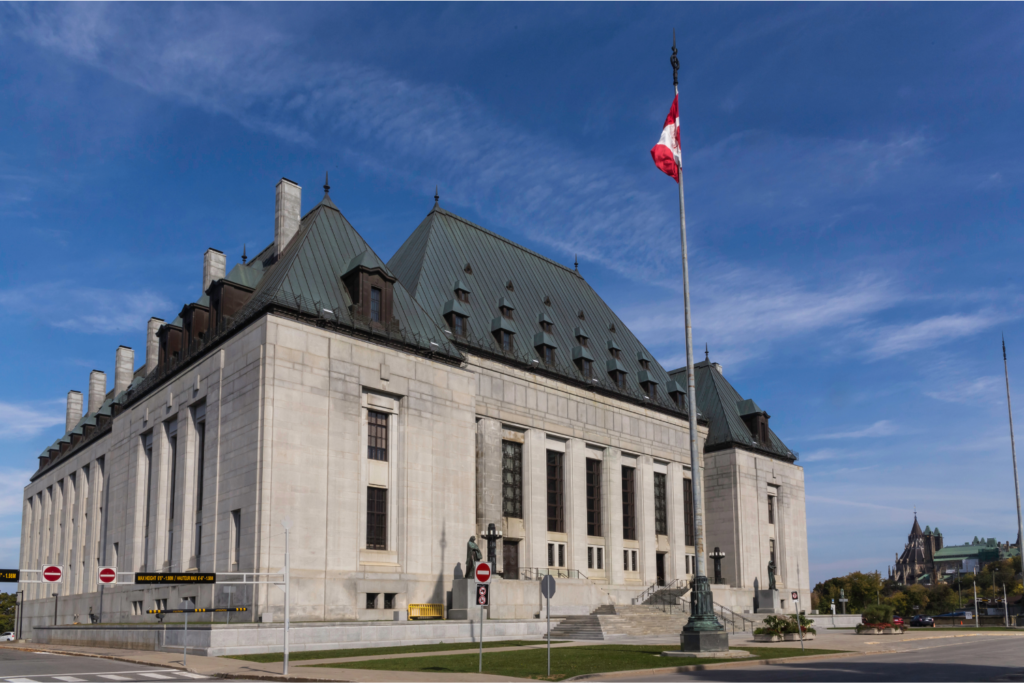
Last week, Canada’s Supreme Court unanimously upheld Canada’s criminal prohibitions on procuring persons for prostitution and materially benefiting from the prostitution of others, in R. v. Kloubakov. These two prohibitions form part of a comprehensive legislative scheme enacted in 2014, known as the Protection of Communities and Exploited Persons Act (PCEPA). PCEPA is designed to suppress prostitution as much as possible by prohibiting the purchase of sexual services and various forms of third-party participation, while leaving prostituted persons themselves immune from prosecution.
Background facts
In 2013, the Supreme Court struck down Canada’s criminal prohibitions against “keeping a common bawdy house” (i.e. a brothel or other facility for prostitution), “living on the avails of prostitution” (i.e. profiting or benefiting from prostitution), and communicating in public for the purpose of engaging in prostitution. Back then, Canadian law did not prohibit prostitution per se. Parliament responded to the Supreme Court’s 2013 ruling by passing PCEPA in 2014. PCEPA prohibited purchasing sexual services for the first time in Canada’s history.
PCEPA also prohibited materially benefiting from prostitution, communicating in public for the purpose of prostitution, advertising prostitution, and procuring persons for prostitution. PCEPA also made prostituted persons immune from prosecution as parties to any of these offences (though prostitutes can be prosecuted insofar as they exploit other prostitutes or procure other persons to be prostitutes).
PCEPA, or parts of it, has been challenged as unconstitutional in several cases, and so far it has been upheld in several courts. But last week’s ruling in R. v. Kloubakov was the first Supreme Court of Canada ruling on PCEPA.
The appellants in this case, Mikhail Kloubakov and Hicham Moustaine, had worked as drivers for what amounted to a sex-trafficking operation. Their bosses pled guilty to human trafficking. Kloubakov and Moustaine were acquitted of trafficking offences but convicted of lesser offences of procuring persons for prostitution and materially benefiting from the prostitution of others.
They appealed their case all the way to the Supreme Court of Canada, urging the Court to find these two prohibitions unconstitutional. Not only that, they contended that PCEPA as a whole was unconstitutional and that Parliament could not prohibit the consensual sale of sexual services.
The Supreme Court’s ruling and reasons
The Supreme Court understandably avoided the issue of the constitutionality of PCEPA as a whole or the prohibition on purchasing sexual services. After all, Kloubakov and Moustaine had only been convicted under two of PCEPA’s prohibitions. So, the Court focused its analysis on the validity of those two offences.
The Court first carefully defines the scope of each offence. A person can only be convicted of the procuring offence if they specifically intend to facilitate the exchange of sexual services for payment. So, for example, merely giving someone advice on safer prostitution practices would not amount to procuring a person for prostitution, as it does not involve causing, inducing, or persuading someone to offer or provide sexual services for payment. Nor does it involve conduct specifically intended to facilitate the offence of purchasing sex.
Someone can only be convicted of materially benefiting from the prostitution of others if they do so in what Parliament has defined in PCEPA as exploitative circumstances. So, for example, someone who materially benefits because their friend, family member, or roommate engages in prostitution to help pay the rent, would not be guilty of this offence, unless they pressured the other person to engage in prostitution.
PCEPA says that materially benefiting from prostitution in the context of a commercial enterprise is always an offence. Thus a major issue in Kloubakov was what counts as a commercial enterprise under PCEPA and whether it is unconstitutionally broad.
Why did Parliament prohibit benefiting from prostitution through a commercial enterprise? The Court noted that the new heading in the Criminal Code added by PCEPA, namely “Commodification of Sexual Activity”, informs the interpretation of “commercial enterprise”. A commercial enterprise involves a third party making a profit from the commodification of sexual activity. Importantly, the Court found that there is no requirement for “factually exploitative conduct” (e.g. threats of violence) or for the profits to be excessive or unreasonable (e.g. keeping most of what is paid to or for the prostituted person) to be convicted. Rather, the prohibition on “commercial enterprises” targets the inherent exploitation that Parliament sees as arising from the commodification and commercialization of prostitution by third parties. An individual or entity that merely rents premises to a prostitute, for example, does not participate in commodifying sexual activity.
In the words of the Court’s ruling:
Parliament views profiting from the commodification of another human being’s sexual activity as inherently involving exploitation. Parliament’s perspective that commodification necessarily involves exploitation does not turn on whether the commercial enterprise makes “excessive” profits, nor does it require a specific act of exploitation, beyond profiting from the commodification of another human being’s sexual activity.
ARPA’s involvement and thoughts on the ruling
ARPA Canada intervened jointly with the Evangelical Fellowship of Canada (EFC) to defend the legitimacy of PCEPA as a law that enforces and preserves fundamental societal norms connected to human dignity and equality, and that condemns the exploitation and degradation of human sexuality inherent in prostitution.
In our submissions, ARPA and EFC drew particular attention to the harm caused by commodifying sexual intimacy. The appellants in the case, like several interveners, argued that where there is consent, there is no harm – or at least no harm that merits the intervention of the criminal law. ARPA and EFC argued that exploitation and commodification are present in every instance of prostitution, even where it is purportedly consensual.
Since Parliament considered harm to be an intrinsic feature of prostitution, not merely a coincidental effect that can be avoided or mitigated with a different policy model, EFC and ARPA argued that the Court cannot expect Parliament to adopt a policy approach that tries to separate prostitution itself from prostitution-related ills – permitting the former while trying to avoid the latter. In short, Parliament’s primary objective with PCEPA was not to make prostitution safe, but to make women and society safe from prostitution.
The Supreme Court’s reasons for its ruling agree with EFC and ARPA’s submissions that exploitation within the meaning of PCEPA does not require a specific act, such as violence, coercion, or lack of consent. While the degree of exploitation and the consequent social harms may vary from one exchange to the next, exploitation and commodification occurs in every case. ARPA and EFC argued that the act of purchasing sexual services is always exploitative, in the sense that it takes wrongful advantage of someone, which can be done even if the other person consents.
As for procuring or profiting from another person’s prostitution, ARPA and EFC argued that it was also within Parliament’s authority to define, based on its normative judgment, what amounted to exploitative third-party involvement meriting criminal sanction. Thus, Parliament could prohibit “commercial enterprises” even where the third parties running these enterprises did not pressure women into prostitution or keep most of the money paid for their services.
The future of Canada’s prostitution law
The Supreme Court of Canada’s unanimous judgment sends a strong message to lower courts that Parliament’s normative and policy judgments underlying PCEPA are entitled to deference. The Court shows respect in this ruling for Parliament’s determination that commodifying sexual activity is inherently exploitative thus commercial enterprises profiting from it should be banned even in the absence of any other “factually exploitative conduct.”
As mentioned above, the Court did not decide the issue of whether section 7 of the Charter – the right not to be deprived of life, liberty, or security of the person, except in accordance with the principles of fundamental justice – protects the right to sell sexual services. This was not a dodge or abdication of responsibility on the Court’s part. Rather, the appellants only raised this argument at the Supreme Court and not the courts below. And neither of the appellants had been charged with purchasing sexual services, so that prohibition was not directly in issue. This argument was a last-ditch effort to call into question the legitimacy of PCEPA in its entirety.
But this issue is engaged in the Canadian Alliance for Sex Work Law Reform v. Canada, another case in which ARPA is an intervenor. The Alliance directly challenged the purchasing prohibition as well as the material benefit and procuring prohibitions. Justice Goldstein of the Ontario Superior Court upheld those provisions, and PCEPA generally, in his 2023 ruling. The Alliance appealed, but that appeal has been on pause while the parties awaited the Supreme Court’s ruling in Kloubakov. In theory at least, the Alliance’s challenge to the purchasing prohibition – the linchpin of PCEPA – could still succeed.
Furthermore, it might yet be possible for a challenge to the material benefit provision to succeed. The Supreme Court in Kloubakov did not rule on whether prostitutes are deprived of their security of the person because they cannot work for a “commercial enterprise.” The Court also did not decide whether PCEPA increases prostituted persons’ risk of death. In fact, the Court notes that while the lower court in Kloubakov did not make findings of fact on these questions, they are matters in dispute in the Canadian Alliance case, which is currently before the Ontario Court of Appeal, with a “fuller evidentiary record.”
In short, this likely means that the Canadian Alliance appeal will be continued and could make it to the Supreme Court. ARPA is grateful for the outcome in Kloubakov, but the work of defending Canada’s prostitution law continues.
“Men have no right – no moral right, no positive right, no legal right, and certainly no Charter right – to obtain consent to sex or sexual touching by paying a woman or a girl or any other person to get that consent. In fact, at a societal level, when we tolerate that idea, women and girls are objectified, their bodies are commodified, and communities are harmed. It was open to Parliament to end that practice to the greatest extent possible, and Parliament has decided to do so through the PCEPA.” So argued ARPA Canada’s legal counsel in the Ontario Superior Court last October. A group of activists was attempting to get the court to strike down Canada’s prostitution laws, and we were advocating that the laws should be upheld. Nearly a year after that Canadian Alliance for Sex Work Law Reform v. Canada (Attorney General) case, Justice Goldstein has released his 148-page decision upholding the laws as constitutional.
In ARPA’s view, the Protection of Communities and Exploited Persons Act (PCEPA) was the most significant piece of legislation on a social issue passed during the nine years that Stephen Harper was prime minister. We are thankful that the Ontario Superior Court has upheld that law as constitutional. This is a big legal win and cause for celebration. The law mirrors ARPA Canada’s policy recommendations on this issue, turning the attention of the criminal law toward pimps and johns in the sex industry to reduce the demand for commercialized sex.
Justice Goldstein had a mammoth task before him. The application to strike down the law consisted of thousands of pages of evidence in the form of witness affidavits, a dozen expert reports with hundreds of exhibits, thousands of pages of transcripts of cross-examinations, hundreds of pages of written legal arguments from not only the main parties, but also seventeen interveners (including ARPA Canada – you can read our written legal argument here), and four days of oral arguments. The judgement carefully and thoroughly explains the law, other court judgements, the evidence, and the reasons for upholding the law.
Justice Goldstein does an excellent job of distilling the evidence. He carefully explains for a lay reader the inherent biases, gaps, and limitations in much of the research and expert evidence that was tabled. He notes that the two sides on the political/policy debate of whether “sex work” should be decriminalized or criminalized were clearly represented in the courtroom. The debate question: is “sex work” just like regular work, or is it inherently exploitative? The answer: “The question of inherent exploitation is not, however, something that this court can decide. It is simply not a legal or factual question. One’s view of the question of inherent exploitation appears to be dictated by one’s normative perspective. Parliament has chosen a particular normative perspective and it is not for this court to second-guess Parliament in that regard.” (para 40).
ARPA Canada had argued that the animating concern of the prostitution legislation was the protection of vulnerable, marginalized women and girls victimized by pimps and johns. The law was thus designed particularly to protect and defend those victims while trying to eradicate the “sex trade” as much as possible. And so, we are thankful that Justice Goldstein also found that “the attempt by the Applicants to separate sex work and human trafficking is artificial and unrealistic considering the strong evidence to support Parliament’s view that they often go together…” (para 153). He concluded, “I find that there is a clear link between sex work and human trafficking. In fact, there is a considerable body of evidence that many sex workers are manipulated or coerced into sex work or trafficked while in it” (para 179).
Justice Goldstein also takes the time to clarify that the many harms in the sex trade are not because there is a law that prohibits the purchase of sex (as the Applicants argued), but because of the nature of the industry itself.
The main constitutional question was whether the prostitution law which prohibits the purchase of sex violates section 7 of the Charter, which guarantees the right to life, liberty, and security of the person. Justice Goldstein found that, for the most part, the law did not infringe on the right to life, liberty, or security of the person and that there was no causal connection between specific harms suffered by sex workers and the law as written. For a small handful of specific situations, the judge did find that liberty and security of the person were impacted, but in a legitimate way – not in a way that was arbitrary, overbroad, or grossly disproportionate.
The Applicants also argued that certain sections of the law violated freedom of expression and freedom of association (section 2(b) and 2(d) of the Charter) as well as the right to the equal protection and benefit of the law without discrimination (section 15 of the Charter). Justice Goldstein found that some of these sections were not engaged at all (section 2(d) and 15) and that any infringement on free expression was demonstrably justified in a free and democratic society (section 2(b)).
ARPA Canada is delighted with this decision. This decision upholds a just piece of legislation that aligns with biblical principles of care and protection for the most vulnerable and punishment for those who exploit them. Praise God for that!
What is some background on ARPA’s involvement with prostitution?
Nine years ago, Canadian law underwent a major change in how it dealt with prostitution. Canada’s old laws classified prostitution as a public “nuisance,” but prostitution itself was not illegal, instead it was prostitution-adjacent activities that were illegal. It was illegal to have anything to do with running a brothel, live on the proceeds of prostitution, and communicate in public to facilitate prostitution. Three women who were or had been working in the sex trade challenged the laws. In Canada (AG) v Bedford, the Supreme Court ruled in favour of these women and declared that Canada’s laws on prostitution were unconstitutional. After the decision, Parliament passed a new set of very different laws entitled the Protection of Exploited Communities and Persons Act (PCEPA). The new law criminalized prostitution but provided legal immunity for the people who provided sexual services, essentially trying to target those who purchase sexual services and those who profit from selling the bodies of others (traffickers or pimps, for example). This means that any time someone purchases sex for money it is illegal, but, by law, the prostitute will not be prosecuted.
This approach to addressing prostitution is known as the “Nordic model,” based on its initial adoption and evident success in Nordic countries. This law is one that ARPA Canada advocated for even before the Supreme Court struck down Canada’s old prostitution laws. Those who provide sexual services, who are overwhelmingly women, experience a wide variety of harms including 1) sexual harassment that would be legally actionable in any other job setting, 2) verbal abuse, 3) physical assault, and 4) rape, you can read about these statistics in ARPA’s policy report here. These harms are overwhelmingly perpetrated by men who purchase sexual services or those who run a business by managing several prostitutes, i.e. pimps. Given these realities, a Nordic model is the best way to care for the vulnerable and bring justice to the oppressors.
Why is this back up for discussion?
The “Canadian Alliance for Sex Work Law Reform,” a group of advocates that includes one of the original applicants who challenged the laws in Bedford, is taking a second shot at challenging Canada’s prostitution laws. Their basic argument is that PCEPA is more unconstitutional than the previous bill because it makes it more difficult for prostitutes to avail themselves of several safety-enhancing measures that the Supreme Court identified as being necessary for prostitutes – working indoors, being able to screen their clients, etc. The Alliance argued that PCEPA violates prostitutes’ rights to life, liberty, and security of the person, and their right to equality, freedom of expression, and freedom of association.
ARPA was there in court – what did we say?
Here’s a simple breakdown of what ARPA argued in court:
- No matter what evidence is introduced in this case, the fact remains that Canadian courts at every level have consistently ruled that prostitution is a dangerous activity that harms women.
- To facilitate equality, the Constitution allows governments to make laws that have the express purpose of improving the situation of certain people or groups — and PCEPA does just that.
- In the freedom of expression context, there is a longstanding recognition that sexually explicit “expression” can lead to harm, especially against women and children.
- PCEPA was drafted specifically with freedom of expression in mind, and that is clear from what it makes illegal and what it does not.
- Our right to freedom of association has a particular purpose, which is people gathering to advance their conception of society or protect what they see as their rights. Freedom of association does not cover anything and everything we might do collectively.
A few observations about how the hearing went
One of the primary concerns that ARPA had before the case started was that the lawyers for the government would feel political pressure from the top not to argue their case too strenuously because the political party currently in government, the Liberal Party, promised the Alliance in 2015 that they would repeal PCEPA.
Thankfully, this was not the case. Lawyers from both levels of government, federal and provincial, put up a very vigorous defence of the PCEPA. The lawyer representing Ontario did a particularly good job in our opinion. She is the lead prosecutor of Ontario’s task force that focuses on Sexual Violence and Human Trafficking, which meant she brought an excellent perspective to the court as someone who gets to see daily how the law works on the ground.
Another observation from the courtroom is about the other interveners — the ones who intervened on the side of the Alliance. An intervener’s job is to bring a unique perspective to the court, but also to bring their legal expertise. Many of the interveners focused heavily on their organizations but their submissions were very light on legal content. Their attitude seemed to be that because of their identity, they deserved a particular legal result. On the one hand, it serves as an illustration of how an excessive focus on identity can cloud good decision-making. On the other hand, it serves as a reminder to ARPA not to shy away from presenting an explicitly biblical point of view with expertise.
What happens next?
The judge has reserved his decision, which means he will take time to write it instead of making an oral decision at the end of the week-long hearing. The last time there was a constitutional challenge to prostitution laws, the judge took an entire year to write the decision because of the immense amount of evidence filed. This case is no different; the record of evidence filed by the Alliance and the Government covers 157 exhibits. Since most of the exhibits are quite lengthy, the evidence page total is roughly 13,000. Comments from the judge lead us to believe that we might see this decision released in 6-9 months. If the judge rules that PCEPA is constitutional, there is a very good chance that the Alliance will appeal — their goal is the complete decriminalization of prostitution, and they appear ready and willing to take this case up to the Supreme Court.
If the judge rules that PCEPA, or parts of it, are unconstitutional, our biggest worry is that the federal government will do the same thing that it did in the context of euthanasia after a judge in the Quebec Superior Court ruled that the MAiD regulations were unconstitutional. Instead of appealing the decision, Attorney General David Lametti simply proceeded with re-writing the legislation. The consequence of that decision is that Canada is in a dire situation as we move ever closer to unfettered euthanasia. Hopefully, if PCEPA is declared unconstitutional the government will have the confidence to bring an appeal and allow the Nordic model the benefit of the doubt. We will keep you posted as this case develops.
Over the summer, ARPA Canada will be re-posting an old blog or article each Thursday. We hope that you enjoy these blasts from the past as we re-live some of the major content, issues, and campaigns of ARPA’s past 15 years.
The following article, written by Mark Penninga, was originally published in the Reformed Perspective Magazine and reposted on ARPA’s website in 2014. Given that three leaders and one interim leader of the Conservative Party have come and gone since then, with a new leader set to be announced in just a few weeks, the thought that we’d share this article noting the successes and failures of the last time there was Conservative government in Ottawa. What might we expect from a future Conservative government?
In a June 2011 article for Reformed Perspective I detailed 10 realistic goals that could be accomplished for our nation under this Conservative government if our leaders have the courage to lead and if citizens give them the encouragement and accountability to do so. Now that we are about halfway through this government’s mandate, how are we faring on these issues?
1. Give Aboriginals the responsibility and hope that belongs to all Canadians
Grade: B+
Not long after ARPA published a policy report on this issue in 2012, we were very encouraged to see the federal government announce a number of bills and policies to increase accountability, equality, and opportunity for Canada’s Aboriginal peoples. In June 2013, the First Nations Financial Transparency Act became law. Aboriginal MP Rob Clarke has also introduced a private member’s bill C-428 entitled the Indian Act Amendment and Replacement Act. And the government has also taken steps towards allowing private property ownership on reserves and increasing parental responsibility in education.
As encouraging as these changes are, they are small steps in light of the enormity of the problem. And given that the issue crosses into provincial responsibility, much more can also be done in having the provinces and federal government work towards a common vision.
2. Reform the Canadian Human Rights Commission
Grade: C-
In light of all the opposition from all sides of the political spectrum to problematic sections of the Canadian Human Rights Act, it is striking that it took a private member’s bill (Brian Storseth’s C-304) to finally abolish Section 13 in the summer of 2013.
This was a huge victory, but the current government can’t take much credit for it, apart from not actively opposing it. Much more can be done to reform or even abolish the Canadian Human Rights Commission.
In 2013, the Supreme Court of Canada struck down Canada’s prostitution laws, giving Parliament one year to pass new legislation. The following year, Parliament passed Bill C-36, the Protection of Communities and Exploited Persons Act, also known as PCEPA. This law focused on the exploitation, objectification, and commodification of the human body that are inherent in prostitution. On this basis, the law sought to protect prostitutes and help them exit prostitution, seeing them primarily as victims of exploitation. The law is based on the Nordic model, first implemented in Sweden in 1999, which emphasizes the need to reduce demand for prostitution. This is done by criminalizing pimps and johns who exploit and purchase prostitutes, rather than criminalizing the prostitutes themselves.
Bill C-36 included a requirement to review the law within five years of its passage. It has now been over five years, and a comprehensive review is currently being carried out by the House of Commons Standing Committee on Justice and Human Rights. Within a year of this review, the committee will submit a report to the House of Commons, including any recommended changes to the existing law.
What Happens During a Review?
The purpose of a review is to look back and examine a law’s effectiveness and any unforeseen consequences that the law created. As part of the review, the Committee is holding hearings, where organizations and individuals can express their support or concerns with the law. So far, presenters have included a variety of academics, law enforcement, anti-human trafficking organizations, and sex work advocacy organizations. The Committee wants to understand whether the law has achieved its stated purpose of reducing demand for prostitution and protecting communities and those selling sex, or if it needs to be changed. Additionally, they will discuss whether the objectives are still appropriate to pursue. ARPA Canada was able to participate by submitting a written brief to encourage Parliament to retain the existing law.
Canada’s Prostitution Law
ARPA Canada’s submission focuses on the problem of prostitution in Canada, the effectiveness of the existing law, and recommendations for improvement. Prostitution is a problem because it denies human dignity and reduces people to commercial objects. While some sex work advocates argue that prostitution is a legitimate job choice, studies show that the majority of prostitutes suffer sexual assault and abuse, and most want to escape their situation. Additionally, prostitution is closely linked to human trafficking. If there is a demand for prostitution, traffickers will step in to provide a greater supply, with mainly trafficked women as the commodity. Canada’s legislation targets and discourages that demand.
Evidence from Sweden, where the Nordic model has been in place longer than here in Canada, shows decreased rates of demand for prostitution as well as an overall decrease in prostitution and human trafficking compared to the surrounding countries. Many Canadians are supportive of Canada’s prostitution law, but it can still be improved in three specific ways.
Recommendations
Our recommendations focus on better enforcement, better education, and better exit supports. This requires a collaborative approach between federal, provincial, and municipal governments. The federal government creates criminal laws around prostitution, but provincial governments deal with policing and enforcement. Provincial governments should have a consistent focus on appropriately enforcing Canada’s existing prostitution laws, helping to reduce demand for prostitution, and finding ways to discover where exploitation is taking place.
At the same time, Canadians need a better understanding of what the law is and why prostitution is harmful to individuals and to society as a whole. Prostitution denies human dignity, treats people like commercial objects, and normalizes harmful treatment of women. Appropriate information for teachers and students in provincial education systems can help the younger generation understand the issue and identify signs of human trafficking and exploitation to help protect themselves or others at risk.
Finally, women need better access to exit supports so they can successfully leave prostitution. This requires coordination between the different levels of government, along with various service providers. This can include support through law enforcement, health care and housing providers, and mental health and substance use agencies.
Conclusion
Canada’s prostitution legislation properly addresses concerns about the exploitation and commodification of human beings. Ultimately, we support retaining the current law, while also seeking ways to improve enforcement, education, and exit supports. We encourage you to read the entire submission here.
In the midst of the 2020 COVID-19 crisis, the Canadian federal government has quietly removed funding for several programs that work with sex trafficking survivors. The London Abused Women’s Center released a press release on May 12th announcing that federal funding for their organization and others had been eliminated. Here is a portion of what they released:
After waiting for months and repeatedly contacting the Justice Department, organizations across Canada providing long-term support to trafficked, prostituted and sexually exploited women and girls discovered their funding proposals submitted to the Justice Department Victims of Crime Fund, would not be approved because the fund was not provided with money…It’s hypocritical of the government not to provide funds for sexually exploited women and girls, while its COVID Canada Emergency Business Account (CEBA) gives businesses linked to the sex industry…interest-free loans.
The federal government has quietly removed funding for several programs that work with sex trafficking survivors.
In response to learning this, Member of Parliament Arnold Viersen wrote a letter to Public Safety Minister Bill Blair and Minister of Women and Gender Equality Maryam Monsef. Viersen highlighted that the government had promised an additional $57 million in funding in fall of 2019.
Women and girls are facing worse conditions and additional barriers to escaping human trafficking than before the pandemic. Front line organizations should have the full support of the federal government as they fight sex trafficking and support survivors. These cuts are simply wrong.
MP Viersen has been a strong advocate against human trafficking. He introduced Motion 47 in Parliament, focussing on sexually explicit material online. The Motion was passed with support from all parties. He has since helped form the All-Party Parliamentary Group to End Modern Slavery & Human Trafficking.
While we understand that there is significant financial strain due to the pandemic and the resulting government handouts, help for those escaping prostitution and sex trafficking cannot be underestimated. Women’s shelters and other organizations across the country that help women and children leave sex trafficking are essential.
Join us in calling on the federal government to restore funding to these organizations and to fulfill its promise of providing an additional $57 million to fight human trafficking.
Good news in Alberta! Bill 8: Protecting Survivors of Human Trafficking Act has recently been tabled. The goal of the bill is to protect survivors of human trafficking and sexual exploitation. In short, the bill helps victims of human trafficking. There are some highlights worth noting:
- A judge has the ability to grant a protection order to the victim, which means the trafficker cannot get close to, speak to or engage with the victim.
- The bill adds a tort. A tort refers to a civil clause that allows the victim to sue the trafficker which lowers the burden of proof as you only have to prove that harm is more likely to be done than not.
There are a couple of things in this bill that show significant effort was taken to understand what tactics human traffickers use. For example, the law specifically allows for the protection order to include returning a pet. This is because human traffickers have threatened to harm pets in order to get victims to do what they want.
The law also links exploitation to pornography. Protection orders can include returning any explicit visual recordings of the victim and prohibiting the use of any distribution of images or recordings of the victim.
It is encouraging to see the Alberta government understand the issue of human trafficking giving real relief to victims.
Please contact your MLA and express support for this bill!
As you write to your MLA asking them to support this bill, ask them to also consider strengthening it. While it is great that a victim can sue their trafficker, it would be better if they could also go after corporations that are complicit. This could include hotels and massage parlours. Often a human trafficker will be operating out of a supposedly legitimate business. Therefore, if a victim could sue that business as well it would put a chilling effect on those businesses.
So, here’s what you can do. Send an Easymail to your MLA. Thank them for tabling Bill 8. And urge your MLA to explore ways to bring complicit corporations into the lawsuits.
In 2014, Parliament passed the Protection of Communities and Exploited Persons Act (Bill C-36) to implement the “Nordic Model” of prostitution law in Canada. This model, and our current law, prohibits the purchase of sex, while granting immunity to those who are prostituted. It also prohibits third parties, particularly pimps, from promoting and profiting from prostitution. The Nordic Model recognizes the prevalence of coercion in prostitution and is designed to ensure that abuse and violence can be reported by prostituted women (and men) without fear of legal repercussions.
A provincial court ruling last week, however, says that key components of this law are unconstitutional.
ARPA Canada followed the legislative process closely in 2014, and we were vocal advocates for legal reform. Our very first Respectfully Submitted policy report was on this issue (updated in 2016 and available here). We were thankful that Parliament passed Bill C-36, which focused on preventing exploitation and victimization and other negative societal effects of prostitution.
In 2015, when Bill C-36 came into effect, police raided Tiffany Harvey and Hamad Anwar’s long-running escort business and charged them with procuring of persons (i.e. “pimping”), advertising, and materially benefitting from the sale of sexual services that were not their own. These aspects of their business are illegal under the new law.
Last week, an Ontario Court judge condoned the couple’s profiting off the prostitution of others, ruling that the relevant parts of the current law are unconstitutional.
Reason for concern
This ruling takes aim at the heart of Canada’s prostitution laws, which recognize prostitution as inherently negative and fraught with victimization. The parts of the law that the judge declared unconstitutional essentially relate to money – who can profit from finding, promoting, and delivering sexual services. This judge’s decision would allow third parties to profit by selling someone else’s sexual services. This is a ruling in favour of pimps, brothel managers, and even human traffickers.
However, this ruling does not immediately make the law null and void, because a provincial court does not have the power to strike down laws. The ruling applies only to this specific case. But to stop this from setting a precedent, we must now look to the Minister of Justice to appeal this ruling.
Prostitution is a difficult issue. Many researchers and sex workers agree that managers, security guards, and drivers who profit from someone else’s sex work add an important layer of safety and support for sex workers. Being able to advertise freely online allows extensive screening, clear boundaries, consistent clientele, and the additional security those afford. (To be clear, the law gives prostituted persons immunity from the no-advertising law, meaning they may advertise their own “services”. They can also screen calls, texts, and messages and keep a list of blacklisted clients.) The judge in this case wrongly equated access to advertising with safety when it’s really about convenience. Convenience is not a constitutional right, especially when the purpose of the inconvenient law is to protect those who are most vulnerable to exploitation and abuse.
At the core of the legal dispute were conflicting accounts of the effects of prostitution on those involved and on society. The judge in this case essentially ignored the testimony of the Crown’s expert witnesses, dismissing them as unwilling to accept “evidence-based research”. He decided that their testimony would “be given no weight” in his decision due to their “lack of impartiality and objectivity” (para. 82) towards seeing prostitution generally as a social harm rather than a job for some women (see para. 77-82). In contrast, he felt the expert witnesses who gave evidence in favour of the applicants (the pimps) seemed committed to evidence-based research and showed no bias (despite the judge noting that one of those “unbiased” witnesses is the “Chair of the Board at Maggie’s, a Toronto sex workers’ action project” and is “an advocate for sex workers’ rights in Canada and is a member of the Canadian Alliance for sex work law reform, which advocates decriminalization of sex work” (para. 39)).
To suggest that anyone is bias-free in the discussion around prostitution is naïve at best. One side argued that prostitution harms society, while the other side argued that “sex work” is just another job, better paying than others that require little education or experience. Both sides brought “biased” witnesses, yet the judge only considered one side.
Disregard for law
Harvey and Anwar made about half a million dollars in 2015, all from promoting and delivering the sexual services of others. Knowing the new laws, they still advertised online and at bus stops around London, Ontario. They recruited new employees, including one undercover police officer, with promises of a healthy tax-free (i.e. illegal) income, training, paid vacation time, and full benefits. The continuation of their escort service after the implementation of new laws showed a flagrant disregard for the law, and should have been treated by the judge as such.
But not only did the two accused disregard the law; the judge himself demonstrated disregard for the decisions of higher courts. In November 2018, a Superior Court judge in Ontario, in a case called R. v. Boodhoo, upheld the prostitution law as constitutional. The Superior Court is a higher court than the Ontario Court of Justice and the latter should have followed the former.
Even if we accept the judge’s reasoning for ruling parts of the law unconstitutional, he went much further than he should have. The parts of the law struck down for the purposes of this case include prohibitions on selling people under the age of 18, and using drugs, alcohol, threats and abuse of trust to make money off the sexual services of others. The clear objective of this section is to target pimps: those who sell other people’s bodies for sexual use. Ruling these unconstitutional shows a reckless disregard for the exploitation and abuse against which the laws were designed.
One saving grace in this judgement is that section 286.1, the provision prohibiting the purchasing of sex, was not challenged. And so the judge could not rule on the constitutionality of criminalizing the purchase of sex. It remains a criminal offence to purchase or attempt to purchase sexual services. The focus of this law is to drive down demand, which also drives down the incentive for pimps to lure or coerce women into prostitution.
Taking a stand
The Charter cannot answer all our questions about right and wrong. We need to look to the broader societal impact a law (or lack of one) can have and the message it sends. Our current prostitution law sends the message loud and clear that women’s bodies are not for sale and that it is morally and legally wrong to purchase or rent them, or for someone else to sell them. The judge failed to appreciate this.
Prostitution contributes to inequality and the objectification of women. It makes sexual consent something that can be purchased, not earned. Legalized prostitution shouts a message that the female body is an object to be rented and used for self-pleasure, instead of the embodiment of a unique soul, to be treasured, loved and cherished. Prostitution culture is inextricably intertwined with human trafficking. Sex is a wonderful gift from God, intended for the bounds of loving marriage, and is not something to be bought and sold for profit. Our bodies are not honored by being put up for sale.
The current prostitution legislation sets a high bar in order to protect the most vulnerable and take a stance against prostitution as a societal harm. Thankfully, this decision by a provincial court judge is not binding on other courts and does not strike down the law – this court lacks that power. Still, we ask you to pray that our government would maintain the current prostitution laws, and push back against judicial activism.
The Federal Government introduces euthanasia bill C-7
A court case out of London doesn’t bode well for prostitution law in Canada
An abortion bill was introduced in the House of Commons just moments ago!
By Lighthouse News
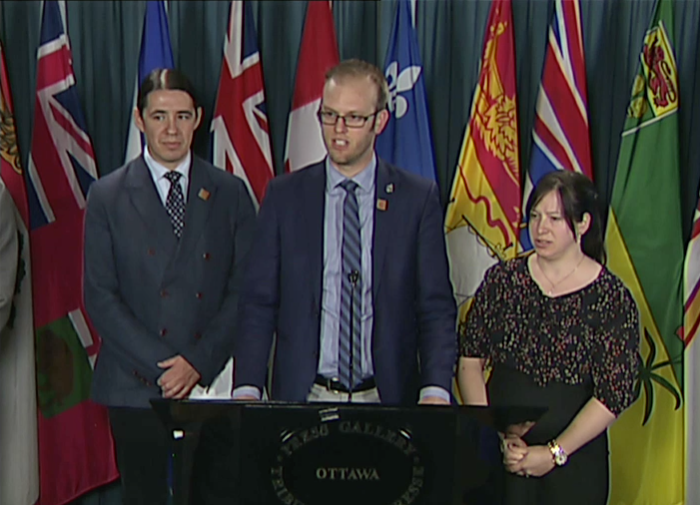
Peace River-Westlock MP Arnold Viersen has been selected as the co-chair of an All-Party Parliamentary Group to end Modern Slavery and Human Trafficking. The All-Part Parliamentary Group (APPG) was launched on April 26th, at a press conference in Ottawa.
Viersen says the group has members from all the major parties in both the House of Commons and the Senate. The APPG is modelled after the UK All-Party Parliamentary Group to end Modern Day Slavery. “That’s where we got the idea,” he says. “There’s a number of other Committees similarly set up here on Parliament Hill; one to end genocide, (another) on cooperatives, that kind of thing.”

MP Arnold Viersen
Viersen says the group will be looking at actions that have been taken in Britain, Europe, and in California, where there are laws in place to force large companies to be accountable to their shareholders on what kind of corporate impact they’re having on human slavery and sex trafficking. “One of the first projects that we’re taking on is called ‘Supply Chain Reporting’; we’ll be looking at how we can put some legislation forward around having publicly traded companies put forward a minimum of a one-page report – as part of their financial reporting – seeing their impact on human trafficking in the world.”
He says in other jurisdictions, that report has to be signed by the Directors of the company. “The fact that it’s signed by all the Directors makes them aware of the fact that Human Trafficking is a thing that you’ve got to be concerned about.”
He says practically speaking, it’ll be up to shareholders to determine the veracity of the reports. “Some companies like McDonald’s (restaurants) might say, ‘There might be some supply chain in the agricultural sector that maybe has an issue, but we’re pretty confident we’ve got that under control’, and if the shareholders believe them on that, it won’t be an issue. The next company – a mining company that’s working in Eritrea – might say ‘Hey, we’ve got nothing going on’, and people may not believe that.”
Other co-chairs of the group include Liberal MP Robert-Falcon Ouellette from Winnipeg, and Quebec NDP MP Christine Moore.
The International Justice and Human Rights Clinic at the Allard School of Law at UBC will be providing administrative support to the group’s work.
You can listen to the full interview with Arnold as featured on our Lighthouse News broadcast here.