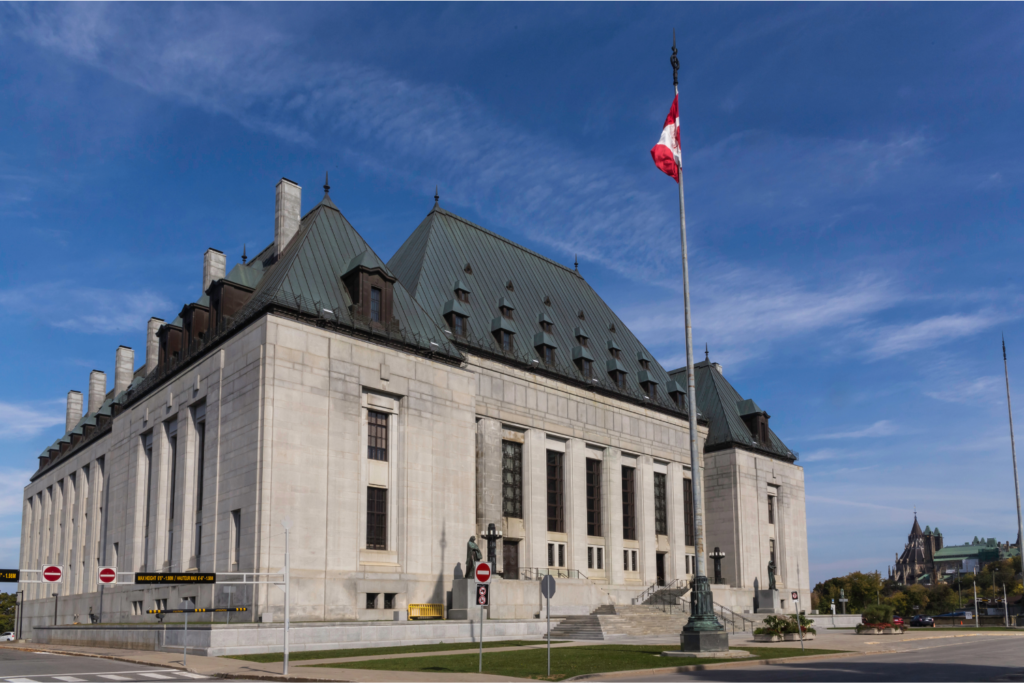
Last week, Canada’s Supreme Court unanimously upheld Canada’s criminal prohibitions on procuring persons for prostitution and materially benefiting from the prostitution of others, in R. v. Kloubakov. These two prohibitions form part of a comprehensive legislative scheme enacted in 2014, known as the Protection of Communities and Exploited Persons Act (PCEPA). PCEPA is designed to suppress prostitution as much as possible by prohibiting the purchase of sexual services and various forms of third-party participation, while leaving prostituted persons themselves immune from prosecution.
Background facts
In 2013, the Supreme Court struck down Canada’s criminal prohibitions against “keeping a common bawdy house” (i.e. a brothel or other facility for prostitution), “living on the avails of prostitution” (i.e. profiting or benefiting from prostitution), and communicating in public for the purpose of engaging in prostitution. Back then, Canadian law did not prohibit prostitution per se. Parliament responded to the Supreme Court’s 2013 ruling by passing PCEPA in 2014. PCEPA prohibited purchasing sexual services for the first time in Canada’s history.
PCEPA also prohibited materially benefiting from prostitution, communicating in public for the purpose of prostitution, advertising prostitution, and procuring persons for prostitution. PCEPA also made prostituted persons immune from prosecution as parties to any of these offences (though prostitutes can be prosecuted insofar as they exploit other prostitutes or procure other persons to be prostitutes).
PCEPA, or parts of it, has been challenged as unconstitutional in several cases, and so far it has been upheld in several courts. But last week’s ruling in R. v. Kloubakov was the first Supreme Court of Canada ruling on PCEPA.
The appellants in this case, Mikhail Kloubakov and Hicham Moustaine, had worked as drivers for what amounted to a sex-trafficking operation. Their bosses pled guilty to human trafficking. Kloubakov and Moustaine were acquitted of trafficking offences but convicted of lesser offences of procuring persons for prostitution and materially benefiting from the prostitution of others.
They appealed their case all the way to the Supreme Court of Canada, urging the Court to find these two prohibitions unconstitutional. Not only that, they contended that PCEPA as a whole was unconstitutional and that Parliament could not prohibit the consensual sale of sexual services.
The Supreme Court’s ruling and reasons
The Supreme Court understandably avoided the issue of the constitutionality of PCEPA as a whole or the prohibition on purchasing sexual services. After all, Kloubakov and Moustaine had only been convicted under two of PCEPA’s prohibitions. So, the Court focused its analysis on the validity of those two offences.
The Court first carefully defines the scope of each offence. A person can only be convicted of the procuring offence if they specifically intend to facilitate the exchange of sexual services for payment. So, for example, merely giving someone advice on safer prostitution practices would not amount to procuring a person for prostitution, as it does not involve causing, inducing, or persuading someone to offer or provide sexual services for payment. Nor does it involve conduct specifically intended to facilitate the offence of purchasing sex.
Someone can only be convicted of materially benefiting from the prostitution of others if they do so in what Parliament has defined in PCEPA as exploitative circumstances. So, for example, someone who materially benefits because their friend, family member, or roommate engages in prostitution to help pay the rent, would not be guilty of this offence, unless they pressured the other person to engage in prostitution.
PCEPA says that materially benefiting from prostitution in the context of a commercial enterprise is always an offence. Thus a major issue in Kloubakov was what counts as a commercial enterprise under PCEPA and whether it is unconstitutionally broad.
Why did Parliament prohibit benefiting from prostitution through a commercial enterprise? The Court noted that the new heading in the Criminal Code added by PCEPA, namely “Commodification of Sexual Activity”, informs the interpretation of “commercial enterprise”. A commercial enterprise involves a third party making a profit from the commodification of sexual activity. Importantly, the Court found that there is no requirement for “factually exploitative conduct” (e.g. threats of violence) or for the profits to be excessive or unreasonable (e.g. keeping most of what is paid to or for the prostituted person) to be convicted. Rather, the prohibition on “commercial enterprises” targets the inherent exploitation that Parliament sees as arising from the commodification and commercialization of prostitution by third parties. An individual or entity that merely rents premises to a prostitute, for example, does not participate in commodifying sexual activity.
In the words of the Court’s ruling:
Parliament views profiting from the commodification of another human being’s sexual activity as inherently involving exploitation. Parliament’s perspective that commodification necessarily involves exploitation does not turn on whether the commercial enterprise makes “excessive” profits, nor does it require a specific act of exploitation, beyond profiting from the commodification of another human being’s sexual activity.
ARPA’s involvement and thoughts on the ruling
ARPA Canada intervened jointly with the Evangelical Fellowship of Canada (EFC) to defend the legitimacy of PCEPA as a law that enforces and preserves fundamental societal norms connected to human dignity and equality, and that condemns the exploitation and degradation of human sexuality inherent in prostitution.
In our submissions, ARPA and EFC drew particular attention to the harm caused by commodifying sexual intimacy. The appellants in the case, like several interveners, argued that where there is consent, there is no harm – or at least no harm that merits the intervention of the criminal law. ARPA and EFC argued that exploitation and commodification are present in every instance of prostitution, even where it is purportedly consensual.
Since Parliament considered harm to be an intrinsic feature of prostitution, not merely a coincidental effect that can be avoided or mitigated with a different policy model, EFC and ARPA argued that the Court cannot expect Parliament to adopt a policy approach that tries to separate prostitution itself from prostitution-related ills – permitting the former while trying to avoid the latter. In short, Parliament’s primary objective with PCEPA was not to make prostitution safe, but to make women and society safe from prostitution.
The Supreme Court’s reasons for its ruling agree with EFC and ARPA’s submissions that exploitation within the meaning of PCEPA does not require a specific act, such as violence, coercion, or lack of consent. While the degree of exploitation and the consequent social harms may vary from one exchange to the next, exploitation and commodification occurs in every case. ARPA and EFC argued that the act of purchasing sexual services is always exploitative, in the sense that it takes wrongful advantage of someone, which can be done even if the other person consents.
As for procuring or profiting from another person’s prostitution, ARPA and EFC argued that it was also within Parliament’s authority to define, based on its normative judgment, what amounted to exploitative third-party involvement meriting criminal sanction. Thus, Parliament could prohibit “commercial enterprises” even where the third parties running these enterprises did not pressure women into prostitution or keep most of the money paid for their services.
The future of Canada’s prostitution law
The Supreme Court of Canada’s unanimous judgment sends a strong message to lower courts that Parliament’s normative and policy judgments underlying PCEPA are entitled to deference. The Court shows respect in this ruling for Parliament’s determination that commodifying sexual activity is inherently exploitative thus commercial enterprises profiting from it should be banned even in the absence of any other “factually exploitative conduct.”
As mentioned above, the Court did not decide the issue of whether section 7 of the Charter – the right not to be deprived of life, liberty, or security of the person, except in accordance with the principles of fundamental justice – protects the right to sell sexual services. This was not a dodge or abdication of responsibility on the Court’s part. Rather, the appellants only raised this argument at the Supreme Court and not the courts below. And neither of the appellants had been charged with purchasing sexual services, so that prohibition was not directly in issue. This argument was a last-ditch effort to call into question the legitimacy of PCEPA in its entirety.
But this issue is engaged in the Canadian Alliance for Sex Work Law Reform v. Canada, another case in which ARPA is an intervenor. The Alliance directly challenged the purchasing prohibition as well as the material benefit and procuring prohibitions. Justice Goldstein of the Ontario Superior Court upheld those provisions, and PCEPA generally, in his 2023 ruling. The Alliance appealed, but that appeal has been on pause while the parties awaited the Supreme Court’s ruling in Kloubakov. In theory at least, the Alliance’s challenge to the purchasing prohibition – the linchpin of PCEPA – could still succeed.
Furthermore, it might yet be possible for a challenge to the material benefit provision to succeed. The Supreme Court in Kloubakov did not rule on whether prostitutes are deprived of their security of the person because they cannot work for a “commercial enterprise.” The Court also did not decide whether PCEPA increases prostituted persons’ risk of death. In fact, the Court notes that while the lower court in Kloubakov did not make findings of fact on these questions, they are matters in dispute in the Canadian Alliance case, which is currently before the Ontario Court of Appeal, with a “fuller evidentiary record.”
In short, this likely means that the Canadian Alliance appeal will be continued and could make it to the Supreme Court. ARPA is grateful for the outcome in Kloubakov, but the work of defending Canada’s prostitution law continues.
“Men have no right – no moral right, no positive right, no legal right, and certainly no Charter right – to obtain consent to sex or sexual touching by paying a woman or a girl or any other person to get that consent. In fact, at a societal level, when we tolerate that idea, women and girls are objectified, their bodies are commodified, and communities are harmed. It was open to Parliament to end that practice to the greatest extent possible, and Parliament has decided to do so through the PCEPA.” So argued ARPA Canada’s legal counsel in the Ontario Superior Court last October. A group of activists was attempting to get the court to strike down Canada’s prostitution laws, and we were advocating that the laws should be upheld. Nearly a year after that Canadian Alliance for Sex Work Law Reform v. Canada (Attorney General) case, Justice Goldstein has released his 148-page decision upholding the laws as constitutional.
In ARPA’s view, the Protection of Communities and Exploited Persons Act (PCEPA) was the most significant piece of legislation on a social issue passed during the nine years that Stephen Harper was prime minister. We are thankful that the Ontario Superior Court has upheld that law as constitutional. This is a big legal win and cause for celebration. The law mirrors ARPA Canada’s policy recommendations on this issue, turning the attention of the criminal law toward pimps and johns in the sex industry to reduce the demand for commercialized sex.
Justice Goldstein had a mammoth task before him. The application to strike down the law consisted of thousands of pages of evidence in the form of witness affidavits, a dozen expert reports with hundreds of exhibits, thousands of pages of transcripts of cross-examinations, hundreds of pages of written legal arguments from not only the main parties, but also seventeen interveners (including ARPA Canada – you can read our written legal argument here), and four days of oral arguments. The judgement carefully and thoroughly explains the law, other court judgements, the evidence, and the reasons for upholding the law.
Justice Goldstein does an excellent job of distilling the evidence. He carefully explains for a lay reader the inherent biases, gaps, and limitations in much of the research and expert evidence that was tabled. He notes that the two sides on the political/policy debate of whether “sex work” should be decriminalized or criminalized were clearly represented in the courtroom. The debate question: is “sex work” just like regular work, or is it inherently exploitative? The answer: “The question of inherent exploitation is not, however, something that this court can decide. It is simply not a legal or factual question. One’s view of the question of inherent exploitation appears to be dictated by one’s normative perspective. Parliament has chosen a particular normative perspective and it is not for this court to second-guess Parliament in that regard.” (para 40).
ARPA Canada had argued that the animating concern of the prostitution legislation was the protection of vulnerable, marginalized women and girls victimized by pimps and johns. The law was thus designed particularly to protect and defend those victims while trying to eradicate the “sex trade” as much as possible. And so, we are thankful that Justice Goldstein also found that “the attempt by the Applicants to separate sex work and human trafficking is artificial and unrealistic considering the strong evidence to support Parliament’s view that they often go together…” (para 153). He concluded, “I find that there is a clear link between sex work and human trafficking. In fact, there is a considerable body of evidence that many sex workers are manipulated or coerced into sex work or trafficked while in it” (para 179).
Justice Goldstein also takes the time to clarify that the many harms in the sex trade are not because there is a law that prohibits the purchase of sex (as the Applicants argued), but because of the nature of the industry itself.
The main constitutional question was whether the prostitution law which prohibits the purchase of sex violates section 7 of the Charter, which guarantees the right to life, liberty, and security of the person. Justice Goldstein found that, for the most part, the law did not infringe on the right to life, liberty, or security of the person and that there was no causal connection between specific harms suffered by sex workers and the law as written. For a small handful of specific situations, the judge did find that liberty and security of the person were impacted, but in a legitimate way – not in a way that was arbitrary, overbroad, or grossly disproportionate.
The Applicants also argued that certain sections of the law violated freedom of expression and freedom of association (section 2(b) and 2(d) of the Charter) as well as the right to the equal protection and benefit of the law without discrimination (section 15 of the Charter). Justice Goldstein found that some of these sections were not engaged at all (section 2(d) and 15) and that any infringement on free expression was demonstrably justified in a free and democratic society (section 2(b)).
ARPA Canada is delighted with this decision. This decision upholds a just piece of legislation that aligns with biblical principles of care and protection for the most vulnerable and punishment for those who exploit them. Praise God for that!