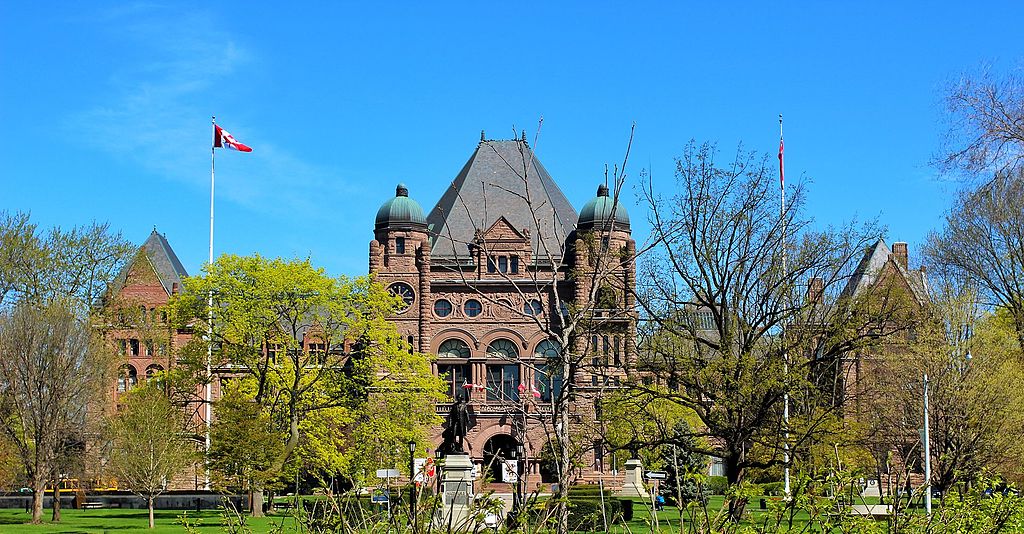
Now that the dust has settled on the 2022 Ontario Election and now that we know who will be representing each riding in the 43rd Ontario Parliament, let’s take a look at some of the fall out.
Historic Election
The 2022 Ontario Election will go down in history for one very concerning reason: only 4.6 million out of a possible 10.7 million voters (or 43%) took the time to have their voices heard. Compared to the 2018 election, which had a 57% voter turnout, this is a marked drop. We can only speculate the reasons why so many stayed home on election day – was there Covid fatigue? Was it the growing cynicism toward voting and politics? Did most feel like none of the parties represented them or their values? Did people think that the election was a foregone conclusion? Regardless of the reason, while people in other parts of the world are quite literally dying to be able to vote, here in Ontario, more people declined their ballot than put an “x” on one.
And the winner is…
Doug Ford will remain Premier of Ontario with his PC Party taking 83 of a possible 124 seats in the legislature. That’s 7 more seats than they won in the 2018 election. The NDP lost nine seats and finished with 31, while the Liberal Party increased their seat count by one to a total of eight seats – still not enough to gain official party status (more on that later). The Greens and their leader Mike Schreiner held onto their single seat in Guelph. The last seat, and probably the most interesting story of the night, went to Independent Bobbi Ann Brady in Haldimand-Norfolk, in a riding that looked like a lock for the PC Party.
New Leadership
With the NDP losing nine seats and the Liberals failing to gain official party status, both Andrea Horwath (NDP) and Steven Del Duca (Liberal) announced that they would be stepping down as leaders of their prospective parties. In her concession speech, Ms. Horwath said that it was time (after leading the party through the last four elections and 13 years) to “pass the torch… to hand off the leadership of the NDP. It makes me sad, but it makes me happy because our team is so strong right now.” While the NDP did take a step back this election from the last and there is surely disappointment in the result, there is truth to the statement that the NDP is in some ways stronger than it’s ever been in Ontario. Traditionally, the NDP has been the third party in the Ontario Legislature, with the Liberals and PCs taking turns as government and official opposition. But the NDP formed the official opposition in both of the last two elections.
It’s hard to find silver linings from the Liberal Party’s perspective. The 2018 election saw the Liberals go from a majority government to a distant third place with only seven seats. That result brought about the resignation of Kathleen Wynne as leader of the party. Steven Del Duca took over that role in 2020 with the goal of rebuilding the party for the 2022 election. One challenge that Mr. Del Duca faced was getting himself back into the Ontario legislature. In 2018, he lost his seat in the riding of Vaughan-Woodbridge to PC candidate Michael Tibollo. The fact that he was not able to win this seat back on election day and that the party only gained one new seat were driving factors for his decision to step down as leader.
Official Party Status
To gain official party status in the Ontario legislature, a party needs to have at least 12 seats. The Liberals were not able to gain this official party status for the second consecutive election. What does that mean for them? To start, each official party is given funds based on the number of MPPs so that the party can hire office and research staff (in addition to the funds provided to each MPP). The Liberals will continue to miss out on this. Additionally, when bills are debated, MPPs that are not from official parties have limited speaking opportunities (and are often excluded altogether). MPPs will essentially sit as independents and will only be able to debate bills if the speaker of the legislative assembly calls on them. This applies to Question Period as well. MPPs can submit requests to the speaker, but the speaker decides whether to call on them or not. These MPPs will still be able to make comments and ask questions on other members’ speeches, raise points of order, receive appointments to committees and present private members bills, but not having official party status certainly limits an MPP and their party.
Looking ahead
In the coming weeks, Premier Ford will be announcing his Cabinet. A few prominent Cabinet Ministers decided not to seek re-election, including Health Minister and Deputy Premier Christine Elliott. Additionally, the legislature will likely come back for at least a few days in order to swear in the MPPs and maybe even present an updated version of the budget. Look for the priorities of the government to be similar to promises made before and during the election campaign:
- Rebuild Ontario’s economy by attracting manufacturing jobs, specifically in the area of electric vehicle battery manufacturing.
- Build highways and key infrastructure, specifically, Highway 413 and the Bradford Bypass, as well as expand GO train service to London and Bowmanville.
- Work to get more people into the skilled trades.
- Expand three-year college degrees and increase minimum wage.
- Keep costs down, specifically by scrapping the licence plate sticker renewal and removing tolls off Highways 412 and 418.
- A plan to stay open by hiring more health care professionals.
- Helping seniors live in their homes longer and working to produce PPE and vaccines in Ontario.
What would we like to see?
The morning after his victory, Premier Ford made one more promise to the people of Ontario. At a news conference he said, “We are going to make sure we keep every single promise.” We hope that promise includes promises made during the 2018 election. During that election, Premier Ford and the PC Party promised to protect the conscience rights of physicians as it pertains to assisted suicide and offering an effective referral. We’re hoping to engage the grassroots in the coming months to bring this issue front and centre in the Ontario legislature once again.
Additionally, prior to the election, we wrote about Why Family Law Should Be An Ontario Election Issue. In this article we outline four key issues we would like to see addressed as it pertains to the family here in Ontario:
- Address the fact that parentage in Ontario law is disconnected from any objective standard.
- Address the fact that the terms “mother” and “father” no longer exist in Ontario law.
- Address the fact that the law permits various arrangement by which multiple adults can sign an agreement to become legal parents of a child.
- Address the reality that Ontario law fails to connect children with their biological parents and instead bases parenting on ‘intent’.
What can you do right now?
First and foremost, remember to pray for our elected officials here in Ontario as they pick up their tasks once again. Pray that they would have clarity on how they ought to govern, that they would recognize where their authority comes from and seek to serve God in the roles that they have. Also, consider sending an email or letter to your MPP and the Premier. Congratulate them and tell them that you’re praying for them and why you’re praying for them.
May God bless Premier Ford, our MPPs, and the entire province of Ontario.
Colin, Daniel and Ryan discuss the results and the impact on the political landscape in Ontario.
If you ask your neighbours to define the family, responses might range from the natural family unit - a mother and father and their biological children – all the way to any social grouping they want it to be. While the way society or the government defines family does not change the reality of the family as instituted by God, how the family is defined in law does indicate where our society is headed in its denial of the family as an independent, fundamental, and the most basic unit of society. This denial or lack of understanding has serious implications for children.
Background
In 2016, the Ontario government under Premier Kathleen Wynne introduced the All Families are Equal Act. The bill was touted as one that would be good for children in Ontario, and which would create equality for all types of families. In reality, it radically redefined the family and what it means to be a legal parent in a way that reflected what adults want instead of what is good for children. The new law came into force on January 1, 2017, and has been in effect for just over 5 years. Although there are many significant issues with this law, we have chosen to focus on four points.
Four Key Issues
If you look up what a family is according to Ontario law, it can be confusing. There are various laws that deal with the family. The Children’s Law Reform Act (the law that was amended by the All Families are Equal Act) defines legal parentage. The law used to state that “for all purposes of the law of Ontario a person is the child of his or her natural parents and his or her status as their child is independent of whether the child is born within or outside of marriage,” with the only exception being adopted children. This has been simplified to state, “A person is the child of his or her parents.” Another Ontario law defines a child as “includ[ing] a person whom a parent has demonstrated a settled intention to treat as a child of his or her family.” This is the first issue: the legislative change ultimately disconnects parentage from any objective standard and allows for various ways to become a legal parent (outside of adoption).
The second issue is that the terms ‘father’ and ‘mother’ no longer exist in Ontario law. Mothers are referred to simply as the “birth parent.” The birth parent is typically legally recognized as the parent of a child … unless a surrogate is used. Fathers also do not exist in the law but are referred to as “the person whose sperm resulted in the conception of a child conceived through sexual intercourse.” The spouse or partner of the birth parent is generally recognized as the parent of the child as well. However, the law allows the biological father of a child to opt out of being a legal parent to the child.
Third, the law permits various arrangements by which multiple adults can sign an agreement to become legal parents of a child. The first type of contract is a ‘surrogacy agreement.’ Adults can sign an agreement with a surrogate mother who carries the child and agrees to give up her legal parentage within seven days of the child’s birth. Additionally, the number of possible legal parents is not limited to two but can include up to four or five adults, none of whom must have a biological connection to the child being born.
The final issue is one that intersects with the three issues mentioned above. Ontario law fails to connect children with their biological parents and instead bases parenting on ‘intent.’ In other words, the desires of adults dictate what a family is, rather than the needs of children. With legal and medical advancements around surrogacy and in vitro fertilization, it has become easy for adults to ‘acquire’ a child in various ways, and also easy for parents to distance themselves from their rightful responsibility for their offspring. While Ontario’s adoption system recognizes that adoptive parents should be screened to determine if they are fit to parent a child, other ‘intent-based parenting’ as defined in Ontario law includes no such screening or safeguards.
The Problem
The most stable family structure is a mother, a father, and their biological children. Mothers and fathers are both critical to a child’s upbringing, and biology is the only objective starting point when defining legal parentage. Multiple studies show that children fare best when living with their married, biological parents. Children are at an increased risk of abuse when living with unrelated adults and having up to four unrelated adults as ‘parents’ only compounds that risk.
To lose a father or a mother is never good for a child, whether because of death, divorce, abandonment, or ‘intent-based parenting.’ Of course, sometimes circumstances that cause a child to lose their parent(s) are tragic and unavoidable. Likewise, sometimes children must be removed from their biological parents due to neglect or abandonment. But the basis for the natural family remains the same.
Some might argue that alternative family arrangements, such as four-parent households, surrogacy agreements, in vitro fertilization, or other parenting situations, are no different than adoption. But there are three fundamental ways in which adoption is different:
- Adoption seeks to mend a broken situation and to provide a family for a child who has been separated from his or her biological family. On the other hand, surrogacy agreements and intent-based parenting create a broken situation where adults intentionally facilitate the removal of a child from his or her biological parents.
- With adoption, the child is the one who is being served, making sure that a child has parents who can care for them. With other alternative arrangements, the adults are the ones being served and the child has to make sacrifices to ensure that adults can have a child without the safeguards of the adoption process.
- Adoptive parents support an adopted child through their loss and are not the cause of the trauma of the child losing their family. In alternative family arrangements, children are living with the adults who caused them to be removed from their biological family and must accommodate and support the adults. Adoption is a critical and necessary solution to situations where children lose their biological parent(s). However, it is vastly different than the additional solutions provided in Ontario law.
In his book The Mission of God, Joe Boot writes, “The family has great power for good toward the well-being of society and it has power in the church and through the church. That is why to attack the family is the surest way to destroy Christianity in a culture or nation and it is why the family must be protected and fought for” (pg. 422). This also has relevance for how the family is defined in law.
Make Family Law an Election Issue
Family law is not a new issue in Ontario, as the radical changes in the law have been in place for five years already. However, it is a critically important issue and the negative effects of such a law are not being discussed. That’s why we are focusing on some of these key issues regarding family law in Ontario.
Ontario has an election on June 2, 2022. We’d like to encourage you to take this opportunity to learn about family law and discuss these issues with your MPP and candidates during the election campaign. Stay tuned for further information and action items on this topic prior to and following the upcoming election period.
Note: This is a brief re-introduction to the issue of family law in Ontario. When the All Families are Equal Act was passed in 2016, ARPA Canada provided written commentary which can be found here and here for further information.