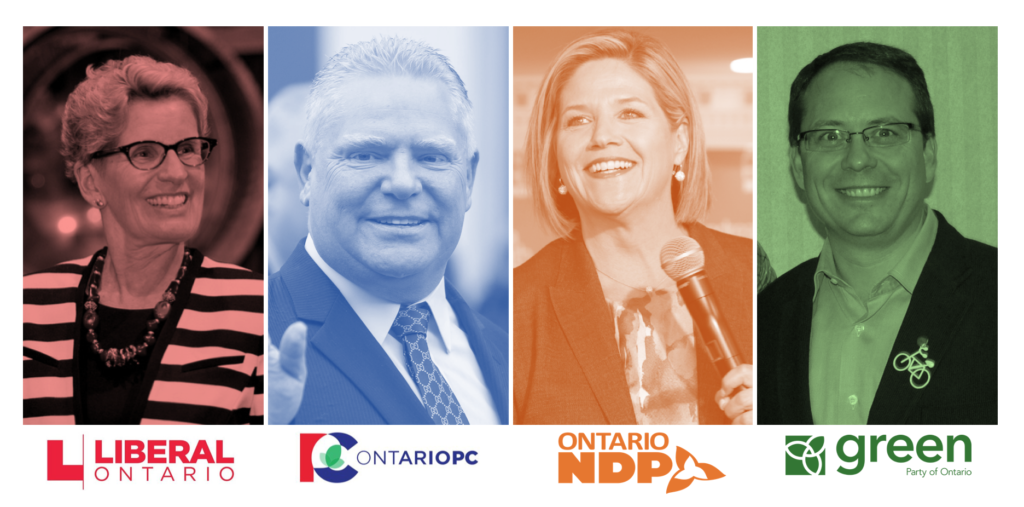
ARPA Canada congratulates all newly elected or re-elected members of the legislative assembly of Ontario. And we congratulate the Progressive Conservative Party of Ontario and its leader Doug Ford for their election victory.
We pray for peace and strength and a time of refreshing for all candidates, as an election can be very physically and emotionally draining. For those elected, may they be blessed as they prepare to take up their work as representatives and legislators. For those not elected, may they experience a smooth return to their work or be able to find new employment.
In keeping with ARPA Canada’s two-fold mission – to educate and equip Reformed Christians for political action and to present a biblical perspective to government – this article speaks both to those in authority and to Christian citizens of Ontario.
Recognizing the source of all authority
We pray that all MPPs and political staff, and indeed all people, may recognize and acknowledge the authority, righteousness, goodness, and love of God. May they endeavor to govern with justice and integrity. May they recognize from whom they receive their position and power and to whom they are answerable.
As Jesus declared to Pontius Pilate, “You would have no authority over me at all unless it had been given you from above.” (John 19) So the Apostle Paul writes, “Let every person be subject to the governing authorities. For there is no authority except from God, and those that exist have been instituted by God.” (Romans 13)
Jesus Christ has all authority. Every human authority is subject to him. As he said, “All authority in heaven and on earth has been given to me.” (Matthew 18)
So the psalmist writes, “Therefore, you kings, be wise; be warned, you rulers of the earth. Serve the LORD with fear and celebrate his rule with trembling.” (Psalm 2)
Every person is ultimately responsible and answerable to God for his conduct during the campaign. Yet we know that the outcome of every election is ultimately in God’s hands.
Praying for rulers, being good citizens
The Apostle Paul writes, “I urge, then, first of all, that petitions, prayers, intercession and thanksgiving be made for all people – for kings and all those in authority, that we may live peaceful and quiet lives in all godliness and holiness.” (1 Timothy 2)
ARPA Canada invites Christians to pray for all those in positions of authority. Please pray for new MPPs as they take up their role. Pray for wisdom for Doug Ford and his team as they organize a new government, assign individuals to Cabinet positions, and decide their legislative agenda. Pray for the Opposition too, that they may perform well the important task of holding the government to account and scrutinizing its policies through debate.
We urge Christians to speak up and to talk with MPPs. Christians’ engagement in politics should be thoughtful, winsome, and loving. At times, there are policies that ought to be exposed as foolish. Even then, Christians should not insult or disparage people, but speak the truth with clarity and conviction while respecting every person as created in God’s image.
Remember the words of Jeremiah (29:7), “But seek the welfare of the city where I have sent you into exile, and pray to the Lord on its behalf, for in its welfare you will find your welfare.”
Governing Canada’s largest province
Human nature is fallen. Our hearts are prone to pride, greed, and lust for power. It’s not a happy reality, but it is worth reflecting on for everyone taking up a position of power.
Ontarians have witnessed the effects of our fallen nature in several ways in recent years, from lies and deception used to obtain and retain power, to irresponsible and deeply damaging public policy choices. Though such conduct and choices do not surprise us, we are right to urge people in government to do better. Let us pray that MPPs hire staff with integrity, and that both MPPs and staff alike may maintain their integrity and be granted wisdom to govern well.
Government is and ought to be “God’s servant for your good” (Romans 13). People in government need to discern what is good. ARPA Canada respectfully submits that several important bills from the last decade indicate that the government of Ontario has failed to discern what is good, right, and just.
For many people, the first thing that comes to mind is likely Ontario’s financial mismanagement. Indeed, ARPA Canada believes it is irresponsible and selfish for this generation to spend so much borrowed money. Ontario has a serious debt issue that must be addressed. However, there are several other issues that tend to get less attention, but are terribly important. These have to do with fundamental freedoms of religion and expression, and with how we understand and legislate with respect to sexuality and gender.
ARPA Canada urges newly elected MPPs and their staff to consider the issues we have identified in our “Ontario Election Report” and to peruse the resources provided there. Please consider what you can do to set things right.
May God guide and bless the government of Ontario.
Ontario’s provincial election is Thursday, June 7 – just two weeks away! Be sure to mark it in your calendar. As always, ARPA Canada wants to help you get informed about the issues and equipped for action. We hope this Election Report helps. Part I introduces seven important policy issues. Part II recaps action items with a concise bullet-point list. Part III provides a list of ARPA resources to consult if you’d like to learn more about any of these issues.
This Ontario Election Report will cover the following issues:
- Protecting families from gender ideology
- Education reform
- Parental involvement with a minor’s abortion decision
- Ending censorship of pro-lifers
- Protecting freedom of conscience for health care providers
- Monitoring and reporting assisted suicide
- Drug policy
The above list is not intended to be comprehensive. Certainly, there are other policy issues that are and should be important to Christians. This report covers issues that are very much alive today and which ARPA has been studying and working on for some time. So let’s get started.
- Protecting families from gender ideology
Bill 89, passed into law in 2017, gives government the power to subject families to its view of sexual identity and morality; embeds gender identity ideology into child and family services law; empowers state agencies and judges to require foster and adoptive families to hold certain views regarding sexuality and gender identity as a pre-requisite for receiving children into their care; undermines parental authority in regard to a child’s moral and religious upbringing; and increases the potential for state intervention in families.
A child who is “at risk of suffering” mental or emotional harm (say, gender dysphoria) and whose parents do not provide “treatment or access to treatment” (say, hormone therapy) is a child in need of protection under the law.
Bill 89’s sponsor, the Minister of Child and Family Services, said, “I would consider that a form of abuse, when a child identifies one way [LGBT+] and a caregiver is saying no, you need to do this differently,” he said. ‘If it’s abuse, and if it’s within the definition, a child can be removed from that environment and placed into protection where the abuse stops,’ he said.” We have already heard reports of how this bill is being used to force compliance with progressive ideology around sexual identity and gender from parents.
The Child, Youth and Family Services Act, 2017 (which Bill 89 enacted) must be repealed or amended so that it does not require parents or caregivers to affirm or socially condition a child in a “gender identity” that is incongruent with the child’s birth sex or to provide access to “treatments” for gender dysphoria such as puberty blockers or cross-hormone treatments. And it must be amended to make clear that parents are free to hold and to teach their children heir conscientious or religious beliefs regarding matters of sexual identity and sexual morality. Write to and speak with candidates about this issue. Make use of the ARPA resource list, below.
Another law, Bill 77, the “Affirming Gender Identity Act”, passed in 2015, should also be repealed or amended. This law prohibits treatment methods for gender identity disorder that focus on making a child comfortable with their birth sex. Bill 77 dictates medical policy in the name of political correctness, removing good care options for parents and children, such as those provided by renowned child psychiatrists like Dr. Kenneth Zucker and Dr. Susan Bradley, who believe that encouraging children to be comfortable with their birth sex helps prevent long-term psychopathological problems. Dr. Zucker was removed from his Toronto clinic under political pressure following Bill 77.
- Education reform
It shouldn’t surprise anyone that home schooling and private schooling have been on the rise in Ontario. Though many of our readers will not have children in public school or “Catholic” school, we should nevertheless, out of Christian love for our neighbours and our society, care about what most Ontario children are being taught.
Much attention has been given to Ontario’s “Health and Physical Education Curriculum”, specifically the “sex ed” parts. People have legitimate concerns with respect to the age-appropriateness of the content, its normalizing of unhealthy behaviours, its failure to address the harms of pornography, and its detaching sex from love and marriage. Doug Ford has promised to consult with parents and replace the curriculum if he becomes premier. That is a promise Ontarians must hold him to and we encourage you to be involved in whatever consultation process may take place should Ford become premier. We need to realize, however, that the problems with Ontario education extend far beyond the Health curriculum.
In 2012, Bill 33 added “gender identity and gender expression” to Ontario’s Human Rights Code. That same year, Bill 13 mandated that school boards promote a positive school climate inclusive of all students, “including pupils of any “race … sex, sexual orientations, gender identity, gender expression, age, marital status, family status or disability” and that boards (including Catholic boards) permit LGBT-positive clubs to be active in their schools and to use the name “gay-straight alliance”.
School boards now cite these two bills as the basis for their policies. The Toronto District School Board, for example, mandates the following:
- “A school should never disclose a student’s gender non-conformity or transgender status to the student’s parent(s)/guardian(s)/caregiver(s) without the student’s explicit prior consent.”
- “School board and school staff are expected to challenge gender stereotypes and integrate trans-positive content into the teaching of all subject areas[…].”
- “Librarians must acquire trans‐positive fiction and non‐fiction books … and encourage the circulation of books that teach about gender non‐conforming people.”
- Students must be granted access to washrooms, sports teams, and other facilities and activities based on gender identity rather than biological sex.
So-called “trans-positive” content has been integrated throughout the curriculum deliberately to make it harder for parents to avoid having their children inculcated with normative instruction about human nature, gender, sex, marriage, and families. Reversing all this any time soon seems unlikely. We should aim in the short term to have provincial legislators acknowledge and respect the authority of parents as first educators.
- Parental involvement with a minor’s abortion decision
“Doug Ford opens controversial abortion debate”, a Toronto Star headline announced. Ford had questioned why there is no requirement of parental consent or consultation for providing an abortion to a minor, though teenagers need parental consent for school trips, among other things. We’re supposed to believe that Ford’s comments were a big political gaffe. In reality, Ford was making a perfectly reasonable point. “I can’t think of a more life-changing procedure for a young woman than an abortion,” he said. “I think that this is an important discussion to have and I would welcome any member who wanted to bring it forward in the Legislature.”
Ford did not promise to introduce a law as premier, but says he would welcome having a member bring the issue forward. Whether that happens is in part up to us. Talk to friends, family, neighbours, and candidates (future MPPs) about the issue. Tell them parents should be involved in medical decisions for minors. If a minor experiences complications after a medical procedure, she will rely on her parents for help finding appropriate care. The decision to have an abortion is a serious one with physical and psychological consequences. A minor will generally benefit from the involvement of her parents, rather than making this decision alone.
- Ending censorship of pro-lifers
As of February 2017, thanks to Bill 163 (“Safe Access to Abortion Services Act”), it is an offence punishable by prison and punitive fines to “attempt to advise or persuade” someone to refrain from having an abortion, or to “attempt to inform a persona concerning issues related to abortion services”, or to “attempt to perform an act of disapproval of abortion” in any way, if the attempt is made within 50m to 150m of an abortion facility.
This law prohibits all forms of peaceful pro-life outreach or expression near abortion facilities. The bubble zone law is unique in that it directly targets only one side of a political and ethical debate for censorship. As such it is a dangerous legislative precedent and should be repealed. If there truly is harassment going on near abortion providers, all the government needs to do is enforce existing criminal laws.
Public streets and sidewalks are not the only arena in which pro-lifers face censorship and discrimination. They also encounter problems hosting events or speakers on university campuses and in placing pro-life advertisements with municipalities. MPPs should take steps to ensure that taxpayer-funded universities and municipalities treat people fairly.
- Protecting freedom of conscience for health care providers
The College of Physicians and Surgeons of Ontario (CPSO) requires physicians to facilitate access to unethical “services” such as euthanasia and abortion by providing an “effective referral” – that is by referring a patient seeking such a service to a known provider of that service. The CPSO contends that its effective referral policy does not make physicians morally complicit. However, if you were to refer someone to a drug dealer or a contract killer, you would be abetting the resulting crime according to Canadian criminal law.
The Ontario legislature has the power to prevent the CPSO from requiring doctors to participate in practices to which they conscientiously object in good faith. The legislature should prohibit all medical regulatory bodies (for nurses and pharmacists and others too) from requiring medical professionals to participate and should legislate employment protections so that they cannot be fired or demoted by a hospital or clinic for refusing to participate. Nearly every jurisdiction in the Western world does notrequire effective referrals. Tell candidates in your riding, and your MPP after the election, that freedom of conscience needs to be respected. After all, we surely don’t want to drive people with strong consciences out of the health care professions!
- Monitoring and Reporting Assisted Suicide
When the Supreme Court of Canada struck down the law that prohibited assisted suicide, it said that the risk of abuse of vulnerable persons could be minimized through a “carefully designed system that imposes strict limits that are scrupulously monitored and enforced.” However, assisted suicide and euthanasia are being performed in Ontario with next to no oversight.
The Ontario government recently passed Bill 84, which requires physicians and nurse practitioners to give notice to the coroner whenever “medical assistance in dying” (MAID) is provided. The Ontario government is right to require physicians to report “medically assisted” deaths to the coroner. However, Bill 84 did not set out the content of the notice. The coroner should be able to determine from the notice, at a minimum, some basic information about the circumstances and the cause of the person’s death. Of course, there may be other ways for the provincial government to monitor euthanasia. We encourage you to raise the issue with candidates. Vulnerable people are at great risk in a system that both permits euthanasia and fails to monitor it carefully.
- Drug Policy
The federal government passed a law last year (Bill C-37) that makes it easier for provinces to establish “safe injection sites” where people can inject illegal narcotics under medical supervision with immunity from prosecution. Meanwhile, Bill C-45, the “Cannabis Act”, which was passed by the House of Commons and has passed second reading in the Senate, will if passed decriminalize recreational marijuana and delegate much of the responsibility for regulating it to the provinces.
Both bills are part of a broader embrace of the “harm reduction” approach to drugs. Such bills require us to consider issues of poverty, addiction, criminality, personal responsibility, rehabilitation, punishment, and more. Drug policy is not an matter that ARPA Canada has yet been able to write a substantive policy report on. Still, we think it’s an issue worth raising and discussing. The provincial government should take steps to prevent the normalization and spread of drug use and instead focus on moving in the other direction.
We encourage you to communicate with candidates leading up to the election, to vote, and to stay in touch with whomever is elected to represent you and your riding at Queen’s Park. Use ARPA’s “12 Step Action Plan” to help you build a relationship with MPPs!
What follows is a short list of ways you can take action on the issues discussed in this article.
- Protecting families from progressive gender ideology
- Tell candidates / MPPs about problems with Bill 89 and ask for their thoughts.
- Ask for a commitment to amend Bill 89 to protect families.
- Ask for a commitment to repeal or amend Bill 77 (“Affirming Gender Identity Act”).
- Education reform
- Ask candidates / MPPs to commit to:
- repealing and replacing the current sex ed curriculum in consultation with parents
- ensuring the curriculum discusses the harms of pornography
- ensuring the curriculum does not make “consent” the sole criterion for sexual morality
- ensuring the curriculum is age appropriate
- ensuring parents are properly informed and have the final say over whether a child attends a class that deals with such matters
- Get involved in future government consultations for a revamped curriculum
- Ask candidates / MPPs to commit to:
- Parental involvement with a minor’s abortion decision
- Ask for a commitment to passing a law that requires parental consent for a minor’s abortion
- Point candidates / MPPs to http://sk.parentalconsent.ca/ as a resource
- Ending censorship of pro-lifers
- Ask candidates / MPPs to repeal or amend Bill 163 (“Safe Access to Abortion Service Act”) to allow for peaceful pro-life expression and outreach
- Explain that a law that is supposedly about ensuring safe access to abortion need not prohibit behaviour that poses no threat to safety.
- Ask candidates / MPPs what they plan to do to ensure that pro-life university clubs are not unjustly discriminated against and censored by student unions or university administration.
- Freedom of conscience for health care providers
- Urge candidates / MPPs to pass legislation to prohibit employers and medical regulatory bodies from requiring people to participate in abortion or euthanasia or other ethically objectionable practices, even through referrals.
- Monitoring and reporting assisted suicide
- Talk to candidates and MPPs about the importance of adequate oversight of “assisted death” – which the Supreme Court said was necessary in order to minimize abuse.
- Refer candidates and MPPs to ARPA’s policy submission and ask them to implement it or something similar.
- Drugs policy
- Talk to candidates and MPPs about how to deter drug use and help those with addictions recover and find meaningful work.
- Discuss with candidates the implications of a government-operated marijuana distribution system.
PART III: ARPA RESOURCE LIST FOR ONTARIO POLICY ISSUES
All of the following resources were written by ARPA staff and take a more in-depth look at the issues above. Feel free to share them with friends, family, neighbours, candidates, and MPPs.
Sexual Orientation and Gender Identity (“SOGI”) laws generally
Regarding Ontario’s major “SOGI” bills, see ARPA blog: “Five bills in five years: Gender ideology in Ontario”
See ARPA Canada’s Policy Report on Gender Identity.
Bill 89 – Gender ideology in child protection services, foster care, and adoption
For this bill, you can find links to the following from the landing page under the heading “Read more”:
- Bill 89 Pushes Gender Ideology in Child Services
- Does Bill 89 protect at-risk kids?
- Does Bill 89 promote human rights?
- Blog: ARPA presents to committee reviewing Bill 89
“SOGI” Education
- See “Five bills in five years” blog above, under the heading “Gender ideology goes to school”
- Blog: Ontario’s highest court: Public education is not neutral
- Blog: Highlights from BC’s SOGI curriculum– It’s about B.C., but the issue is similar in ON.
- Op-ed (Lethbridge Herald): Bill 24 offers the illusion of freedom
Parental consent for a minor to have an abortion
WeNeedaLaw has set up a page dedicated to campaigning for a parental consent law in Saskatchewan (sk.parentalconsent.ca). Its resources are useful for Ontario as well.
Bubble zones / Censoring pro-life expression
- News: Ontario to introduce “safe access zones” legislation targeting pro-lifers
- Blog: Safe access zone legislation is unconstitutional: ARPA speaks to Committee
- Blog: Treating peaceful pro-life persuasion as hate speech
- Op-ed (Lethbridge Herald): Bill 9 [Alberta] would ban peaceful persuasion
Freedom of conscience for health care professionals
- News: Conscience rights of Ontario doctors ignored
- News: Passed – Manitoba’s Bill 34 to protect conscience rights
Assisted Suicide and Euthanasia
- News and Action item: Canada must start monitoring “medically assisted dying”
- Policy submission: ARPA submission to Committee regarding Bill 84, “Medical Assistance in Dying Act”
Drugs policy, marijuana legalization, safe injection sites
- Blog: Safe injection sites – Coming to a city near you?
- Blog: Could marijuana decriminalization present an opportunity for better policy?
- Video: Marijuana – Personal liberty or state responsibility?

Patrick Brown’s PC Party is facing considerable internal dissension; several unsuccessful nominees are going to court, challenging the way nomination procedures have been run. Social conservatives in that province are becoming increasingly concerned with what they see as a drift by the Ontario PCs into social liberalism. That has prompted the creation of several new parties, and some protest movements against Brown’s leadership.
To talk about these developments, I’m joined on the program this week by Dr. David Koyzis. Dr. Koyzis is the long-time head of the political science program at Redeemer University College in Ancaster, just outside of Hamilton.
LN: First of all, I want to say that this is not about partisanship. ARPA has always been strictly non-partisan. But the reality is that for a lot of Christians in Ontario right now, they’re faced with some dilemmas right now. On the education front for example, Kathleen Wynne’s Liberals have managed to alienate a lot of traditional Christian and social conservative voters with that sex-ed curriculum piece. And that means that in a normal election cycle, those people might vote against the Liberals, which would likely put them in the PC camp.
But the perceived reality now is that Patrick Brown’s PC’s haven’t done much to impress that same block of voters, correct?
DK: Well I think that’s true, and I think one of the things we need to be aware of – the way that politics works, especially in Canada and other countries that have an electoral system similar to ours – is that parties are loose coalitions of disparate groups, many of which don’t easily coexist with each other within the same partisan body. And I think that’s what we’re seeing here in Ontario as well. So social conservatives do not make up the whole of the Progressive Conservative Party in Ontario. But of course, any would-be leader who wants to try to make it to the top in the party is going to have to appeal to as many of those factions as possible.
LN: And that’s the critique of Patrick Brown. He used social conservatives to get himself elected to the leadership, but now a lot of those people are looking at him and saying “you’ve thrown us under the bus.” Is that a fair critique?
DK: It is, and it isn’t. It is in the sense that I think that Patrick Brown is not following the preferences of social conservatives. But it isn’t in the sense that other politicians do the same thing.
For example, when George H. W. Bush was President of the United States, there was a pro-life gathering on Capitol Hill in Washington, and he did not go out and join them, but he simply phoned them and talked to them on the phone and expressed support that way. He did not want to have a photo-op with pro-lifers on Capitol Hill because his calculation was that that would not help him politically. So I don’t think that Patrick Brown is unusual in that respect.
LN: You know, the very fact that there’s room for somebody like Sam Oosterhoff in the PC caucus says something, still, about the PCs, right?
DK: It does, and if the party leader does not intervene directly in the vote of a riding association then yes, you can have people who might be outside of the mainstream being nominated by the riding association.
LN: But we now have the creation of several what I would call splinter groups. We first saw it last year with the registration of the anti sex-ed party which was focused on that one issue. Now there’s a bunch of new groups coming out of the woodwork. There’s the Trillium Party, there’s a website called “imout.ca,” (and) a Facebook group that says “Take Back Our PC Party”.
How much impetus do these groups really have? Are they just a few disgruntled folks, or is there more going on here?
DK: Well, I think they are disgruntled folks. I think there’s no doubt about that. Whether they will be able to have an impact on the direction of the Progressive Conservative Party is…I would be very doubtful about that, because it’s not clear to me that they represent the broad mainstream.
But we’ve seen something happen similar to that on the federal level when Stockwell Day was elected the leader of the Canadian Alliance. He seemed to be less than skillful at maintaining the loyalty of his caucus, and so a number of people bolted and formed splinter groups in the federal Parliament. So we may see something along those lines here.
Now the Trillium Party does have an MPP at Queen’s Park, but that’s only one person. So whether they will succeed in making a dent in the PC Party is really difficult to say at this point. I think they probably will not, but what they could do is end up throwing the election to Kathleen Wynne’s Liberals.
LN: Because of the political reality of vote-splitting, right?
DK: Exactly.
LN: This turmoil could play out that way in the election?
DK: That’s right. Splintering and forming another party might make sense if we had some form of proportional representation. In a country like the Netherlands, for example, it is not that difficult to get members elected to the second chamber of the Dutch Parliament, because they have a fairly pure form of proportional representation, and you’re voting not so much for a single candidate as for a political party list. If we had something even remotely similar to that here in Ontario, then it might make sense for other parties to try to get into the act. But the system that we have here – that’s popularly called “first past the post” – tends to favour a two-party system.
LN: And finally – and really this is the nub of the issue – with all the turmoil that’s going on in Ontario politics right now, all the stuff we’ve talked about, what are Christian voters to do? Is it a matter of choosing the lesser of several evils? Do the voters stand on principle, irrespective of the electoral consequences?
I think we all recognize these are not easy questions.
DK: They’re not. Most people in this province or in Canada as a whole tend to vote for the lesser of perceived evils. I think we saw that south of the border last year with the presidential election. There were a lot of people that voted Donald Trump that were not at all enthusiastic about him, but simply did not want his opponent to get into the White House. And in Ontario, we have a very similar type of a system. Basically, if you’re not voting for one of the major parties, you are effectively wasting your vote. And so people want to vote for a candidate that they believe has a good chance of winning, and candidates from minor parties simply do not have that.