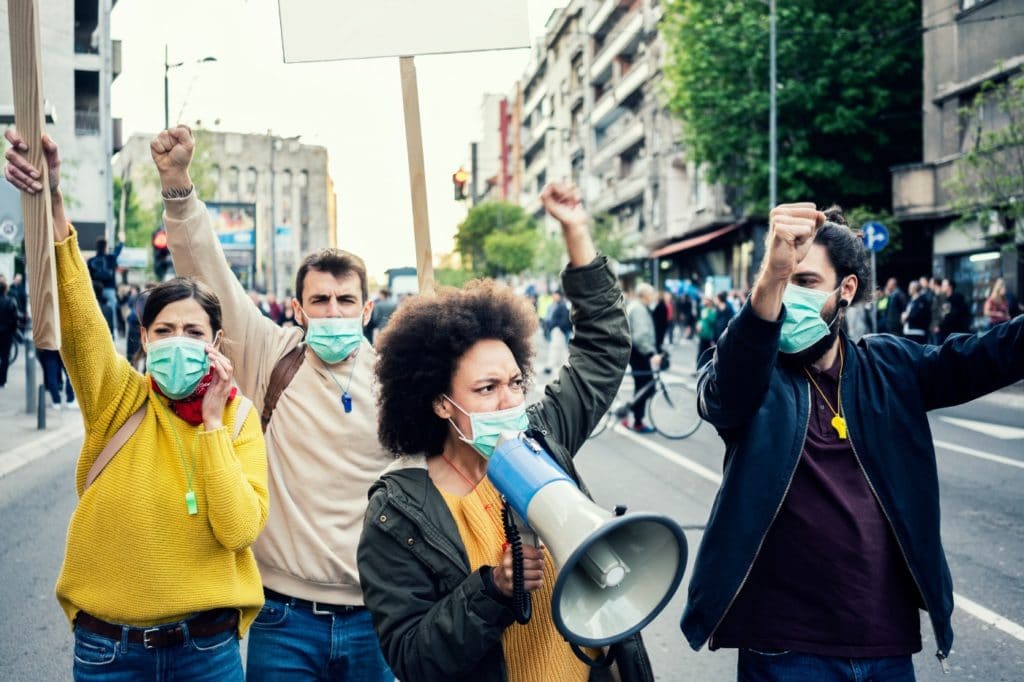
Randy Hillier, a former Progressive Conservative and then independent MPP, was a prominent critic of COVID-era lockdowns, mask mandates, and vaccine passports. In 2021, Hillier attended and helped organize several outdoor gatherings to protest such policies.
Consequently, Hillier was charged with two provincial offences under the (somewhat ironically named) Reopening Ontario Act. He faced a penalty of between $10,000 to $100,000 and up to a year of prison.
But Hillier challenged the constitutionality of the specific regulation under the Act that he was charged with violating. That regulation did not allow outdoor gatherings of any size at all, although it allowed very small indoor or outdoor gatherings for weddings, funerals, and religious worship services.
Hillier contended that the regulation violated his freedom of peaceful assembly under section 2(c) of the Canadian Charter of Rights and Freedoms. Unlike most COVID court cases, Hillier’s case was exclusively about freedom of assembly.
The lower court upheld the regulation. Last week, a unanimous Court of Appeal ruling overturned that ruling and declared the regulation to be constitutionally invalid. This is the first major court ruling that found COVID-era restrictions on gatherings unconstitutional. Every other ruling – including the three cases that ARPA intervened in in British Columbia, Manitoba, and Ontario regarding worship services – had upheld the bans on gathering.
Court of Appeal overturns lower court ruling
Justice Lauwers, for a unanimous Court of Appeal, distinguished this case from the failed challenges to strict size limits on worship gatherings, noting that “while Ontario tailored restrictions on religious gatherings to facilitate freedom of religion, no such tailoring was performed to facilitate the right to peacefully assemble.”
The Court concluded that there was no evidence that the government had even considered making any exceptions to its general gatherings ban to allow for some form of limited, peaceful assemblies and political protests. “The effect of the ban in this case was to stifle assembly aimed at expressing collective opposition to the ban itself.”
Justice Lauwers noted that there is little case law on freedom of assembly, as constitutional cases involving assemblies are often litigated primarily on other grounds – especially freedom of religion, expression, and association. Consequently, the Court relied heavily on academic commentary on freedom of assembly rather than on court precedents.
The purposes of freedom of assembly
But freedom of assembly is important in its own right. “[T]he point in setting the right of assembly apart from [expression] and [association] is the assembly itself,” the judgment says, quoting a recent essay on freedom of assembly by Professor Jamie Cameron. “Put another way, the assembly is, in its own right, ‘the constitutional event’.”
Given the lack of precedent, the judgment relies extensively on Professor Cameron’s analysis of what freedom of assembly requires, as well as Professor Richard Moon’s.
The Court considers the underlying purposes of freedom of assembly, noting that assembly “can advance the democratic goals of ‘self-government, truth seeking, and self-realization’” and can “empower unheard, marginalized voices.” A public assembly can “leverage a message of protest or dissent, forcing the community to pay attention and become involved in redressing grievances.”
The Court also highlighted several points from Professor Richard Moon’s commentary on freedom of assembly. Notably, “a demonstration is an act of solidarity […] but also [a] collective act of expression.” Protests may “help overcome the fragmentation of public discourse,” and “[give] a sense of presence, and connection with others, that is lacking in mediated forms of communication.” Also, Moon writes, protests “can make visible the extent and depth of support for a position.”
Freedom of assembly protects both the act of assembling together in a physical location and the activities related to achieving that, such as planning for and publicizing the gathering, and travelling to and from the assembly. Further, digital connectivity and virtual meetings may complement but do not replace participation in physical public assemblies.
Ontario government failed to enact proportional gatherings limit
The Court found that the government had failed to consider whether there were less restrictive means of achieving its legislative goal of minimizing the spread of COVID. Put another way, the government failed to consider if there were forms of limited public protest that could be permitted without unacceptable risk of viral spread. At the same time, the government had come up with tailored (albeit very restrictive) policies for other activities, such as shopping for essentials, or gathering for a funeral or a worship service.
Justice Lauwers goes on to conduct a “proportionality analysis,” as required by Supreme Court of Canada precedent. This analysis requires judges to weigh the “deleterious effects” on a Charter right or freedom against the “salutary effects” of the law or government decision being challenged in court. In other words, did the benefits of the policy outweigh the costs?
Before answering this question, Justice Lauwers notes, “The core problem with [determining] proportionality is that the detriments to be suffered by individuals and groups in any case […], on the one hand, and the benefits that accrue to the common good, on the other, are usually incommensurable.” By “incommensurable,” he means: “There is no common basis, common denominator or common measure for evaluating and balancing the competing claims of the individuals and groups negatively affected by a law or decision, against any benefits to the common good.”
It is heartening to see judges acknowledge this problem, since the “proportionality” analysis can easily be used to disguise judicial policy or political biases. Still, this is the approach prescribed by the Supreme Court, so Justice Lauwers does his best. He highlights that “there is no evidence as to the increase in risk posed by the outdoor protests in which Mr. Hillier participated.” The onus was on the government of Ontario to show that allowing any outdoor protests of any size posed a significant risk. It failed to do so.
Takeaways
First, this is a personal win for Randy Hillier. Unless the government appeals, Hillier will be free from the threat of penalties, as the regulation he is charged with breaching has been declared void.
Second, the restrictions on peaceful assembly are no longer in force, so this ruling didn’t strike down any law. But it forms an important precedent that should give governments pause before completely banning a constitutionally protected activity, even temporarily.
Finally, we congratulate our friends at Christian Legal Fellowship for publishing the 2022 essay collection about protecting Charter freedoms that included Professor Cameron’s essay, mentioned above, which proved to be of great assistance to the court.
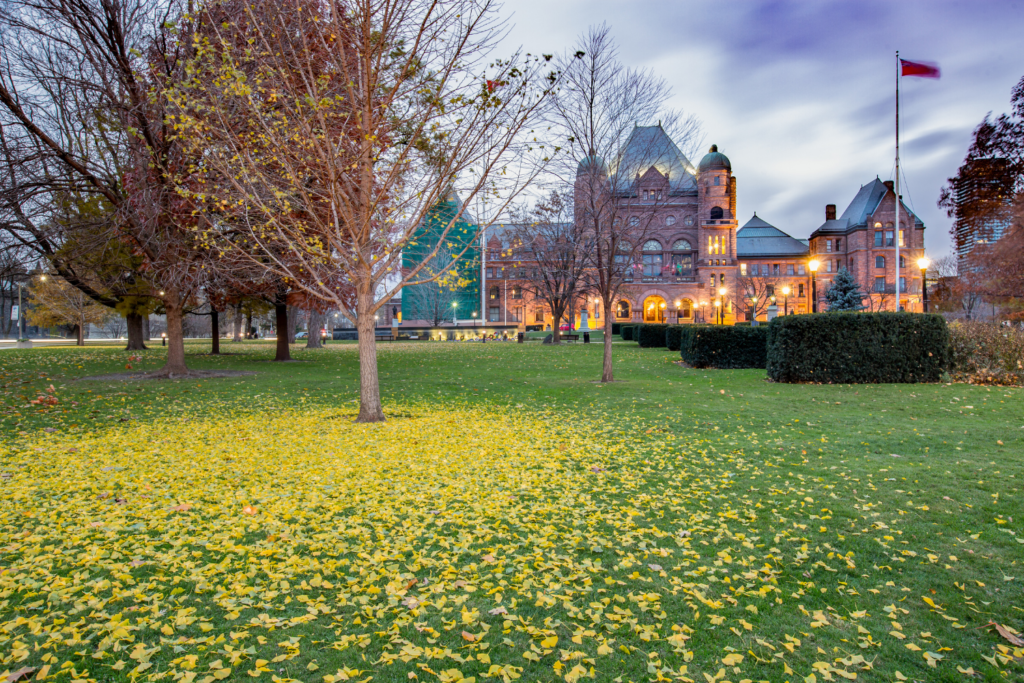
The Ontario Legislature often returns from their summer break in mid-September and continues with the work they had started before the break. But, with the federal election in full swing this September, the government chose to prorogue the legislature (end the current session) and return on October 4th with a new session. So, following the extended break, with the provincial election in June 2022 coming into sight, the Ontario Legislature has been quite busy over the past month. Some of this activity is particularly worth noting.
Every new session of the Legislature begins with a speech from the throne. In the speech, where the government can share their priorities, the government once again emphasized the importance of prioritizing health and long-term care moving forward. The opposition is also keen to share their priorities leading up to the election and many of their private members’ bills also have a focus on health and long-term care. Over 35 bills have been introduced in the past few weeks. Some of these prioritize important policies which align with various recommendations in ARPA Canada’s recent elder care policy report. Others focus on more concerning policy options.
Long-Term Care
When a legislature is prorogued, all bills that have not been passed need to start the process over. This was the case with the More Than a Visitor Act. MPP Lisa Gretzky has re-introduced this bill which recognizes the value of care from family and friends for residents in a formal care setting. This bill, if passed, would allow designated caregivers to visit residents in congregate care settings, to provide physical and tangible support – even during a pandemic. The More Than a Visitor Act has been reintroduced as Bill 19. As when this bill was first introduced, we encourage you to send an EasyMail to your MPP in support of this legislation.
Another of ARPA’s elder care recommendations is that governments work with care homes to develop minimum staffing requirements for long-term care. Bill 14, the Time to Care Act, seeks to ensure that long-term care residents have at least four hours a day of nursing and personal support services. Last year, the government committed to having this in place by 2024-25 and shows the same priority in recent long-term care legislation. Last year, the Ontario Long-Term Care COVID-19 Commission also provided recommendations to the government, many of which were in line with ARPA Canada’s recommendations on Elder Care. Another private member’s bill, Bill 4, seeks to ensure that the Ontario government implements those recommendations and reports on the progress being made.
Vaccinations
Bill 6, the Jobs and Jabs Act, is another private member’s bill that many Ontarians have been paying attention to. This bill would prohibit employers from intimidating or dismissing employees based on their vaccination status or their refusal to disclose vaccination status. On the surface, the intent of the bill is helpful, with its desire to ensure that employees are not penalized based on their personal medical decisions. However, we also ought to be concerned when the government tells private businesses who they can and cannot fire. Because the legislature randomly draws ballots for when private members’ bills will be discussed, this bill will not be on the agenda for 2nd reading until March 2022.
Protests
There are also two different private members bills that seek to ban COVID-19 protests outside of hospitals and other health facilities. This is concerning because Ontarians should be allowed to protest if they choose, as long as they are not breaking existing laws around obstruction, trespassing, or other misbehaviours. You can read some further commentary on this topic here. If you are concerned about this, you can also send an EasyMail to your MPP here.
Gender
Another bill of concern is Bill 17, the Gender Affirming Health Care Advisory Committee Act. This bill seeks to create an advisory committee that would make recommendations to the Minister of Health with regards to “improving access to and coverage for gender-affirming health care.” The bill goes on to define gender-affirming health care as “procedures, medical treatments and referral processes that align a patient’s body and physical presentation with their gender identity.” Recommendations from the committee would likely include things like improving access and coverage for procedures related to gender transition, expanding OHIP coverage for various sex-change treatments, and how to “define gender-affirming health care procedures as lifesaving procedures.”
Bill 17 explicitly promotes and normalizes sex-change surgeries and other medical procedures and treatments for gender dysphoria, instead of supporting body-affirming counselling for those who struggle with their gender and sexuality. The Gender Affirming Health Care Advisory Committee Act has already passed second reading with all-party support and has been forwarded to the Standing Committee on Social Policy for further study.
Stay Tuned
We mention just a few of the current bills on the Ontario agenda to look at some of the priorities that MPPs have been promoting with the return of the Legislature. We can continue to encourage our elected representatives to promote positive elder care, including prioritizing the involvement of family caregivers and ensuring adequate staffing ratios in long-term care homes. At the same time, we can point out areas of concern where our MPPs do not view the role of the government correctly, or where they have an improper understanding of healthcare and its purposes. As some of these bills progress, we will provide updates and action items as necessary.
Last week, the province of Quebec passed a law making it illegal to participate in a protest relating to the COVID-19 pandemic within 50 meters of a COVID-19 testing or vaccination site, health or social services institution, or an education or child care facility. The law even forbids someone from inciting anyone to organize such a demonstration. Other provinces – such as the government of British Columbia and the official opposition and a private member in Ontario – and even the federal government are contemplating issuing similar laws.
These proposals have arisen after a number of demonstrations outside schools and hospitals took place across the country, many of which were organized by nurses to demonstrate their support for fellow health care workers’ choice not to be vaccinated. Some of these demonstrations made it difficult for ambulances and other vehicles to access the hospital. One school in British Columbia locked down after protesters entered the school.
Such protest-free “bubble zones” that regulate speech and expression in a particular area are not new. British Columbia, Ontario, Quebec, Alberta, and Nova Scotia all have legislation that forbids pro-life expression or even offering information about abortion within certain parameters around abortion clinics, hospitals, or doctors’ offices. Politicians at the time justified the legislation as necessary to prevent extreme actions against abortion doctors or women on their way to the abortion clinic, even though harassment, assault, and other apparent concerns were already illegal. We oppose these laws as disproportionate infringements on freedom of expression, and there is currently an ongoing constitutional challenge of the Ontario law waiting for trial.
In the wake of increasing calls for protest-free zones in relation to COVID-19, here are a few suggestions for legislators, law enforcement, and protestors.
Legislators – Don’t Do It
Legislators should resist the temptation to prohibit all COVID-related protests, even if it is a politically popular choice. The right of peaceful assembly, including the right to protest, is a fundamental political freedom that should not be infringed upon lightly. Throughout Canadian history – and, indeed, Western history – protests like the Winnipeg General Strike and the On to Ottawa Trek have been pivotal avenues for social and political change.
We can make a distinction between restrictions on gatherings that target the content or subject matter of the gathering as opposed to the place or manner of the demonstration. For example, noise by-laws impact the manner in which protests are conducted regardless of the content of the message. Bubble zone laws, on the other hand, specifically target the content of the speech, making it illegal to express disapproval of abortion or COVID policy. The latter is far more troubling and constitutionally suspect.
Also, all three levels of government should not equate the actions of one person or a small minority of people to an entire crowd. In many demonstrations, some people may indeed go too far, but governments should not assume that the actions of those individuals represent the intent of everyone else. Proposing and passing legislation that prohibits the freedom of peaceful assembly and democratic expression of everyone based on the actions of a handful of an unruly few, is a grossly disproportionate infringement of fundamental rights and a heavy-handed use of the law.
Applying these criteria to the demonstrations at hand, no level of government should forbid demonstrations just because they dislike the purpose of the protest, such as protests opposing mandatory vaccinations or promoting an alternate policy approach to handling COVID. We allow for lawful dissent on all sorts of policies. This is an important aspect of the way our democracy works. Demonstrators should be constitutionally free to present their case in the public square.
Law Enforcement – Enforce the Law
Instead of legislators creating new laws which specifically outlaw protests based on the subject matter, law enforcement should endeavour to enforce the existing laws governing general conduct around protests. Remember, the Charter right is to peaceful assembly, meaning assemblies that cause havoc aren’t given constitutional protection. If an anti-vaccination protestor illegally obstructs roadways, trespasses on private property, or assaults anyone, law enforcement should use reasonable means to try to enforce the laws on the books. Much of the impetus for laws outlawing COVID protests outside of hospitals or schools is fueled by the (alleged) misconduct of some demonstrators, more so than the content of their protest. Adding more laws that ban the same activities doesn’t aid the police.
This enforcement should not be applied selectively. Whenever demonstrations cross the threshold of legality, law enforcement should attempt to restore order. Otherwise, just laws become a mockery instead of carrying the weight they justly deserve. Whether COVID protestors impede access to a hospital, teachers on a labour strike block access to a school, climate activists block bridges, or members of First Nations block railways, it is incumbent on law enforcement to endeavour to enforce existing laws before the legislature try to craft new ones.
We fully recognize that there are complex assessments that go into crowd and riot control. Throughout history, we have witnessed law enforcement use excessive force to break up rallies or detain criminals. Sometimes this squelches the problem, but sometimes it turns a disorderly protest into a violent riot. In other cases, excessive police action transforms illegitimate protestors into martyrs for their cause. There may also be times where the prudent thing for law enforcement to do is to remove a law-abiding person from a law-breaking protest or assembly. We pray that God might give law enforcement both the courage to enforce the law whenever possible, and the wisdom to know what intervention would be most effective.
Demonstrators – Be Winsome
And finally, demonstrators be winsome as you advance your cause. Political demonstrations are a key method of democratic expression, and these rallies are fueled by the zeal of the demonstrators. But if the desire is to persuade the public it is important to remember that your rally may detract from a cause because of the behaviour of some more radical protestors who attach themselves to your group. We also need to remember that we have responsibilities about how to behave as Christians that transcend the advancement of a political cause. So, here are some suggestions for how to successfully advance your cause as a Christian:
- Follow the law (unless you have a very compelling reason why an unlawful act is justified). This is our moral obligation and is also wise. Lawlessness will generally land you not only in hot water with law enforcement but also in the court of public opinion. The March for Life, for example, always puts the Ottawa police on notice, and applies for the proper permits.
- Be courteous. Beyond even the letter of the law, be courteous to fellow protestors, passers-by, and especially those whom you are protesting against. Think about things on a more personal level; do you usually convince someone by shouting in anger, or having a calm reasonable discussion with them? Again, this is not just a strategy, but a Christian obligation. As Paul wrote in 2 Timothy 2:24-25 “And the Lord’s servant must not be quarrelsome but kind to everyone, able to teach, patiently enduring evil, correcting his opponents with gentleness. God may perhaps grant them repentance leading to a knowledge of the truth,” Let our demonstrations be one of reason and solidarity that depends on God to change hearts, not one of anger or slander. A demonstration that is simply a display of anger and frustration will be dismissed as just that.
- Try to be very clear and very focused with your messaging. Many of the recent protests outside hospitals were organized by nurses in support of nurses. Yet, many misunderstood this message due to the competing messages on display and a lack of understanding both within the hospital and in the general public as to the cause of the protest. Selective reporting contributed to that misunderstanding, but don’t underestimate the value of clearly communicating a concise message during the protest as well as to the local media beforehand. Letters to the editor are a great way to do that.
Conclusion
All of the points above can be summed up in one phrase, applicable to everyone: do the right thing with wisdom. Legislators, respect the important political and legal rights of your citizens. Law enforcement, endeavour to uphold the law. Demonstrators, model your behaviour to advance your cause.
There is no question that demonstrations are key forms of democratic, political expression that governments should be very hesitant to regulate. Protests are important in our religious history too; there is a reason why those who broke off from the Roman Catholic church were called protest-ants. But when we protest, where we protest, why we protest, and how we protest are all important considerations as we participate in democratic discourse together.
It’s been over 13 months since the first Covid-19 restrictions were enacted across Canada. Since then, ARPA has launched targeted campaigns in British Columbia and Ontario and encouraged Reformed Christians in all provinces to use emails, phone calls, petitions, letters to the editor, and social media to ask their provincial leaders to allow church leadership to make the decision on how Christians can safely gather for corporate worship. We argued that corporate worship is an essential activity and that these restrictions are unconstitutional. At various times and places, we have pointed out that the regulations have been much more relaxed around many other activities in society – shopping, working out, playing sports, attending movie theatres, eating at restaurants, or participating in a protest – than for worship services.
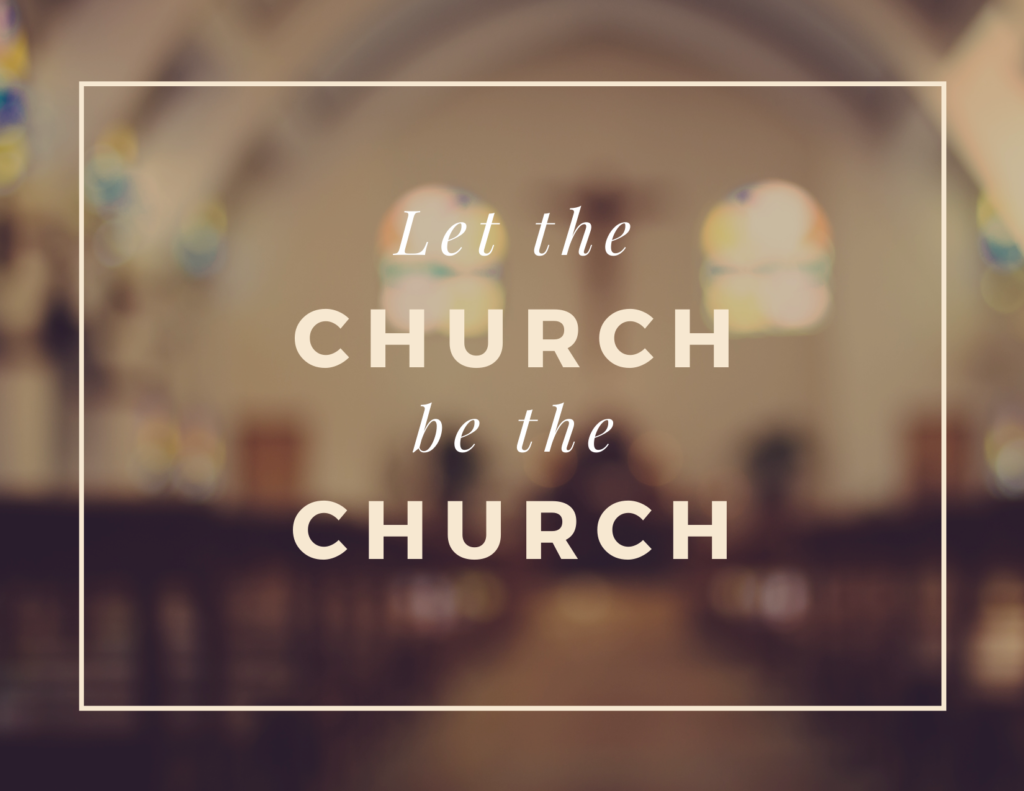
Now, we are taking a step back from these specific and targeted messages and launching a new national campaign simply asking our provincial representatives to Let the Church be the Church.
The aim of this campaign is to communicate not only the essential nature of in-person worship, but also, the Church’s desire to remain faithful in her call to acts of mercy, hospitality, visiting the sick, and caring for widows. The church longs to be the church, in word and in deed. Significant limitations on worship services may be necessary and prudent to prevent the transmission of COVID-19, but the authority to enact such limitations on Christian worship primarily belongs to local church governments.
In this, Let the Church be the Church campaign, we are encouraging you to send postcards to your local governing officials. You can get them in three ways:
- Fill out this order form and tell us how many you would like. We’ll mail them to you or drop them off at your house as soon as possible.
- Email your local provincial manager. Contact Levi Minderhoud in British Columbia, Ed Hoogerdyk in Alberta, Ryan Mans in Ontario, or Colin Postma for elsewhere in Canada.
- Print off a copy of the postcard using your own printer. You can download the postcard template by clicking here.
The front of the postcard conveys the main message that governments are to “let the Church be the Church.” On the back, you can write a short message explaining how you think the government should do this in your community. As noted above, the message doesn’t have to just be about worship services. In our Fall Tour, we outlined many activities that God calls the Church to perform that are being curtailed during this pandemic. Here are some suggestions for you:
- Recognize the authority of local church governments over worship services. Allow local churches to decide how to best balance their duty to worship corporately with their duty to protect their members and their neighbours from harm.
- Allow Christians to fulfill their calling to care for the sick, the aged, and the vulnerable.
- Prioritize religious services and activities when crafting provincial and local reopening plans.
Although you may have some frustration about how your provincial leaders have handled restrictions, it is very important to ensure that you convey your message with humility and respect. Include encouragement, sympathy for the challenges presented by the pandemic, and/or a promise to pray for their work.
Once you’ve written your short message, address your postcard. Your name and address go in the top left corner and the name and address of your local government official go on the right side.
You don’t have to stop at writing a letter to your MLA or MPP. Consider sending one to your neighbouring MLAs or MPPs, your premier, your health minister, your public safety minister, your provincial health officer, your local health authorities, or even your police chief. All our politicians, public health officials, and law enforcement officials would benefit from this reminder to let the church be the church.
You flooded the offices of our MPs with pink envelopes in support of C-233 and the protection of pre-born girls from sex-selective abortion. Let’s do the same with these postcards!
*Unlike letters to our federal MPs, mail to our provincial or local authorities DO require postage, so don’t forget to add a stamp in the top right corner.
In a disappointing ruling released last night, the Chief Justice of the Supreme Court of British Columbia upheld the prohibition of in-person worship services. These restrictions were first implemented on November 19th, 2020, and continue to this day.
Many Christians will be very disappointed, perhaps even angry, with this decision. Reformed Christians have an earnest, deeply-held belief that they must both respect the governing authorities and gather regularly to worship with other believers. The absolute prohibition of in-person worship services placed many Christians in an unfair dilemma, making it very difficult to balance both of these convictions. This decision perpetuates the tension between obeying the government and obeying the requirements of one’s faith.
The churches at the centre of this case argued that these restrictions infringed their freedom of religion, freedom of expression, freedom of assembly, and freedom of association – all four of the Charter’s fundamental freedoms. Chief Justice Hinkson agreed that all four fundamental freedoms were infringed yet decided that these infringements were reasonable given the circumstances. He ruled that these infringements are reasonable and justifiable in “a free and democratic society” (s. 1 of the Charter).
We can be thankful that the Chief Justice recognized the profound impact these absolute prohibitions have on religious communities. But we should also be gravely concerned that he does not seem to have an appreciation for how central gathered worship is to Christians. In the judgement, Chief Justice Hinkson suggests that because both secular and religious schools can gather, that the current restrictions do not disadvantage those with religious beliefs. But this fails to appreciate the centrality of gathered worship to Christian communities. It is small comfort for a child to be able to gather with other Christians for the purpose of learning at school, but not to gather for the purpose of worship at church.
While administrative decision-makers like Public Health Officers do require a level of deference due to their expertise, Charter rights cannot be ignored even in a pandemic. The government is still obligated to consider and respect the rights and freedoms of its citizens when crafting laws and regulations.
Unfortunately, this decision risks entrenching unfair treatment against minority religious communities. The provincial leaders of British Columbia prohibit in-person worship services while they continued to permit in-person activities at bars, restaurants, gyms, and most other businesses. Constitutionally protected activities – such as practicing one’s religion at a corporate worship service – are disallowed, while trivial activities – purchasing a pair of socks at any big box store – are permitted. This decision entrenches unfair treatment against religious activities.
ARPA Canada had the opportunity to intervene in the case, zeroing in on how the COVID-19 restrictions unfairly and unequally impacted churches. Chief Justice Hinkson interacted with ARPA’s arguments on a number of occasions and accepted a number of ARPA’s legal propositions. For example, he does recognize that the government’s authority over religious communities is not absolute, a point that ARPA raised in its submissions. In paragraph 200, Hinkson states, “Religious bodies have a sphere of independent spiritual authority, at the core of which is the authority to determine their own membership, doctrines, and religious practices, including the manner of worship.” This admission from the court is worth celebrating.
An important element of the reasonableness test for justifying Charter rights infringements is the minimal impairment test. That is, if the government is going to infringe our fundamental freedoms, they must choose a way that impairs the right minimally. When every other province – and even British Columbia for the first half of the pandemic – seems able to accommodate worship services at some capacity, whether a cap of 100 people or a percentage of a building, we feel that the absolute prohibition in British Columbia cannot be minimally impairing. This might be an issue to bring to the Court of Appeal for clarification. If the PHO can allow other gatherings to resume with enhanced safety protocols and enforcement, we do not think it is constitutionally justifiable to refuse the same treatment to worship services but simply to continue an absolute ban with respect to them.
Despite this decision, this issue lives on. The churches that initiated the case have the right to appeal the decision to the BC Court of Appeal. Even if the case is not successfully appealed, a collection of Canadian Reformed Churches and the Catholic Archdiocese of Vancouver have also filed their own judicial reviews on the Public Health Officer’s denial of their request for reasonably accommodate in-person worship services in their fact-specific cases.
Christians across the province should continue to call for Dr. Bonnie Henry to repeal or relax these restrictions on in-person worship services. Religious convictions and practices can’t be discarded because they are inconvenient, carry some degree of risk, are not considered as valuable as ‘economic’ or ‘educational’ activities, or are not universally practiced by all British Columbians. They are fundamental to the people of faith who practice them. That is why they are enshrined as fundamental freedoms in the constitution. Christians should continue to abide by reasonable health protocols to help prevent the spread of the virus, but the freedom to act upon their religious convictions must be recognized by the government.
Last week, the BC Supreme Court spent four days (March 1-3, 5) hearing the case of Beaudoin v. BC, where three BC churches are challenging the Provincial Health Order prohibiting in-person worship services.
The case was heard by Chief Justice Hinkson, the Chief Justice of the BC Supreme Court, and now we await his decision. The Chief Justice had rejected an injunction request from the government in mid-February when the province tried to force the closure of churches that continued to hold in-person worship services contrary to the public health orders.
The Churches’ Case
The lawyer arguing on behalf of the three churches – Paul Jaffe – had the first opportunity to make his case. He emphasized points that Christians (including ARPA Canada) have made repeatedly in the past months:
- It is inconsistent and arbitrary for the government to allow schools to function, businesses to remain open, gyms to operate, and people to congregate at the bar to watch a hockey game, but not allow masked, physically distant individuals and families to gather for worship.
- The orders are overly broad; the government doesn’t need to completely shut down in-person worship services to accomplish its objective of reducing the spread of COVID-19.
- The orders infringe on several Charter rights: the freedom of religion (Charter section 2(a)), the freedom of expression (section 2(b)), the freedom of peaceful assembly (section 2(c)), the freedom of association (section 2(d)), the right to liberty (section 7), and the right to equal treatment under the law (section 15).
- The public health orders also demonstrate how Dr. Henry’s prioritization of values apply to all British Columbians, whether they share her priorities or not; she appears to value school, workouts, or shopping more highly than corporate worship.
ARPA’s Intervention
ARPA Canada is so thankful that the judge also granted ARPA leave to intervene, accepting our 20 pages of written legal argument (you can read them here) and twenty minutes of oral arguments, where we could present legal analysis on particular constitutional points from the perspective of the Reformed community. Geoffrey Trotter, the lawyer speaking on ARPA’s behalf, focused on how the importance of assembling together for worship is a central, deeply-held belief of Reformed Christians. He explained that there is no “magic number” of how many people must be present to fulfill the obligation to gather for worship, but that number certainly is more than zero. He also drove home the point that it is unfair to allow people to engage in a wide variety of activities, but not to attend an in-person worship service.
The Government’s Case
Then, the government’s lawyer stood up. His major argument was a procedural one. Since the churches involved in the case had been granted a so-called “section 43 variance” (to hold outdoor services with maximum 25 people, capped at one hour, with no singing, and with the wearing of masks while remaining physically distanced for the entire service), he argued that the churches could no longer challenge the health order. The only thing they could challenge was the reasonableness of this variance. He suggested the case had to be started all over again, specifically challenging just this variance.
In case Chief Justice Hinkson didn’t accept that argument, the government’s lawyer had a back-up argument. Although the government conceded that they did violate British Columbian Christians’ Charter section 2 fundamental freedoms of religion, expression, and peaceful assembly, he argued that these infringements were reasonable and justified under the circumstances (see section 1 of the Charter). The government lawyer argued that COVID-19, especially the new variants of the virus, posed a grave public health concern. Dr. Bonnie Henry weighed the risks of the virus spreading and the rights of people and judged that an absolute prohibition on in-person worship services was acceptable and necessary.
The Churches’ Reply
In response, Jaffe argued that the judge shouldn’t consider the variance granted to the churches because it was a strategic move to get the case thrown out. Originally, when faced with a number of churches that continued to meet, the government first refused to reconsider their orders, then sought an injunction to shut the churches down, and then, only once it was clear that a court case was imminent, gave a limited variance to the churches (an 11th-hour accommodation of sorts). Jaffe also pointed out that Dr. Henry gave a more generous variance to the Jewish community within a couple of days of asking for it, which was inconsistent and unfair.
In either case, applying for a variance of the health orders was a catch-22. If the churches did not apply for the variance, the government could claim that the churches hadn’t exhausted the internal appeal mechanism before going to court and they must apply for a variance before challenging the health orders. But if they did apply for and were granted a variance, even if it is substantially less of an accommodation than requested, the government could claim that they wouldn’t be able to challenge the health orders themselves anymore because the orders didn’t apply to them.
The Judge’s Comments
The comments and questions of Chief Justice Hinkson were encouraging. He does not consider the case a “battle of the experts” on COVID-19 and rightly considers second-guessing the medical opinion of Dr. Henry to be largely outside his area of expertise. His role is to review the health orders (or variances) to ensure that any infringements on rights and freedoms are “reasonable in a free and democratic society.” In particular, the chief justice voiced concern to the government lawyer that the apparent differential treatment of places of worship being absolutely prohibited from meeting compared to bars and pubs being open for strangers to drink and watch the hockey game together gave him serious concern.
As ARPA Canada’s lawyer Mr. Trotter explained, the judge, who does not necessarily have medical expertise, does not need to substitute his own view on what level of risk is tolerable in the circumstances. But he can just look to Dr. Henry’s choices to see what level of risk she says is tolerable and then insist under s. 15 of the Charter that she extends no less tolerance to risk created by religious gatherings.
Chief Justice Hinkson will take all the arguments into consideration as he crafts his decision in the coming weeks or months. He has a difficult task. We can be thankful that his experience and wisdom will be applied in this case. Continue to pray for this judge as he seeks to dispense justice from the bench.
How Does This Case (And Other Cases) Impact Other Churches?
This particular case (Beaudoin v. BC) involves three churches, plus several individuals, challenging the public health orders, but it is not the only such case in British Columbia. The Catholic Archdiocese of Vancouver and a number of Canadian Reformed Churches have also filed legal challenges of the worship service prohibitions. Although a judge has the power to strike down or modify the restrictions as they apply only to the petitioners before them (e.g. the three churches, Catholic churches, or Canadian Reformed Churches), it is also possible that the decision the judge issues will be general enough to benefit all churches in the province.
Depending on exactly how the judge crafts his ruling, the other two legal challenges may become moot. However, if Chief Justice Hinkson upholds the orders, then the other two legal petitions that have since been filed will give churches a second and third chance to challenge the reasonableness of the accommodations available within the orders. In any case, stay tuned for ARPA Canada’s commentary on the final ruling once it comes out.
Conclusion
Continue to pray for Chief Justice Hinkson as he deliberates on this case in the coming weeks, that he might appreciate the importance of gathering together for corporate worship and protect our freedom to peacefully, carefully, and reasonably assemble to worship God as we are directed to in His Word.
Those who follow ARPA Canada’s work will know that government-imposed COVID-19 restrictions have received a lot of attention from us over the last year. We expect this to continue into 2021 as we seek to intervene in a variety of court cases with a specific focus on the restrictions limiting or prohibiting in-person worship services.
Almost a year has passed since the first lockdowns in March of 2020, and Christians in most of the provinces in Canada are currently forbidden by their provincial government from taking part in corporate worship. Through all this, those entrusted with the office of leadership in churches have given countless hours to work through their obligations to honour our civil authorities, care for their flocks, love their neighbours, and obey Christ’s command to them to gather publicly to worship. We heartily thank these brothers for their service of love, respectfully urge our readers to pray for them regularly, and hope to be a blessing to them as they carry on their work through 2021.
As in all challenging circumstances, poor information and poor communication can lead to even more challenges and factions. We have been grateful to see the lengths to which many churches are going to understand the situation and to communicate with their members. In the same vein, we hope these questions and answers will help address concerns and questions that may arise as we go through 2021 amidst these challenges.
So why exactly is ARPA Canada advocating for in-person worship services while there is a pandemic going on?
Scripture commands corporate worship and the Reformed confessions and the Church Order attest to the same (e.g. Hebrews 10:24-25, 1 Cor 16:1-2, Col 3:16, Acts 2:1, Acts 4:31, Belgic Confession Art. 28 and 29, Heidelberg Catechism Lord’s Day 38, Westminster Confession 21.1, Church Order Art. 52). Gathering with the body of Christ to hear God’s Word proclaimed, pray, sing, take part in the sacraments, and give to those in need must be a regular part of our lives and is critical for the spiritual, emotional, and physical health of Christians (and for the entire nation!) (e.g. Luke 22:14-20, 1 Cor 11:6, Belgic Confession Art. 33, 35). The highest law of Canada (our constitution), guarantees the fundamental freedoms of religion and peaceful assembly. It shouldn’t be a surprise that Christians would stand up for these most basic freedoms and the responsibilities that come with them.
Churches understand that this requirement for corporate worship comes alongside a duty to love and to protect life. When COVID-19 first hit Canada, we are not aware of one Reformed church that did not voluntarily suspend or drastically restrict their corporate worship services days before they were ordered to by the civil government. Close to a year has passed and our understanding of the virus is far greater than it was. The actions of the civil government make it very clear that COVID-19 is a concern to be aware of, but not something that should stop students from attending schools, children from going to daycare, the public from accessing marijuana and alcohol, and a host of other activities (in BC the public can go to almost any establishment except a church).
To add to all of this, the evidence is clear that churches do not disproportionately cause the spread of COVID-19 and have been very willing to take great precautions to ensure the safety of all those attending corporate worship services. The duty of citizens is to respectfully communicate with the civil government so that it properly understands the need for corporate worship. Especially in this secular age, we can’t expect the civil government to understand this on its own.
What legal actions are Reformed churches taking in response to the government restrictions on worship services?
Churches have responded in a variety of ways depending on the province they are in and the circumstances in their local community. Each province has taken a different approach to corporate worship.
BC decided to shut down all in-person worship services on November 19th, while allowing stores, bars and restaurants, art galleries, swimming pools and gyms, hockey clubs, and almost every other public establishment to stay open. Since then, some Reformed churches have been convicted that, in this context, they are called by God to resume worship services. Some of these churches are facing heavy fines and are working with the Justice Centre for Constitutional Freedoms (JCCF) to challenge the restrictions and fines in court. At the same time, a different group of Reformed churches has been abiding by the public health orders to date but have retained legal help and have approached the provincial government seeking a variance to the order. The BC government has not responded by the deadline so these churches are proceeding with a judicial review. (A judicial review is simply an action on the part of a citizen or group of citizens asking the judiciary to determine if the actions and decisions of the other branch of government – in this case, the executive branch – are legally and constitutionally justified.)
In Alberta, the situation is much different, as churches have been able to meet for worship with a capacity limit set at a percentage of building capacity (from 50 to 30 to 15 percent). The provincial government there has given clear direction about how the restrictions will be lifted as hospitalization rates decrease.
Manitoba’s government closed down in-person worship similarly to BC’s government, but applied those restrictions much more evenly across most public establishments. To date, Reformed churches there have not taken legal action that we are aware of, though a different group of churches is working with the JCCF in a significant case that challenges many of the government restrictions on COVID-19.
In Ontario, after an initial three-month restriction on corporate worship, in-person worship services were permitted with 30% building capacity until Christmas Day. The next day, Ontario imposed a 10-person limit on corporate worship, anywhere in the province. Earlier in 2020, the Wellandport United Reformed Church began organizing a court challenge of the restrictions on in-person services. The initiating documents for that judicial review have now been filed.
Why can’t Christians agree on the right course of action (either just submit to the government till the pandemic is over, or do the right thing by meeting as we are called to by Christ)?
Using an illustration outside of the COVID-19 context, André Schutten, our Director of Law and Policy, is writing a helpful article that explains why Christians can reasonably come to different conclusions about what it means to be faithful. You will find that published on our website soon.
What is ARPA Canada’s role in all of this?
We believe it is the responsibility of the church office-bearers to determine how to respond to the government-imposed restrictions since God has given them their office (e.g. 1 Tim 5:17, Titus 1:7, 1 Peter 5:1-2). ARPA Canada has not been given authority from God to make decisions for churches. As an organization that seeks to be a blessing to the church, we do not want to interfere in this responsibility. Failing to respect our place could result in driving a wedge between members of a church and their God-given authorities. It is possible that circumstances change such that, similar to Bill C-6 (criminalizing conversion therapy), we are convicted that there is only one faithful response. But that is not the case today.
That said, we will continue to do what we can to help churches in their challenging task. Like we have done in 2020, we will continue to facilitate communication with government officials, provide legal advice when possible (including legal opinions on the constitutionality or legality of certain restrictions), help connect churches with other churches or legal experts, publish helpful analysis from a public policy perspective, and also intervene in relevant court cases.
Why is ARPA Canada getting involved with court cases about restoring in-person worship services, especially cases where the churches going to court aren’t complying with public health orders (like the JCCF’s BC challenge)?
ARPA Canada has intervened in more than a dozen court cases. At the centre of some of these cases were people and organizations that were doing or teaching things that some Reformed Christians would not want to align ourselves with (the shunning practices of Jehovah’s Witnesses in the Wall case on church discipline, or the antics of Bill Whatcott in the Whatcott case on freedom of expression, for example). Yet we intervened in those cases to advance principles in law that are critical for the wellbeing of our nation and the protection of the ministry of the church.
Regardless of what individual Christians conclude about whether we can defy public health orders that prevent Christians from corporate worship at all, we ought to all agree that the principle of corporate worship (freedom of religion and peaceful assembly) is one that needs to be protected in law and carefully guarded. The civil government can reasonably limit these fundamental freedoms, but the justificatory standard for such limits is and must be high.
In these court cases, the judiciary is examining the principle of the importance of corporate worship. Our mission includes bringing a biblical perspective to our civil governments. In other words, our intervention in this kind of case is exactly what we exist for.
The civil government has an immense responsibility and ought to be shown honour, respect, obedience, and patience (see Romans 13 and Belgic Confession Art. 36). But it is also important to recognize that the opinion or decision of a particular government official does not necessarily represent the final authority of the civil government. The civil government is made up of multiple levels and branches and is itself bound by a higher law – the constitution. We are blessed with a constitution because history has shown us that unchecked and coercive power in a fallen world is dangerous. It is possible that when a government official makes an edict, that official is the one acting illegally (contrary to the constitution). The judiciary exists in part to ensure there is an independent check on the power of government officials.
The civil government must – as the constitution requires – demonstrably justify their restrictions. The place for that analysis to take place is in the courts. Thank God for the separation of powers between the judiciary, the executive, and the legislature! This separation of powers and this legal mechanism for examining and challenging laws is a gift from God leading to ordered liberty.
It is completely appropriate for churches to appeal to the judicial branch of the civil government when it believes an order or action from the legislative and executive branch of civil government may not be justified. “Taking the government to court” is not insubordination or disrespectful (or all that accurate, since “the court” is just one branch of the government). On the contrary, it shows respect for the structure of the civil government, which is divided into multiple parts in recognition of human depravity and the need for checks and balances.
At the same time, the civil government has not been given unilateral authority to direct everyone simply because they desire to. God has given it a specific role and task, which is limited in jurisdiction. God has also given authority to other institutions to make decisions about many aspects of life. Sometimes these jurisdictions overlap. When that is the case, the institutions have a moral obligation to communicate respectfully to partner spheres, rather than dictate to them. For example, it is inappropriate for the civil government to “give permission” to churches to meet virtually since Christ gives authority to the church to call people to worship.
In ARPA Canada’s attempts to intervene in cases around this matter, we will clarify to the court that we do not counsel or direct churches in regard to whether to comply with public health orders. Christ has given the authority to the church leadership to make that decision. Our interest in the case is to advance the principles that we have stood behind since the founding of ARPA Canada.
What is a legal intervention, what is it for, and what does it accomplish?
We should first make clear what exactly an intervention is and what it is not.
Each legal case has two parties who are going to court in order to resolve a dispute. An intervener does not take the side of one of the parties, but rather comes as a “friend of the court.”
The reason why some interveners (like ARPA) are granted intervener status is that in some court cases (usually constitutional cases), the outcome will impact more people than just the two parties involved. In those cases, a court may grant permission to others to contribute legal arguments and perspectives to assist the court as it wrestles with these complex issues.
An intervener gives the court the advantage of a perspective and arguments other than those of the parties. Interveners are given strict limits of what they may or may not contribute (for example, they cannot raise new legal issues, and they usually cannot introduce evidence). Intervenors can (and are encouraged to) communicate with the parties, but they remain independent. This means that an intervener cannot control which arguments are advanced, or which legal strategy the two parties employ in the case.
When ARPA Canada intervenes in a court case, we do so to fulfill our mission of bringing a “biblical perspective to our civil governments.” We do so in line with our core principles (usually intervening in cases pertaining to life, freedom, family, etc.) The purpose of intervening is to be a blessing to the court by helping it to understand the issues at hand from our limited and particular perspective and to try to ensure that, as the law develops through a particular case, it does so in a way that accommodates our religious and philosophical commitments as much as possible.
Intervening in a case does not necessarily imply support or opposition for one of the parties in the case. For example, if a church that has not complied with government orders is fined and appeals the fine to a court, ARPA Canada’s intervention in the case is done without taking sides between the church and the civil government. Instead, ARPA Canada’s role would be to help the court understand a particular angle or perspective that is in line with our core principles.
ARPA Canada urges our readers to pray fervently for our leadership, in church and state, to recognize their calling from the LORD and to seek to fulfill it faithfully, in a spirit of love and peace.
A petition filed by the Justice Centre for Constitutional Freedoms on behalf of a variety of individuals challenges the British Columbian Public Health Orders that prohibit all in-person worship services. The names of the petitioners are not published to avoid undue attention, but it includes several pastors of churches currently gathering despite the restrictions. The petitioners are asking the Court for a declaration that the Orders forbidding gathering for worship are an unjustifiable infringement of Charter guaranteed freedoms and therefore should be set aside. There are also eight separate $2,300 tickets issued for disobeying the Orders that the petitioners request to be dismissed.
This petition is the first step in what will likely be a lengthy legal process during which the BC Court will hear the petitioners’ claims and the government’s justification before determining the constitutionality of the various health orders.
Understand One Another
The petition, which you can read more about here, only includes an overview of the testimonies from the petitioners, as well as a summary of the applicable law. When the Court hears this case, lawyers will go into more detail about what happened and how the laws should apply. But even from this summary petition, you can learn about those who are a part of this case.
We are seeing across the country, even among Reformed churches, a diversity of opinions on whether we should or should not gather for worship during these Covid-19 restrictions. ARPA Canada believes it is up to the leadership of individual churches to make decisions about whether to gather for worship. You may or may not agree with the wisdom or the Biblical warrant for the decisions made by the individuals bringing this case forward, but we think it is worth considering this petition as an opportunity to understand our brothers and sisters. In that vein, here are some themes that emerge from these churches’ testimony that will come before the court:
- The pastors express a desire to submit to God’s command to gather in worship.
- These pastors repeatedly indicate their concern for the harms of not gathering for corporate worship. They mention the loneliness, depression, anxiety, and fear of the members. One pastor expressed concern especially for the most vulnerable as gathering is essential for the church to identify the needs of the congregation.
- Several of these churches suspended gathering for worship in March. Noting the unknown nature of Covid-19 at that time, these churches chose to be cautious and not gather.
- After a period of time, they began to gather again, submitting to the BC restrictions of having no more than 50 people.
- All the churches have rigorous Covid-19 protocols that they have maintained since they resumed gathering. This includes social distancing, contact tracing, better air circulation, enhanced cleaning, suspension of nursery and coffee hours, etc.
- One pastor testifies that there has not been a single case of Covid-19 among the members in over 6 months of meetings. This is consistent with what we have seen across BC. Churches have not been a source of spread.
This is a particularly challenging time for the church as we navigate Covid-19 restrictions in our daily lives while physically separate from many in our church families. Restrictions on corporate worship have led to diverse opinions among both individuals and congregations. Let’s take the time to pray for one another, seek to understand one another, and engage charitably with one another. Pray also that our government would have soft hearts toward those who view physical gathering for worship as essential, and that we all might be able to gather peacefully for worship very soon.
Calgary and conversion therapy, charges dropped against Toronto Pastor David Lynn, and churches calling on provincial premiers to remember them when reopening!
Join ARPA Canada’s Director of Law & Policy, in conversation with philosopher and theologian Rev. Dr. Joe Boot and legal scholar and executive director of the Christian Legal Fellowship Derek Ross, in conversation about the impacts of government regulations on fundamental freedoms and how we can evaluate that through a lens of sphere sovereignty.