Add New Post

Conversations about conversion therapy are back on Parliament Hill. And, no, they’re not talking about repealing or amending Canada’s deeply flawed conversion therapy ban. Instead, they’re doubling down.

On January 7, 2022, Parliament passed Bill C-4. This bill expanded the “hate propaganda” section of Canada’s Criminal Code to ban conversion therapy. As we discussed many times in connection with Bill C-4, the definition of conversion therapy was left wildly broad, banning any practice, treatment, or service designed to change an individual’s sexual orientation to heterosexual, to change an individual’s gender identity to cisgender, or to change an individual’s gender expression so that it corresponds to the sex assigned to them at birth.

In one fell swoop, this legislation forbade the Christian perspective on sexual orientation, gender identity, and gender expression from being applied in medicine or psychiatry. Counselling to deal with unwanted same-sex attraction? Banned. Addressing gender dysphoria by suggesting that a person embrace the body they have? Illegal. Retreats for transgender youth about biblical masculinity and femininity? Forbidden.

André Schutten, ARPA’s Director of Law & Policy at that time, pointed out that this law actually discriminates against “LGBTQ+ Canadians as well as those questioning their gender identity…It [denies] them the broad range of choices for counselling and spiritual support that are freely available to all other Canadians.”

But the advocates of the LGBTQ+ cause haven’t stopped. On June 13, 2024, MP Mark Gerretsen introduced Bill C-404, An Act to establish National Conversion Therapy Awareness Day, so that the anniversary of the passage of the conversion therapy law – January 7 – would be dedicated to reminiscing about “the harms caused by conversion therapy.” Bill C-404 is a private member’s bill and such PMBs don’t usually become law.  But given the inordinate amount of attention given by the Liberal and NDP parties to LGBTQ+ issues (and the fact that the conversion therapy ban passed unanimously two and a half years ago), this bill might very well make it all the way through. So reach out to your MP and let them know that you oppose efforts to create a National Conversion Therapy Awareness Day and encourage them to vote against C-404.

ABOUT

The Government of Canada has now passed a conversion therapy ban that may have far-reaching implications for church leaders, teachers, and parents. In order to prepare the Church to faithfully navigate these conversion therapy bans, ARPA Canada and Free to Care are (co-)hosting an event in Regina, Saskatchewan. The format for this weekend conference is outlined below.

Part 1

Information Evenings

The information session on Friday evening is designed for any Christians, their friends, and their neighbours who are interested in understanding the issue of conversion therapy and how poorly drafted legal bans have negative effects not only on the Christian and broader community but also on our LGBTQ neighbours. Doors open at 7:00 PM and the presentations begin at 7:30 sharp. Everyone welcome!

Please register for one of the Friday evening session below:

Part 2

PRACTICAL WORKSHOPS & BREAKOUT SESSIONS

The practical training Saturday session is tailored to (but not exclusively for) church office bearers, pastors, ministry leaders, and teachers building off of the Friday evening information evening. They seek to:

  • Assist elders and pastors to respond well to church members’ questions about sexual ethics and/or identity
  • Help elders and pastors speak about issues of sexual ethics and personal identity in ways that are biblically sound and that are aware of political and legal sensitivities
  • Provide advice for pastors regarding the manner in which they can address sensitive issues in their sermons
  • Help churches formulate / develop / adapt church policies

This session begins at 8:00 AM sharp, and we hope to wrap up by noon.

Please register for the Saturday session below. Please note, if you hope to join us for the Saturday session, we highly recommend that you attend a Friday session as well.

Each event will feature André Schutten, legal counsel and the director of law & policy with ARPA Canada, and Jojo Ruba, the executive director of Free to Care. Each event will be moderated by Ed Hoogerdyk the provincial manager in Alberta.

The Government of Canada has now passed a conversion therapy ban that may have far-reaching implications for church leaders, teachers, and parents. In order to prepare the Church to faithfully navigate these conversion therapy bans, ARPA Canada and Free to Care are (co-)hosting an event in Winnipeg, Manitoba. The format for this weekend conference is outlined below.

Part 1: Information Evenings

The information session on Friday evening is designed for any Christians, their friends, and their neighbours who are interested in understanding the issue of conversion therapy and how poorly drafted legal bans have negative effects not only on the Christian and broader community but also on our LGBTQ neighbours. Doors open at 7:00 PM and the presentations begin at 7:30 sharp. Everyone welcome!

Please register for one of the Friday evening session below:

Part 2: Practical Workshops & Breakout Sessions

The practical training Saturday session is tailored to (but not exclusively for) church office bearers, pastors, ministry leaders, and teachers building off of the Friday evening information evening. They seek to:

This session begins at 8:00 AM sharp, and we hope to wrap up by noon.

Please register for the Saturday session below. Please note, if you hope to join us for the Saturday session, we highly recommend that you attend a Friday session as well.

Each event will feature André Schutten, legal counsel and the director of law & policy with ARPA Canada, and Jojo Ruba, the executive director of Free to Care. Each event will be moderated by Ed Hoogerdyk the provincial manager in Alberta.

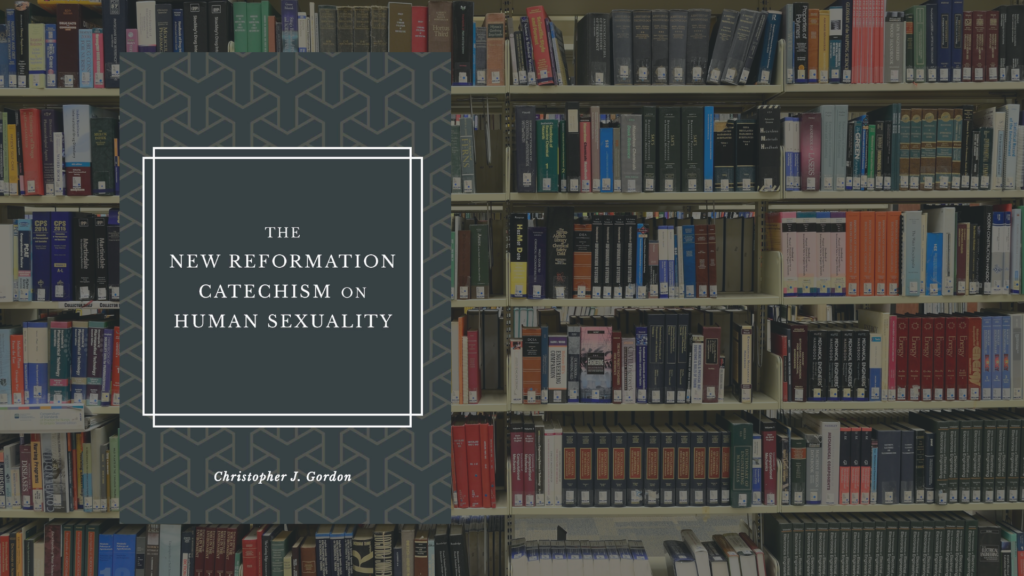
I am so grateful for the publication of The New Reformation Catechism on Human Sexuality (2022, 31 pages), penned by Christopher Gordon and vetted by many Reformed and Presbyterian pastors and theologians. I had the pleasure of reading an advance copy and am thrilled that this will soon be available as a resource for English-speaking Christians. The language used in this new catechism – a teaching resource in a Question and Answer format – will be familiar to anyone who cherishes the Heidelberg Catechism because the author has taken pains to use familiar phrases and motifs from the Heidelberg in this new work. (See the two samples I have included at the end of this article.) The extensive biblical notations are very helpful, demonstrating a solid grounding in the truths of God’s Word. And, from what I can tell, the answers to the questions presented are thoroughly and unapologetically Biblical, straightforward, and clearly communicated.

In my work with ARPA Canada, I have travelled the country over the past year and a half, presenting to hundreds of church leaders on the issue of conversion therapy and the religious battle of our day between the gnostic and pagan humanist’s view of human sexuality and identity (the dominant view of our culture and government today) on the one hand and the Christian and biblical view of sexuality and identity on the other hand. I have been asked many times whether it was time for a new, additional catechism or confessional document to address the contentious religious questions of our day. To those who ask these questions, I wholeheartedly recommend this book as a resource that fits the bill.

My unsolicited advice is that every church should purchase and distribute copies of this catechism to every family who sits in their pews and, more importantly, take the time to teach through it. The men and women, teenagers, boys and girls in our pews are being daily catechized by the dominant institutions of our society to accept wholly or in part the pagan or gnostic view of human sexuality and identity. It is a destructive theology. Our historic confessions do not grapple with this religious debate in sufficient measure (and understandably so – the challenges of our day were not theologically pressing or controversial at the time of the Reformation). We can benefit from new resources that equip us to know and understand what God teaches about who we are and how we should live, and why His way is good, true, and beautiful.

Some Reformed Christians might be uneasy with the idea of a single person writing a catechism like this, preferring instead a document vetted by a larger group of churches (a federation or denomination). But to that, I point out that two of the three confessional documents of Reformed Churches were written by only one or two men (the Belgic Confession by Guido de Brès, and the Heidelberg Catechism by Zacharias Ursinus, with the help of Caspar Olevianus). While broader assemblies and synods deliberated over making these catechisms or confessional statements theological standards, these broader assemblies did not commission the original drafts. So, in the case of this new resource, we have a theologically astute pastor drafting a much-needed resource for the church to clarify a theological assault on Christian teaching, helped and advised along the way by a large group of theologians. The end product will be a blessing to any church that picks it up. Whether this catechism should rise to the level of a confessional standard is another matter.

If I can be picky, my only concern with the document is its name. I find it unfortunate that it includes the word “new” in it. I believe this catechism can and will be an enduring resource, and I hope that 50 and 100 and 500 years from now, Christians will turn to this catechism or other ones like it as an old, but accurate and true and lovely, Catechism on Human Sexuality. Nevertheless, this should not make you hesitate to pick up your copy as soon as you can. Here’s a link where you can read Rosaria Butterfield’s foreword to the New Reformation Catechism on Human Sexuality, and this is a link to where the book can be purchased.

Here’s a sample:

1. Q.  Why is it comforting that we have a new identity in Jesus Christ?
A. I am being remade into the image of Christ, 
to have a true identity—1
in body and soul,
throughout the whole course of my life,
to enjoy God and glorify him forever.2
 
He redeemed my life with the precious blood of his Son,3
and has delivered me from the lie of Satan in the Garden.4
He also watches over me in such a way
that he might free me from all sexual impurity
as the temple of his indwelling;5
in fact, all things must work together
to remake me into the image of his Son.6

Because I have this new identity,7
Christ, by his Holy Spirit, 
also assures me of God’s steadfast love,8
and makes me wholeheartedly willing and ready
from now on to enjoy true freedom as a new creation.9

1 Gen. 1:26-27; Rom. 8:29; 2 Cor. 3:18; Col. 3:10
2 Ps. 146; 1 Cor. 10:31
3 1 Pet. 1:18-19; 1 John 1:7-9; 2:2
4 Gen. 3:4-5; John 8:34-36; Heb. 2:14-15; 1 John 3:1-11
5 1 Cor. 3:16; 1 Cor. 6:15-20
6 Rom. 8:29; 2 Cor. 3:18
7 2 Cor. 5:17
8 Ps. 103:8-10; John 16:25-27

9 John 8:32; Gal. 5:13

34. Q. What is involved in genuine repentance of all sexual sin?
A. Two things:

The dying-away of the old self,
by hating all forms of sexual immorality
and fleeing from it;1

And the rising-to-life of the new self,
by finding great joy in leading a sexually pure life
and, if married, by properly loving our spouses.2

1 2 Cor. 5:17; Eph. 4:22-24; Col. 3:5-10; 1 Cor. 6:15-20
2 Ps. 51:8, 12; Isa. 57:15; Rom. 6:1-11; Eph. 5:22-33

André Schutten is the Director of Law and Public Policy for ARPA Canada

Any time there is an election, there is an opportunity to speak up for issues that matter.

While two major federal political parties have had stable leadership for several years now (Justin Trudeau became the leader of the Liberals in 2013 and Jagmeet Singh became the leader of the NDP in 2017), the federal Conservative Party is starting its third leadership race in the past five years. To date, Pierre Poilievre, Leslyn Lewis, Jean Charest, Roman Baber, Scott Aitchison, Patrick Brown, Marc Dalton, and Leona Alleslev have all been approved as candidates, although several other people have declared their intention to run.

Although ARPA Canada does not endorse any political parties or specific candidates, we strongly encourage Christians to become involved in leadership races for the opportunity they provide to raise critical issues for discussion. Given the current political climate, we’re focusing on three issues at the federal level right now: conversion therapy bans, euthanasia, and hate speech.

Why Conversion Therapy Bans?

Late last year, the Parliament of Canada passed Bill C-4, which criminalized conversion therapy. This ban on conversion therapy featured an overly broad definition that may include Christian counselling and conversations about a biblical understanding of gender and sexuality. Although many Members of Parliament opposed previous iterations of this bill, Bill C-4 passed unanimously in December. This unanimous passage was unexpectedly proposed by the Conservative official opposition. We are hoping that this leadership race will provide some clarity around the Conservative party’s stance on conversion therapy as well as the stance of individual candidates on this issue.

Why Euthanasia?

The Parliament of Canada also passed Bill C-7 last year, a bill that expanded access to euthanasia. The immediate expansion significantly reduced safeguards and the bill also determined that people with a mental illness would be eligible for euthanasia as of March 2023, unless Parliament adjusts the law before then. Additionally, the Interparliamentary Committee on MAiD has been reconvened yet again to examine Canada’s euthanasia law. The new leader of the Conservative party will likely influence the position of the Conservative members on that committee. The expansion of medically assisted death is a huge concern for Christians and for many groups advocating on behalf of people with disabilities or mental illnesses. We hope that all the Conservative leadership candidates give this issue the attention that it deserves and specifically take a stand against the expansion of euthanasia to those with mental illness.

Why Free Speech/Hate Speech?

Finally, the current government has introduced Bill C-11, a bill that increases the government’s ability to curtail freedom of expression on the internet, and has promised to re-introduce a provision forbidding hate speech in the human rights code. While the Bible does not support unfettered free speech (e.g. commands against blasphemy, false witness, slander, or gossip), these restrictions of free speech may very well forbid the expression of the truth, or at least limit the acceptable bounds of debate on key moral, political, and policy issues.

How Can We Be Involved?

As all the Conservative leadership candidates tour the country and host in-person or virtual events, we encourage you all to raise these three issues. Quickly brief yourself on the issues using our One-Pagers below, attend the candidates’ meetings, and respectfully ask the candidates about their position on these issues. The more that these candidates realize that these three issues are of great concern to the people they seek to represent, the more they will be required to grapple with and respond to these issues.

What About Other Issues?

Of course, there are many more issues of importance that you might want to know a candidate’s stance on! Put some thought into what key issues the Bible speaks to and what questions you might want to be answered by the candidates.

What’s the Timeline?

The leadership candidates will be crisscrossing the country over the next several months, endeavouring to sell memberships to citizens and asking for their vote. The deadline for potential candidates to enter the leadership race was April 19th and the verified list of candidates will be released on April 29th.  Those who wish to vote in this Conservative leadership race must become members of the party by June 3rd. Voting will occur late in the summer, with the winner announced on September 10th.

What About the Other Parties?

As mentioned above, only the Conservative party is in the midst of a leadership race. However, these issues are not just ones that the Conservative party needs to wrestle with. All political parties must as well. We encourage supporters of other parties to pose these questions to the leaders of their own political parties, whether that leader is Justin Trudeau, Jagmeet Singh, Yves-François Blanchet, or Maxime Bernier. The Green Party is also without a permanent leader at this stage. An upcoming Green party leadership race is also an opportunity for Christians – whether members of that party or not – to raise concerns about conversion therapy, euthanasia, and hate speech/free speech within that party as well.

After each federal election, the Prime Minister’s office releases Mandate Letters for each of the cabinet ministers. These letters explain the Prime Minister’s expectations for each member of his cabinet and lay out challenges and commitments that come with their role. At the same time, these letters are made publicly available so that Canadians can understand some of the priorities that the federal government will focus on over the next few years.

The ministers’ mandate letters were released on December 16, 2021. The basic template of each letter focuses on recovery from COVID-19, climate change, the rights of Indigenous Peoples, systemic inequity of minority groups within Canada, and general expectations for ministers. Many of the objectives and commitments in the letters are similar to what the government had promised prior to the election, so there are no major surprises. However, specific commitments are worth noting as we keep an eye on how they develop over the coming years.  

Charitable Status

In line with the Liberals’ election promise regarding charitable status for certain organizations, the Deputy Prime Minister and Minister of Finance has been tasked with the following: “Introduce amendments to the Income Tax Act to make anti-abortion organizations that provide dishonest counselling to pregnant women about their rights and options ineligible for charitable status.” It’s unclear how exactly the government would remove charitable status from pro-life organizations or how far that would extend. However, the possibility is very concerning, and ultimately the government needs to recognize the value and importance of organizations like pregnancy care centres.

Hate Speech

Before the summer break in 2021, the government had introduced both Bill C-10 and Bill C-36, which focused on hate speech and regulating online content. Although those bills died when the election was called, the Liberals are once again focused on regulating and limiting freedom of expression both online and in public. The Minister of Housing and Diversity and Inclusion was given the following task: “As part of a renewed Anti-Racism Strategy, lead work across government to develop a National Action Plan on Combatting Hate, including actions on combatting hate crimes in Canada, training and tools for public safety agencies, and investments to support digital literacy, to prevent radicalization to violence and to protect vulnerable communities.”

In addition, the Minister of Justice will “continue efforts with the Minister of Canadian Heritage to develop and introduce legislation as soon as possible to combat serious forms of harmful online content to protect Canadians and hold social media platforms and other online services accountable for the content they host, including by strengthening the Canadian Human Rights Act and the Criminal Code to more effectively combat online hate and reintroduce measures to strengthen hate speech provisions, including the re-enactment of the former Section 13 provision.” This seems to be a replication of what was previously Bill C-36. However, there is a possibility that this legislation will include positive components around combatting online pornography as well as more negative limits on freedom of expression. ARPA Canada’s analysis of last year’s Bill C-36 can be found here.

The Minister of Canadian Heritage is expected to “reintroduce legislation to reform the Broadcasting Act to ensure foreign web giants contribute to the creation and promotion of Canadian stories and music.” The previous version of this legislation, Bill C-10, also included the possibility of regulating social certain private social media content that was determined to be a ‘broadcast.’ Further information around Bill C-10 can be found here.

We will be keeping watch to see what exactly is included in this type of legislation if and when it is introduced.

Pre-born Children

The government often speaks of ‘sexual and reproductive health’ to refer to abortion access. The recent mandates encompass that, and also specifically include issues such as in vitro fertilization and surrogacy. The Minister of Health is mandated to: “work to ensure that all Canadians have access to the sexual and reproductive health services they need, no matter where they live, by reinforcing compliance under the Canada Health Act, developing a sexual and reproductive health rights information portal, supporting the establishment of mechanisms to help families cover the costs of in vitro fertilization, and supporting youth-led grassroots organizations that respond to the unique sexual and reproductive health needs of young people.” 

The Minister of Finance and the Minister for Women and Gender Equality and Youth are tasked with “expand[ing] the Medical Expense Tax Credit to include costs reimbursed to surrogate mothers for IVF expenses.”

One issue here is the clear plan to continue pressuring the province of New Brunswick to fund abortions in private clinics, something they are the only province not to do. More on that topic can be found here.

The focus on in vitro fertilization and surrogacy raises questions and concerns about how far these procedures might become commercialized in Canada. For further information on these issues, you can read ARPA Canada’s policy reports on both in vitro fertilization and surrogacy.

Gender and Sexuality

Regarding issues of gender and sexuality, the mandate letters only speak in broad terms, especially since Bill C-4, which banned so-called ‘conversion therapy’ was passed before the mandate letters were released. There is a lot of language around efforts to promote equality and remove discrimination for minority groups both in Canada and around the world.

The Minister of Justice is told to: “Build on the passage of Bill C-4, which criminalized conversion therapy, [and] continue to ensure that Canadian justice policy protects the dignity and equality of LGBTQ2 Canadians.”

The Minister for Women and Gender Equality and Youth is directed to “launch the Federal LGBTQ2 Action Plan and provide capacity funding to Canadian LGBTQ2 service organizations” and “continue the work of the LGBTQ2 Secretariat in promoting LGBTQ2 equality at home and abroad, protecting LGBTQ2 rights and addressing discrimination against LGBTQ2 communities, building on the passage of Bill C-4, which criminalized conversion therapy.”

It is hard to say what ‘building on the passage of Bill C-4’ looks like exactly because specifics are not provided. However, Bill C-4 is concerning on multiple levels, and building on it will likely follow in a similar vein.  Further information on Bill C-4 can be found here.

Child Care

Child care continues to be an issue the federal government is pushing. The Minister of Families, Children and Social Development is tasked with concluding negotiations with provinces that have not yet signed an agreement with the federal government (Ontario and New Brunswick), and ensuring that $10-a-day child care is available throughout Canada. They also plan to “introduc[e] federal child care legislation to strengthen and protect a high-quality Canada-wide child care system.”  You can read more about a Christian perspective on universal child care here.

Drug Use

The Minister of Mental Health and Addictions is tasked with advancing “a comprehensive strategy to address problematic substance use in Canada, supporting efforts to improve public education to reduce stigma, and supporting provinces and territories and working with Indigenous communities to provide access to a full range of evidence-based treatment and harm reduction, as well as to create standards for substance use treatment programs.”

This is not a new issue but there seems to be a new emphasis on it. Bill C-5, a reiteration of Bill C-22 from the previous Parliament, seeks to move increasingly towards treating substance abuse as a health issue instead of a criminal issue.

Conclusion

The issues presented here are priorities of the federal government, and they also raise various questions and concerns about what changes to legislation and regulations on these topics will look like. Stay tuned for further resources and action items as we see how these issues develop over the next few years.

In the wake of the unanimous passage of C-4 (conversion therapy) through the House of Commons and the Senate, a number of ARPA staff took to the keyboard and submitted letters to the editor decrying this development. Here’s what five staff had to say…

C-4 Blew Up

Published by Daniel Zekveld in the Ottawa Sun

C-4 is an apt bill number for the conversion therapy bill that blew up in the House of Commons and more recently in the Senate, leaving our democracy suffering as a result. Last I checked, democracy meant that we Canadians choose people to represent us. But, apparently, it makes no difference when it comes to conversion therapy, a bill that was controversial in the past session of Parliament and remains controversial among many Canadians today.

The reason we have opposition parties is to oppose government legislation. Even if it isn’t opposing the principle, opposition parties are supposed to improve legislation through the parliamentary process.

But this has all changed. Supposedly legislation can pass every step in the House of Commons within 48 hours with all-party unanimous consent, and likewise in the Senate. No need for debate. No need for improvement. No opposition. In fact, hardly enough time for constituents to provide input to their representatives. This is problematic in the context of Bill C-4, but also sets a dangerous precedent for other pieces of legislation.

Democracy in Canada briefly exploded over Bill C-4. That doesn’t mean it’s broken forever, but it’s time for our MPs and senators to seriously consider their roles in passing legislation for the good of all Canadians.

Many Canadians have reason to be concerned with the wording of Bill C-4, even if it contains some good. Does our government care anymore?

O’Toole’s Tories do not understand the role of the Opposition

Published by Mike Schouten in the Toronto Star

Did MPs shirk their responsibilities in this instance?

You bet they did.

In a speech to the Empire Club of Canada in 1949, one of the greatest Conservative leaders John Diefenbaker said this about the role of the Opposition: “If Parliament is to be preserved as a living institution, His Majesty’s Loyal Opposition must fearlessly perform its functions. When it properly discharges them the preservation of our freedom is assured. The reading of history proves that freedom always dies when criticism ends. … [The Opposition] finds fault; it suggests amendments; it asks questions and elicits information; it arouses, educates and moulds public opinion by voice and vote. It must scrutinize every action by the government and in doing so prevents the shortcuts through democratic procedure that governments like to make.”

Diefenbaker would consider his party’s passivity on Bill C-4 to be a dereliction of duty.

The fact that it was the Opposition who moved to pass this bill without scrutiny amplifies the neglect.

Parliamentary Procedure in Laypersonese

Submitted by Ed Hoogerdyk

So, on December 1, 2021, the Opposition presented this motion in the House of Commons:

That, notwithstanding any Standing Order or usual practices of the House, Bill C-4, an act to amend the Criminal Code (conversion therapy) be deemed to have been read a second time and referred to a Committee of the Whole, deemed considered in Committee of the Whole, deemed reported without amendment, deemed concurred in at the report stage and deemed read a third time and passed.

The masked members of the House passed the motion, hugged, shook hands, and danced.

In laypersonese the motion reads:

We have a great idea! Let’s forget that lawmaking is one of our most important responsibilities. It’s almost Christmas and we don’t want all this legislative stuff to take up most of our time. Think about it: no study, no debate, no work! So, let’s put democracy on hold, skip all this needless process hoopla, and just pretend that it all happened anyway! We say pass C-4 and dance on the floor!

Dear Canadians, isn’t this embarrassing? Let’s hope the Senate takes at least an extra half hour in their deliberations to make up for it, before body-affirming counseling becomes illegal for children, teens, and consenting adults who do not identify as heterosexual or cisgender.

A New Kind of Conversion Therapy

Submitted by Anna Nienhuis

Mere days into the new session of Parliament, all political parties collaborated to fast-track Bill C-4, a bill to ban conversion therapy. This move, instigated by the official opposition (many of whom voted against a similar bill earlier this year), eliminated any possibility of debate, study, amendments, or voting – basically all the steps we have a House of Commons and opposition party for.

Bill C-4 bans any practice that has a goal of changing someone’s sexual orientation from homosexual to heterosexual or gender identity from transgender to cisgender. It remains legal to counsel a cisgender or heterosexual individual to become transgender or homosexual, but it is illegal to try to persuade in the opposite direction.

Coercing or forcing people to change their sexual orientation or gender identity is wrong. But counseling those who wish to be comfortable and confident in their biological bodies should not be wrong. And subjecting those struggling with their gender identity to invasive and often irreversible treatments to change their God-given bodies should be wrong.

We are trading one type of conversion for another. Coercion, shaming, force, and silencing are not being eliminated, simply shifted to another group: those who believe in the biblical truth that God’s creation of male and female is a beautiful thing and that people should be helped to be comfortable in their bodies, regardless of whether their interests or personalities align with unnecessary gender stereotypes associated with their biology.

Bill C-4 effectively bans counselors from offering body-affirming counseling to LGBTQ2S+ children, teens, and adults seeking to address their gender dysphoria or unwanted sexual behaviours. It’s bad legislation, and our democratic system completely failed to make it better.

Conversion Therapy Bans Go Too Far

Submitted by Levi Minderhoud

It seems these days that everyone is opposed to conversion therapy. Almost every media article I’ve read on the topic defines conversion therapy something like this: “conversion therapy is a widely discredited and harmful practice that tries to change an individual’s sexual orientation or gender identity.” The House of Commons recently passed a bill – unanimously – that bans conversion therapy.

But even if you agree with the main thrust of these bans, this conversion therapy ban goes too far. We don’t ban people from trying to change other identities; Christians are free to evangelize to Sikhs and Liberals are free to convince New Democrats to change their political identities. Our identities often change naturally through life. Why should it be a criminal offence to try to persuade someone to change their sexual or gender identity?

Even more concerning is the fact that conversion therapy bans also prohibits conversations that try to change someone’s behaviour. Even if you think that aspects of your identity can’t change, surely it should be legitimate to try to influence someone’s behaviour? Canadians are free to try to convince their neighbour to mow their lawn more frequently, vote for the Green party, or get their COVID shot. Why should it be a criminal offence to try to persuade a friend not to look at gay pornography or a son not to wear a dress?

The most concerning part of conversion therapy bans is that it tries to criminalize not only outward actions but internal beliefs, the belief that one sexual orientation or gender identity is better than another. This attempt to criminalize beliefs runs completely counter to the pluralistic, multicultural nature of our country. It seems that Canadians value a diversity of sexual orientations and gender identities over a diversity of beliefs.

And that’s a concerning state of affairs.

Have you had a letter to the editor published recently? If so, we’d love to hear from you!

The Government of Canada has now passed a conversion therapy ban that may have far-reaching implications for church leaders, teachers, and parents. In order to prepare the Church to faithfully navigate these conversion therapy bans, ARPA Canada, Free to Care, the Acacia Group, and the Reformed Bible College are (co-)hosting a series of conferences in Ontario, British Columbia, and Alberta in 2022. The format for these weekend conferences is outlined below.

Part 1: Information Evenings

The information sessions on Friday evenings are designed for any Christians, their friends, and their neighbours who are interested in understanding the issue of conversion therapy and how poorly drafted legal bans have negative effects not only on the Christian and broader community but also on our LGBTQ neighbours. Doors open at 7:00 PM and the presentations begin at 7:30 sharp. Everyone welcome!

Please register for one of the Thursday/Friday evening sessions below:

Part 2: Practical Workshops & Breakout Sessions

The practical training Saturday sessions are tailored to (but not exclusively for) church office bearers, pastors, ministry leaders, and teachers building off of the Friday evening information evening. They seek to:

The Ontario session begins at 8:00 AM sharp, and we hope to wrap up by noon. Given current circumstances, we will not be serving breakfast or lunch, but we will have some light snacks and coffee available.

Please register for one of the Saturday sessions below. Please note, if you hope to join us for a Saturday session, we highly recommend that you attend a Friday session as well.


Each event will feature André Schutten, legal counsel and the director of law & policy with ARPA Canada, and Jojo Ruba, the executive director of Free to Care, with John Sikkema, a lawyer with The Acacia Group, joining the Ontario events. Each event will be moderated by the provincial managers (Ryan Mans in Ontario, Levi Minderhoud in British Columbia, and Ed Hoogerdyk in Alberta).

Acacia Group

This blog post was originally published in Convivium Magazine. It is reproduced here with permission.

On December 1st, I watched in stunned disbelief as the Conservative Party of Canada proposed, and then unanimously supported, a motion to expedite the Liberal’s Bill C-4, an act to amend the criminal code in order to ban conversion therapy. In less than 30 seconds, a bill that will profoundly impact religious communities and members of the LGBTQ community, and threatens to undermine fundamental freedoms in disturbing ways, skipped over the entire Parliamentary procedure of the House of Commons: second reading and debate, Justice committee study with experts and stakeholders, report stage, final debate and the third reading vote.

Six days later, the Senate – that supposed chamber of sober second thought – repeated the gimmick, with Conservative Senator Housakos, the acting leader of the opposition in the Senate – putting forward a motion for the unanimous consent of the Senate to pass the bill without any study or deliberation. To my knowledge, never has a piece of criminal legislation sailed through both houses of Parliament without any study whatsoever.

In reflecting on the past week, one of my thoughts is how far the leadership of this conservative party has fallen from more principled days in opposition, like those of the Right Honourable John Diefenbaker. I could only imagine him angrily chastising the party he led from December 1956 to September 1967 for what they had done (or more accurately, what they had failed to do) in the House of Commons in the late afternoon of December 1st, 2021. So, I decided to posthumously interview the Leader of Her Majesty’s Loyal Opposition (1956-57, 1963-67) and former Prime Minister (1957-1963) to get his thoughts.

*Interviewer’s note: In what follows, all quotations noted with quotation marks are historically recorded statements made by Diefenbaker. Anything without quotation marks may or may not be editorialized additions.

André Schutten: Mr. Diefenbaker, thank you so much for agreeing to this rather unconventional sort of interview. It’s not my regular habit to interview or consult the dead.

The Right Honourable John Diefenbaker: You ought to be careful young man. King Saul didn’t fare so well after consulting the ghost of Samuel. But I really don’t mind being disturbed this time. I was rolling in my grave anyway.

AS: I can only imagine. For the benefit of our readers, let me set the context. On Monday, Justice Minister David Lametti tabled Bill C-4 in the House of Commons. This bill proposes to criminalize a practice known as conversion therapy and expands on two previous bills from the prior Parliament (Bill C-8 and Bill C-6). Many critics of the bill, including feminist groups, doctors, religious leaders, and freedom advocates, have winsomely engaged in the debate over this issue for the past two years. The big issue with the bill is not whether to ban conversion therapy. All agree on that point. The issue turns on the definition: the definition of conversion therapy in the bill is very broad and goes well beyond capturing the coercive and tortuous practices that have been long discredited. Fix the definition, say the critics (and I am one of them), and you fix the bill.

JD: Yes, I follow. But I overheard some of the Conservative Members of Parliament saying – a pathetic excuse, honestly – that they were only returning the same bill to the place in the Parliamentary proceedings that it was at when the election was called?

AS: It is a little unnerving that the ghost of John Diefenbaker is listening in on Conservative caucus deliberations.

JD: It would be good for them to know. Most of them would do well to consider the afterlife…

AS: Indeed. But yes, the excuse that they were just returning the bill to where it was before the election is misleading for two reasons: first, this is a new Parliament, so any government that wants to retable a bill always starts over. But more importantly, this isn’t the same bill. The Liberal government fundamentally changed this bill, increasing the breadth of the ban, even banning spiritual counselling for consenting adults and banning “wait-and-see” approaches to gender dysphoria in young kids. This bill tramples freedom: freedom of expression, freedom of religion and conscience, freedom to pursue the medical or spiritual care one as one sees fit.

JD: “Freedom includes the right to say what others may object to and resent… The essence of citizenship is to be tolerant of strong and provocative words.” You know, probably my most oft-quoted statement (and it’s a good one, if I may say so), is that, “I am a Canadian, free to speak without fear, free to worship in my own way, free to stand for what I think right, free to oppose what I believe wrong, or free to choose those who shall govern my country. This heritage of freedom I pledge to uphold for myself and all mankind.”

AS: That’s a bold and visionary statement Mr. Diefenbaker. And I agree. Sadly, your party didn’t uphold that pledge this week. The topic was just too sensitive for some of them. Some of them tell me they were “taking too much heat.”

JD: “You can’t stand up for Canada with a banana for a backbone.”

AS: [*chuckles]

JD: “We must vigilantly stand on guard within our own borders for human rights and fundamental freedoms which are our proud heritage……we cannot take for granted the continuance and maintenance of those rights and freedoms.”

AS: I agree. I’m not sure the Opposition members understand just what they’ve done. I am most concerned about the kids and other Canadians struggling with deep, existential questions about who they are, how they should live, and how to square their deep feelings and questions of identity with their spiritual commitments. This bill bans access to one set of answers. But the Conservatives also sold out on that heritage of freedom. Look, I’m a constitutional lawyer and I’m telling you, this bill tromps all over freedom of religion for pastoral counsellors, freedom of conscience for medical professionals, freedom of expression for preachers and teachers, freedom of association for communities of faith, and – perhaps ironically – the equality rights of members of the LGBTQ+ community.

JD: The what community?

AS: The LGBTQ+ community. That acronym developed a little after your time, I guess. Anyway, for those who are gay or lesbian, or who are attracted to the same sex but want and choose to live according to their spiritual or religious convictions, they are prevented by the government (with the applause of the opposition) from accessing the kind of help and services that you or I would be able to access.

JD: Yeah, that is ridiculous.

AS: What surprised or shocked me most was that the Opposition motion in support of the government bill was unanimous. Not one MP or Senator stood against it even though some 60 of those MPs had voted against a more mild version of the bill just six months earlier. Judging by the reaction on the floor, there were a small number of that caucus who were coerced to keep their mouth shut or lose their job, despite that same morning their leader having pledged a “free vote” on this issue. A few good men and women must have been threatened by their fellow Conservatives to keep quiet.

JD: “What is the difference between a cactus and a conservative caucus? On a cactus, the pricks

are on the outside.”

AS: [*laughter]

JD: “One moment [Parliament] is a cathedral, at another time there is no words to describe it when it ceases, for short periods of time, to have any regard for the proprieties that constitute not only Parliament, but its tradition. I’ve seen it in all its greatness. I have inwardly wept over it when it is degraded.”

AS: I was inwardly weeping this week. I’m guessing a few good MPs were as well. I see this, first and foremost, as a failure of leadership. But let’s talk about the role of the Opposition in Parliament some more.

JD: “The Opposition that fulfills its functions makes as important a contribution to the preservation of the Parliamentary system as does the government of the day.”

AS: Well, what is that function then? Can you expand on that?

JD: “If Parliament is to be preserved as a living institution, His Majesty’s Loyal Opposition…”

AS: Actually, it’s Her Majesty’s Loyal Opposition now…

JD: Okay. Well, I was quoting from the speech I gave in October of 1949 to the Empire Club of Canada. And at that time the Head of State was King George VI. And so I said, “If Parliament is to be preserved as a living institution, His Majesty’s Loyal Opposition must fearlessly perform its functions. When it properly discharges them the preservation of our freedom is assured. The reading of history proves that freedom always dies when criticism ends. It upholds and maintains the rights of minorities against majorities. It must be vigilant against oppression and unjust invasions by the Cabinet of the rights of the people. … It finds fault; it suggests amendments; it asks questions and elicits information; it arouses, educates and molds public opinion by voice and vote. It must scrutinize every action by the government and in doing so prevents the short-cuts through democratic procedure that governments like to make.”

AS: I love that line: “Freedom always dies when criticism ends”. Brilliant. And I completely agree with how you ended that: the Opposition “prevents the short-cuts through democratic procedure that governments like to make.” Well said. Sadly, the Opposition this week did the exact opposite. They gave the government a short-cut!

JD: “Parliament is a place where in full discussion freedom is preserved, where one side advances arguments and the other examines them and where decisions are arrived at after passing through the crucible of public discussion. The Opposition that discharges its responsibilities becomes the responsible outlet of intelligent criticism. Indeed, most, if not all, authorities on constitutional government agree that Britain’s freedom from civil war since the development of the party system is due in the main to the fact that the Opposition has provided an outlet and a safety-valve for opposition.”

AS: You used the phrase “intelligent criticism.” I like that. And I saw that in the last Parliament with Bill C-6 (the previous iteration of this bill). I saw 62 MPs speak winsomely, thoughtfully, carefully, on a sensitive issue, giving intelligent criticism. Parliament can criminalize tortuous, coercive conversion therapy without going too far, without violating fundamental freedoms. But then this week, due to fatigue, laziness, cowardice, I’m not sure what, but they caved.

JD: “[T]he experience of history has been that only a strong and fearless Opposition can assure preservation of our fundamental freedoms and of the rights of the individual against executive and bureaucratic invasions of those rights. Quintin Hogg, an outstanding member of the British Parliament has given the answer in these words: ‘Countries cannot be fully free until they have an organized Opposition. It is not a long step from the absence of an organized Opposition to a complete dictatorship.’”

AS: So true. So, would you say that the Opposition must oppose in each and every instance?

JD: “The Opposition cannot oppose without reason. Its alternative policies must be responsible and practicable for it has a responsibility to the King to provide the alternative government to the one in power. Without an Opposition, decision by discussion would end and be supplanted by virtual dictatorship for governments tend to prefer rule by order-in-council to Parliament and bureaucrats prefer to be uncontrolled by Parliament or the courts.”

AS: This is definitely a big issue that I’ve been tracking especially in the last two years. The executive and bureaucratic branch is almost wholly untethered by the legislative branch. We sometimes say we have “responsible government” but I feel like it’s in name only.

JD: “The responsibility of the Opposition has been greatly increased, for in the last few years the Cabinets in the various Parliaments of the British Commonwealth have recovered most of the powers lost two hundred years ago. It must not be forgotten that Parliament gave up many of its rights during the days of war and allowed fundamental freedoms to be abrogated. These rights were given up as security for victory. These freedoms must be restored and only with a strong Opposition is restoration certain.”

AS: History is repeating itself! Parliament (and the provincial legislatures) have allowed fundamental freedoms to be abrogated in many ways in the face of a pandemic, and these freedoms were given up as security for safety. But here too, the criticism from the opposition in any province or in Parliament seems only that the government has not abrogated freedoms enough.

JD: “It is human nature for governments to find the Opposition distasteful and the longer governments are in power the more they become convinced that they govern by Divine Right and that their decisions are infallible. Only a strong Opposition can prevent a Cabinet with a commanding majority from ruling without regard to the rights of minorities.”

AS: Tell me about it. We have drifted a long way in the last few decades Mr. Diefenbaker.

JD: “The absence of a strong Opposition means a one party state. A one party state means an all-powerful Cabinet. It is as true in the twentieth century as it was in the nineteenth when Lord Acton wrote, ‘All power corrupts; absolute power corrupts absolutely.’”

AS: Actually, he said, “Power tends to corrupt, and absolute power corrupts absolutely.”

JD: Watch your sass there, son.

AS: Sorry sir. Please go on.

JD: “There have been tremendous changes in government in the last fifty years but it is nonetheless true now as it was at the beginning of this century that only with an organized and effective Opposition can democracy be preserved. Canada’s freedom and destiny is in the custody of the Opposition no less than it is of the Government. Government has become so complex and its ramifications so extensive that no matter how industrious a member of Parliament may be, it is impossible to master all the problems that come before Parliament and more so in that there are not available to the Opposition the trained civil servants who are at the disposal of the government at all times.”

AS: This is a really good point. I remember meeting once with the official opposition’s justice critic. He told me he had two policy staffers. That’s it. His counterpart on the government side has 3,000 lawyers at his disposal within the Justice Department. The justice critic was outgunned and appreciated any extra advice I could offer for that reason alone.

JD: “In my opinion the Opposition will not be able to discharge its duty unless it has available to it trained and outstanding research experts whose salaries will be paid by the state.”

AS: I guess, in the meantime, this is where groups like my employer ARPA Canada come in?

JD: Yep. That’s exactly right. The more you can help and the more your community can support you, the more impact for good you will have.

AS: Thank you. I’ll make sure our constituents hear that too. They have been incredibly supportive in the past decade, I must say.

JD: “While Parliament has its short-comings it remains the bulwark of our freedom. … Parliament must continue to be the custodian of freedom. To that end it must constantly change its procedure to meet the changing needs of a modern world but must be changeless in its concept and tradition. Parliament will only remain the guardian of freedom and our free institutions so long as His Majesty’s Loyal Opposition is fully responsible and effective in the discharge of its functions.”

AS: That’s a great note to end this interview on, Mr. Diefenbaker.

JD: You should really get your readers to read my whole speech on the role of the opposition. It was quite a good speech, if I do say so myself.

AS: It is an excellent speech and should be mandatory reading in every grade 10 civics class and a prerequisite for anyone to serve as a Member of Parliament. I’ll post a link to the speech Mr. Diefenbaker.

JD: Post a what?

AS: Never mind. Thank you so much for sharing your wisdom and your vision for the role of the opposition. And thank you for being a principled leader in your time, one to whom others who follow in your footsteps ought to aspire. May you rest in peace.

*In the interview above, I use quotation marks to indicate direct quotes from Mr. Diefenbaker’s past speeches or writings. Where there are no quotation marks, the interviewer has used his imagination to communicate what the ghost of “Dief, the Chief” might have said in an interview.

Send an EasyMail to Senators today! – https://easymail.staging.arpacanada.ca/?topic=10685 Bill C-4, banning so-called ‘conversion therapy’ was unanimously passed in the House of Commons and has now been fast tracked into the Senate. Write to your Senators asking them to oppose this legislation.