Andre explains the details, arguments and next steps coming out of the Trinity Bible Chapel decision.
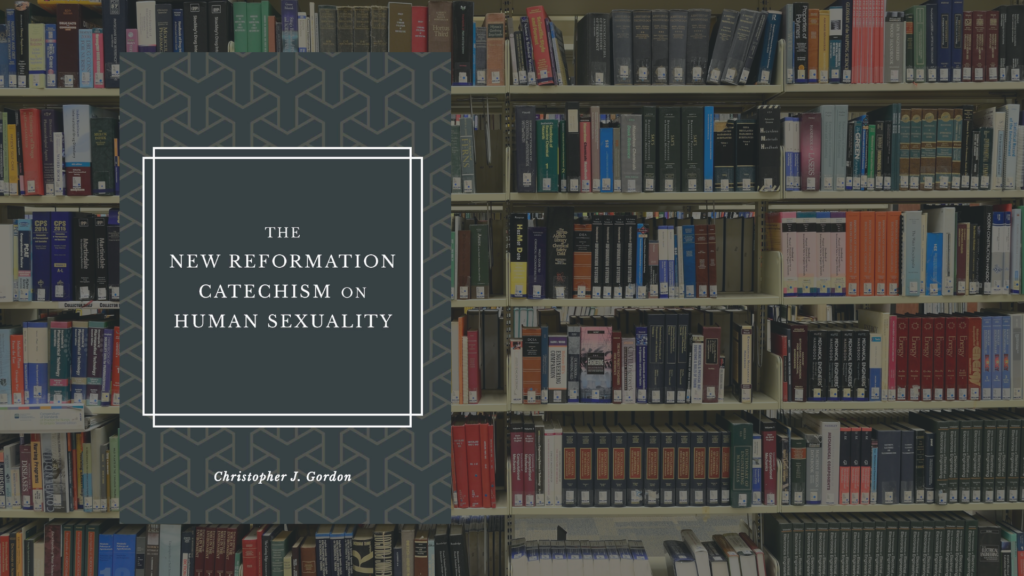
I am so grateful for the publication of The New Reformation Catechism on Human Sexuality (2022, 31 pages), penned by Christopher Gordon and vetted by many Reformed and Presbyterian pastors and theologians. I had the pleasure of reading an advance copy and am thrilled that this will soon be available as a resource for English-speaking Christians. The language used in this new catechism – a teaching resource in a Question and Answer format – will be familiar to anyone who cherishes the Heidelberg Catechism because the author has taken pains to use familiar phrases and motifs from the Heidelberg in this new work. (See the two samples I have included at the end of this article.) The extensive biblical notations are very helpful, demonstrating a solid grounding in the truths of God’s Word. And, from what I can tell, the answers to the questions presented are thoroughly and unapologetically Biblical, straightforward, and clearly communicated.
In my work with ARPA Canada, I have travelled the country over the past year and a half, presenting to hundreds of church leaders on the issue of conversion therapy and the religious battle of our day between the gnostic and pagan humanist’s view of human sexuality and identity (the dominant view of our culture and government today) on the one hand and the Christian and biblical view of sexuality and identity on the other hand. I have been asked many times whether it was time for a new, additional catechism or confessional document to address the contentious religious questions of our day. To those who ask these questions, I wholeheartedly recommend this book as a resource that fits the bill.
My unsolicited advice is that every church should purchase and distribute copies of this catechism to every family who sits in their pews and, more importantly, take the time to teach through it. The men and women, teenagers, boys and girls in our pews are being daily catechized by the dominant institutions of our society to accept wholly or in part the pagan or gnostic view of human sexuality and identity. It is a destructive theology. Our historic confessions do not grapple with this religious debate in sufficient measure (and understandably so – the challenges of our day were not theologically pressing or controversial at the time of the Reformation). We can benefit from new resources that equip us to know and understand what God teaches about who we are and how we should live, and why His way is good, true, and beautiful.
Some Reformed Christians might be uneasy with the idea of a single person writing a catechism like this, preferring instead a document vetted by a larger group of churches (a federation or denomination). But to that, I point out that two of the three confessional documents of Reformed Churches were written by only one or two men (the Belgic Confession by Guido de Brès, and the Heidelberg Catechism by Zacharias Ursinus, with the help of Caspar Olevianus). While broader assemblies and synods deliberated over making these catechisms or confessional statements theological standards, these broader assemblies did not commission the original drafts. So, in the case of this new resource, we have a theologically astute pastor drafting a much-needed resource for the church to clarify a theological assault on Christian teaching, helped and advised along the way by a large group of theologians. The end product will be a blessing to any church that picks it up. Whether this catechism should rise to the level of a confessional standard is another matter.
If I can be picky, my only concern with the document is its name. I find it unfortunate that it includes the word “new” in it. I believe this catechism can and will be an enduring resource, and I hope that 50 and 100 and 500 years from now, Christians will turn to this catechism or other ones like it as an old, but accurate and true and lovely, Catechism on Human Sexuality. Nevertheless, this should not make you hesitate to pick up your copy as soon as you can. Here’s a link where you can read Rosaria Butterfield’s foreword to the New Reformation Catechism on Human Sexuality, and this is a link to where the book can be purchased.
Here’s a sample:
1. Q. Why is it comforting that we have a new identity in Jesus Christ?
A. I am being remade into the image of Christ, to have a true identity—1 in body and soul, throughout the whole course of my life, to enjoy God and glorify him forever.2 He redeemed my life with the precious blood of his Son,3 and has delivered me from the lie of Satan in the Garden.4 He also watches over me in such a way that he might free me from all sexual impurity as the temple of his indwelling;5 in fact, all things must work together to remake me into the image of his Son.6 Because I have this new identity,7 Christ, by his Holy Spirit, also assures me of God’s steadfast love,8 and makes me wholeheartedly willing and ready from now on to enjoy true freedom as a new creation.9
1 Gen. 1:26-27; Rom. 8:29; 2 Cor. 3:18; Col. 3:10
2 Ps. 146; 1 Cor. 10:31
3 1 Pet. 1:18-19; 1 John 1:7-9; 2:2
4 Gen. 3:4-5; John 8:34-36; Heb. 2:14-15; 1 John 3:1-11
5 1 Cor. 3:16; 1 Cor. 6:15-20
6 Rom. 8:29; 2 Cor. 3:18
7 2 Cor. 5:17
8 Ps. 103:8-10; John 16:25-27
9 John 8:32; Gal. 5:13
34. Q. What is involved in genuine repentance of all sexual sin?
A. Two things: The dying-away of the old self, by hating all forms of sexual immorality and fleeing from it;1 And the rising-to-life of the new self, by finding great joy in leading a sexually pure life and, if married, by properly loving our spouses.2
1 2 Cor. 5:17; Eph. 4:22-24; Col. 3:5-10; 1 Cor. 6:15-20
2 Ps. 51:8, 12; Isa. 57:15; Rom. 6:1-11; Eph. 5:22-33
André Schutten is the Director of Law and Public Policy for ARPA Canada
In a concerning development, the government of New Brunswick, through its latest Covid-19 restrictions, now requires churches to choose one of two paths for corporate worship. One path requires churches to require proof of full vaccination for anyone who comes to worship and participate at the communion table. If a church agrees to enforce a vaccine passport policy, then those who enter there are not required to physically distance, there are no capacity limits, and congregants can sing while masked. There is another path for churches who believe their congregation should not be segregated and refuse to require full proof of vaccination as a condition of corporate worship or to access the sacraments. For those churches, the rules prohibit singing, impose a 50% seating limit with social distancing, and require a fixed seating plan among other things. Similarly, Manitoba’s latest restrictions include this distinction: “Faith-based indoor gatherings have been reduced to 25 people or 33% capacity… faith-based gatherings can take place without restrictions for fully vaccinated people.”
These are the first instances we have seen in Canada where provincial governments are applying the Covid-19 vaccine passports to churches. We are grateful that no other provincial government to date has done so, but we are concerned other provinces may follow suit.
Imposing vaccine passports on worship services unnecessarily infringes on the separation of church and state
ARPA Canada believes that the civil government should not impose vaccine requirements on worship services nor require churches to impose vaccine requirements as a condition for attending worship. In a piece we recently released, we said:
“The civil government does not have authority from God to determine who comes to worship. The call to come is free and open to all. It is in corporate worship that the keys of the kingdom are clearly exercised: the preaching of the gospel (including through the administration of the sacraments) and church discipline. These keys are given to the church, not the state.”
Participating in gathered, assembled worship is the obligation of every individual at the call of the elders. It is not a permitted activity bestowed on the bride of Christ at the discretion of the civil government. The civil government is given authority by God to pursue public justice (Romans 13), but it is the church who holds the keys of the kingdom (Matthew 28:18-20) including determining when and in what manner worship is to take place. The church, then, “governs itself according to the pure Word of God, rejecting all things contrary to it and regarding Jesus Christ as the only Head.” (Belgic Confession, Article 29). That is, the church must recognize that it is Jesus as their head who determines who may come to worship – not the civil government.
We go on to say:
“There are Scriptural reasons and standards by which someone could be denied admission by church leaders. One reason relates to contagious diseases, but the standard for denying access to the assembly of God on the grounds of a contagious disease is set through careful consideration of a variety of scriptural principles by the church elders and not by the civil government.”
Ceding that authority to determine who may come to worship is a case of rendering unto Caesar what is God’s.
A choice that’s not really a meaningful choice
We can be thankful at least that New Brunswick and Manitoba are not imposing the vaccine passports directly on churches, treating the church and corporate worship like restaurants or movie theatres. Had provincial governments picked this route, the issue would be much more clear-cut. Instead, these provincial governments have given churches the choice between vaccine passports and very few restrictions or no vaccine passports with much greater restrictions.
It should be noted that the choice offered to churches isn’t really a meaningful choice at all. As one Christian nurse put it, the church is the emergency room for the soul. And just like the ER at the hospital where she works accepts all patients who need help, whether they are smokers or obese or unvaccinated, so the church needs to tend to the souls of all who come to the door for help, whether they are vaccinated or not.
Even if 100% of their members are vaccinated, a church that does not verify vaccination status and is open to guests who may possibly be unvaccinated would be stuck in the “unvaccinated” category with severe restrictions on corporate worship. This doesn’t mean their worship service is filled with unvaccinated people. Rather, the worship service would be comprised of people whose vaccine status is simply unknown. And the likelihood that 100% of the members of a church are vaccinated is very slim anyway. The unity of the church, particularly manifest at the Lord’s Supper table and experienced in corporate worship, has a very low tolerance for segregation. Any separation must be rooted in Scriptural principles.
We encourage a response
We are encouraged to see many provinces refraining from imposing vaccine passports on churches. British Columbia, which had treated churches very poorly from November to May, is now treating churches with much more respect. That’s worth acknowledging and applauding. And this is due, in part, to Christian leaders (and others) carefully, thoughtfully engaging with political leaders behind the scenes in that province. Praise God for listening ears! So far, Alberta and Ontario seem reluctant to impose a vaccine mandate on churches as well. But we shouldn’t just assume it will stay this way.
ARPA staff have heard about many churches already writing to provincial leaders, thanking them for not applying the vaccines to churches and urging the provinces to hold the line on this. This is great news! Being proactive against divisive policies is necessary. The social and spiritual health and unity of local communities – including religious communities – have profound public health benefits. The healthier and more united churches are, the more these churches can bless the communities in which God has placed them.
Whether you’re an office-bearer or not, you should speak up on this issue in encouraging and winsome ways. We have seen over the past 18 months a consistent lack of understanding by our culture of the role of the church. Rather than wait for more problems to develop, this is a key time to enlighten our government of what the church is, what worship is, and why vaccine passports are an unacceptable policy. This is also a good time to offer prayer and encouragement to these representatives during this very difficult time. Combining your request with a token of appreciation (like a bouquet of flowers or a large collection of cards and coloured pictures from young children in the congregation) can go a long way to building a mutually respectful relationship with a local member of your provincial legislature.
We communicate with our governments in the knowledge that He who sits enthroned in heaven is in control and actively working on our behalf. And so, as you undoubtedly already do, continue to practice the exhortation of Paul “that supplications, prayers, intercessions, and thanksgivings be made for all people, for kings and all who are in high positions, that we may lead a peaceful and quiet life, godly and dignified in every way. This is good, and it is pleasing in the sight of God our Savior” (I Tim 2:1-3).
May we continue to have the freedom to worship our God according to His Word, and may the unity and courage of the bride of Christ be a witness to our country of the sure hope we have.
It’s been over 13 months since the first Covid-19 restrictions were enacted across Canada. Since then, ARPA has launched targeted campaigns in British Columbia and Ontario and encouraged Reformed Christians in all provinces to use emails, phone calls, petitions, letters to the editor, and social media to ask their provincial leaders to allow church leadership to make the decision on how Christians can safely gather for corporate worship. We argued that corporate worship is an essential activity and that these restrictions are unconstitutional. At various times and places, we have pointed out that the regulations have been much more relaxed around many other activities in society – shopping, working out, playing sports, attending movie theatres, eating at restaurants, or participating in a protest – than for worship services.
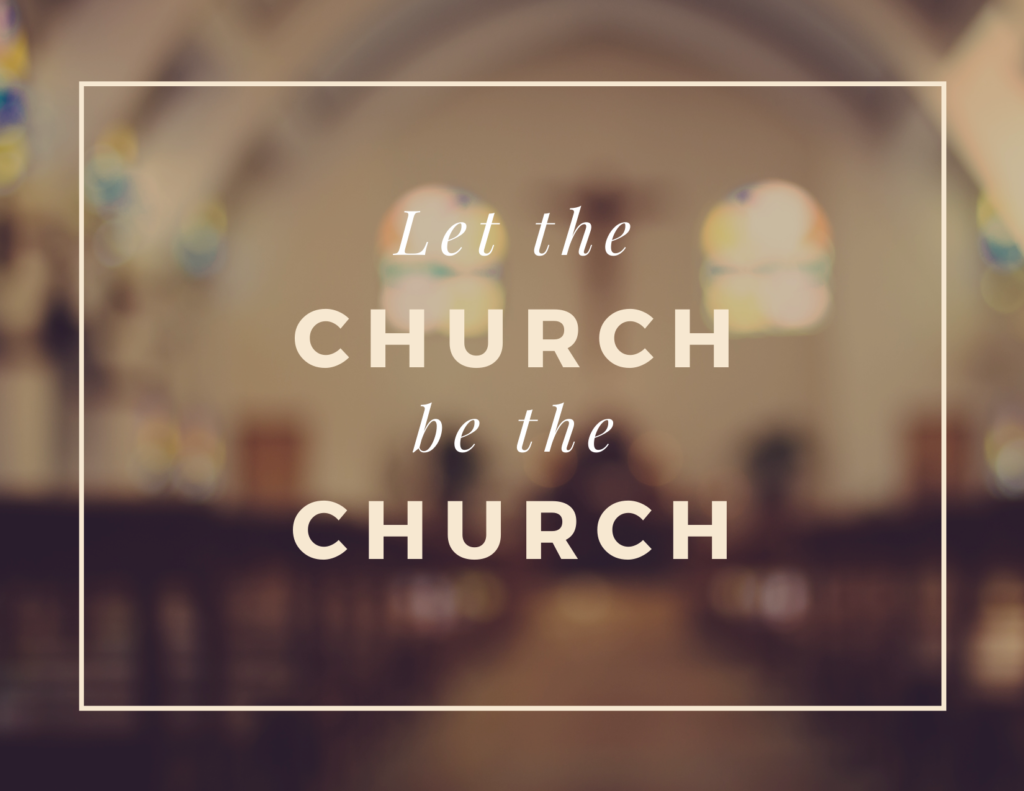
Now, we are taking a step back from these specific and targeted messages and launching a new national campaign simply asking our provincial representatives to Let the Church be the Church.
The aim of this campaign is to communicate not only the essential nature of in-person worship, but also, the Church’s desire to remain faithful in her call to acts of mercy, hospitality, visiting the sick, and caring for widows. The church longs to be the church, in word and in deed. Significant limitations on worship services may be necessary and prudent to prevent the transmission of COVID-19, but the authority to enact such limitations on Christian worship primarily belongs to local church governments.
In this, Let the Church be the Church campaign, we are encouraging you to send postcards to your local governing officials. You can get them in three ways:
- Fill out this order form and tell us how many you would like. We’ll mail them to you or drop them off at your house as soon as possible.
- Email your local provincial manager. Contact Levi Minderhoud in British Columbia, Ed Hoogerdyk in Alberta, Ryan Mans in Ontario, or Colin Postma for elsewhere in Canada.
- Print off a copy of the postcard using your own printer. You can download the postcard template by clicking here.
The front of the postcard conveys the main message that governments are to “let the Church be the Church.” On the back, you can write a short message explaining how you think the government should do this in your community. As noted above, the message doesn’t have to just be about worship services. In our Fall Tour, we outlined many activities that God calls the Church to perform that are being curtailed during this pandemic. Here are some suggestions for you:
- Recognize the authority of local church governments over worship services. Allow local churches to decide how to best balance their duty to worship corporately with their duty to protect their members and their neighbours from harm.
- Allow Christians to fulfill their calling to care for the sick, the aged, and the vulnerable.
- Prioritize religious services and activities when crafting provincial and local reopening plans.
Although you may have some frustration about how your provincial leaders have handled restrictions, it is very important to ensure that you convey your message with humility and respect. Include encouragement, sympathy for the challenges presented by the pandemic, and/or a promise to pray for their work.
Once you’ve written your short message, address your postcard. Your name and address go in the top left corner and the name and address of your local government official go on the right side.
You don’t have to stop at writing a letter to your MLA or MPP. Consider sending one to your neighbouring MLAs or MPPs, your premier, your health minister, your public safety minister, your provincial health officer, your local health authorities, or even your police chief. All our politicians, public health officials, and law enforcement officials would benefit from this reminder to let the church be the church.
You flooded the offices of our MPs with pink envelopes in support of C-233 and the protection of pre-born girls from sex-selective abortion. Let’s do the same with these postcards!
*Unlike letters to our federal MPs, mail to our provincial or local authorities DO require postage, so don’t forget to add a stamp in the top right corner.
In a disappointing ruling released last night, the Chief Justice of the Supreme Court of British Columbia upheld the prohibition of in-person worship services. These restrictions were first implemented on November 19th, 2020, and continue to this day.
Many Christians will be very disappointed, perhaps even angry, with this decision. Reformed Christians have an earnest, deeply-held belief that they must both respect the governing authorities and gather regularly to worship with other believers. The absolute prohibition of in-person worship services placed many Christians in an unfair dilemma, making it very difficult to balance both of these convictions. This decision perpetuates the tension between obeying the government and obeying the requirements of one’s faith.
The churches at the centre of this case argued that these restrictions infringed their freedom of religion, freedom of expression, freedom of assembly, and freedom of association – all four of the Charter’s fundamental freedoms. Chief Justice Hinkson agreed that all four fundamental freedoms were infringed yet decided that these infringements were reasonable given the circumstances. He ruled that these infringements are reasonable and justifiable in “a free and democratic society” (s. 1 of the Charter).
We can be thankful that the Chief Justice recognized the profound impact these absolute prohibitions have on religious communities. But we should also be gravely concerned that he does not seem to have an appreciation for how central gathered worship is to Christians. In the judgement, Chief Justice Hinkson suggests that because both secular and religious schools can gather, that the current restrictions do not disadvantage those with religious beliefs. But this fails to appreciate the centrality of gathered worship to Christian communities. It is small comfort for a child to be able to gather with other Christians for the purpose of learning at school, but not to gather for the purpose of worship at church.
While administrative decision-makers like Public Health Officers do require a level of deference due to their expertise, Charter rights cannot be ignored even in a pandemic. The government is still obligated to consider and respect the rights and freedoms of its citizens when crafting laws and regulations.
Unfortunately, this decision risks entrenching unfair treatment against minority religious communities. The provincial leaders of British Columbia prohibit in-person worship services while they continued to permit in-person activities at bars, restaurants, gyms, and most other businesses. Constitutionally protected activities – such as practicing one’s religion at a corporate worship service – are disallowed, while trivial activities – purchasing a pair of socks at any big box store – are permitted. This decision entrenches unfair treatment against religious activities.
ARPA Canada had the opportunity to intervene in the case, zeroing in on how the COVID-19 restrictions unfairly and unequally impacted churches. Chief Justice Hinkson interacted with ARPA’s arguments on a number of occasions and accepted a number of ARPA’s legal propositions. For example, he does recognize that the government’s authority over religious communities is not absolute, a point that ARPA raised in its submissions. In paragraph 200, Hinkson states, “Religious bodies have a sphere of independent spiritual authority, at the core of which is the authority to determine their own membership, doctrines, and religious practices, including the manner of worship.” This admission from the court is worth celebrating.
An important element of the reasonableness test for justifying Charter rights infringements is the minimal impairment test. That is, if the government is going to infringe our fundamental freedoms, they must choose a way that impairs the right minimally. When every other province – and even British Columbia for the first half of the pandemic – seems able to accommodate worship services at some capacity, whether a cap of 100 people or a percentage of a building, we feel that the absolute prohibition in British Columbia cannot be minimally impairing. This might be an issue to bring to the Court of Appeal for clarification. If the PHO can allow other gatherings to resume with enhanced safety protocols and enforcement, we do not think it is constitutionally justifiable to refuse the same treatment to worship services but simply to continue an absolute ban with respect to them.
Despite this decision, this issue lives on. The churches that initiated the case have the right to appeal the decision to the BC Court of Appeal. Even if the case is not successfully appealed, a collection of Canadian Reformed Churches and the Catholic Archdiocese of Vancouver have also filed their own judicial reviews on the Public Health Officer’s denial of their request for reasonably accommodate in-person worship services in their fact-specific cases.
Christians across the province should continue to call for Dr. Bonnie Henry to repeal or relax these restrictions on in-person worship services. Religious convictions and practices can’t be discarded because they are inconvenient, carry some degree of risk, are not considered as valuable as ‘economic’ or ‘educational’ activities, or are not universally practiced by all British Columbians. They are fundamental to the people of faith who practice them. That is why they are enshrined as fundamental freedoms in the constitution. Christians should continue to abide by reasonable health protocols to help prevent the spread of the virus, but the freedom to act upon their religious convictions must be recognized by the government.
Today’s Throw Back Thursday article is the second installment of the four-part series entitled “Kingdom Citizens in Secular Canada,” originally presented at a 2005 Burlington Reformed Study Centre event. The series was reproduced in the January 6, 2006, issue of the Clarion magazine, and reprinted on ARPA’s blog on July 3, 2009.
The author of the second part of this series is Dr. F. G. Oosterhoff. Dr. Oosterhoff was a historian, active in secondary and post-secondary education, who specialized in European history, church history, and the history of ideas. Dr. Oosterhoff had already retired when she authored this article in 2005, and she recently passed into glory.
Christian Politics, What Does it Involve?
By Dr. F.G. Oosterhoff
Tonight and next week we speak about our calling as Christians in a secular society. Among the topics to be discussed are the causes of today’s secularizing trend, the strategy we should follow in trying to stem that trend, and the best means of organizing politically. With respect to the last issue, we would seem to have two options. One is to join a Christian political party, such as the Christian Heritage Party; the other is to do what many Christians south of the border are doing. It is to organize as a Christian alliance and so attempt to influence one of the mainline parties. In the United States that is the Republican Party. In Canada it would most likely be the Conservatives.
As a result of ongoing limits and restrictions, our church communities and the work of our churches amongst their members and their neighbourhoods remains limited by these capacity requirements.
With the threat of a third wave and a third lockdown, would you join us in calling on the Ontario Government to expand worship services and recognize the Church as essential?
We particularly appreciate the approach and tone that the Alberta government previously took in applying their church reopening policy (though they have since deviated from this course) :
“We also recognize that places of worship are structured environments with respected leaders who will work with their congregation to ensure measures are in place. Attendance caps have been removed with the knowledge that each faith community’s leadership will be responsible for ensuring that measures are taken to prevent spread within their community.”[1]
If you are wondering why ARPA Canada is advocating for in-person worship services during a pandemic? Read this article for an explanation.
What can I do?
- Send this EasyMail to your MPP encouraging them to relay your concerns to the Ontario Government about expanding services.
2. A petition has been circulating in relation to worship services in Ontario. We believe it is worth supporting. Download it below. It includes a page with instructions.
Last week, the BC Supreme Court spent four days (March 1-3, 5) hearing the case of Beaudoin v. BC, where three BC churches are challenging the Provincial Health Order prohibiting in-person worship services.
The case was heard by Chief Justice Hinkson, the Chief Justice of the BC Supreme Court, and now we await his decision. The Chief Justice had rejected an injunction request from the government in mid-February when the province tried to force the closure of churches that continued to hold in-person worship services contrary to the public health orders.
The Churches’ Case
The lawyer arguing on behalf of the three churches – Paul Jaffe – had the first opportunity to make his case. He emphasized points that Christians (including ARPA Canada) have made repeatedly in the past months:
- It is inconsistent and arbitrary for the government to allow schools to function, businesses to remain open, gyms to operate, and people to congregate at the bar to watch a hockey game, but not allow masked, physically distant individuals and families to gather for worship.
- The orders are overly broad; the government doesn’t need to completely shut down in-person worship services to accomplish its objective of reducing the spread of COVID-19.
- The orders infringe on several Charter rights: the freedom of religion (Charter section 2(a)), the freedom of expression (section 2(b)), the freedom of peaceful assembly (section 2(c)), the freedom of association (section 2(d)), the right to liberty (section 7), and the right to equal treatment under the law (section 15).
- The public health orders also demonstrate how Dr. Henry’s prioritization of values apply to all British Columbians, whether they share her priorities or not; she appears to value school, workouts, or shopping more highly than corporate worship.
ARPA’s Intervention
ARPA Canada is so thankful that the judge also granted ARPA leave to intervene, accepting our 20 pages of written legal argument (you can read them here) and twenty minutes of oral arguments, where we could present legal analysis on particular constitutional points from the perspective of the Reformed community. Geoffrey Trotter, the lawyer speaking on ARPA’s behalf, focused on how the importance of assembling together for worship is a central, deeply-held belief of Reformed Christians. He explained that there is no “magic number” of how many people must be present to fulfill the obligation to gather for worship, but that number certainly is more than zero. He also drove home the point that it is unfair to allow people to engage in a wide variety of activities, but not to attend an in-person worship service.
The Government’s Case
Then, the government’s lawyer stood up. His major argument was a procedural one. Since the churches involved in the case had been granted a so-called “section 43 variance” (to hold outdoor services with maximum 25 people, capped at one hour, with no singing, and with the wearing of masks while remaining physically distanced for the entire service), he argued that the churches could no longer challenge the health order. The only thing they could challenge was the reasonableness of this variance. He suggested the case had to be started all over again, specifically challenging just this variance.
In case Chief Justice Hinkson didn’t accept that argument, the government’s lawyer had a back-up argument. Although the government conceded that they did violate British Columbian Christians’ Charter section 2 fundamental freedoms of religion, expression, and peaceful assembly, he argued that these infringements were reasonable and justified under the circumstances (see section 1 of the Charter). The government lawyer argued that COVID-19, especially the new variants of the virus, posed a grave public health concern. Dr. Bonnie Henry weighed the risks of the virus spreading and the rights of people and judged that an absolute prohibition on in-person worship services was acceptable and necessary.
The Churches’ Reply
In response, Jaffe argued that the judge shouldn’t consider the variance granted to the churches because it was a strategic move to get the case thrown out. Originally, when faced with a number of churches that continued to meet, the government first refused to reconsider their orders, then sought an injunction to shut the churches down, and then, only once it was clear that a court case was imminent, gave a limited variance to the churches (an 11th-hour accommodation of sorts). Jaffe also pointed out that Dr. Henry gave a more generous variance to the Jewish community within a couple of days of asking for it, which was inconsistent and unfair.
In either case, applying for a variance of the health orders was a catch-22. If the churches did not apply for the variance, the government could claim that the churches hadn’t exhausted the internal appeal mechanism before going to court and they must apply for a variance before challenging the health orders. But if they did apply for and were granted a variance, even if it is substantially less of an accommodation than requested, the government could claim that they wouldn’t be able to challenge the health orders themselves anymore because the orders didn’t apply to them.
The Judge’s Comments
The comments and questions of Chief Justice Hinkson were encouraging. He does not consider the case a “battle of the experts” on COVID-19 and rightly considers second-guessing the medical opinion of Dr. Henry to be largely outside his area of expertise. His role is to review the health orders (or variances) to ensure that any infringements on rights and freedoms are “reasonable in a free and democratic society.” In particular, the chief justice voiced concern to the government lawyer that the apparent differential treatment of places of worship being absolutely prohibited from meeting compared to bars and pubs being open for strangers to drink and watch the hockey game together gave him serious concern.
As ARPA Canada’s lawyer Mr. Trotter explained, the judge, who does not necessarily have medical expertise, does not need to substitute his own view on what level of risk is tolerable in the circumstances. But he can just look to Dr. Henry’s choices to see what level of risk she says is tolerable and then insist under s. 15 of the Charter that she extends no less tolerance to risk created by religious gatherings.
Chief Justice Hinkson will take all the arguments into consideration as he crafts his decision in the coming weeks or months. He has a difficult task. We can be thankful that his experience and wisdom will be applied in this case. Continue to pray for this judge as he seeks to dispense justice from the bench.
How Does This Case (And Other Cases) Impact Other Churches?
This particular case (Beaudoin v. BC) involves three churches, plus several individuals, challenging the public health orders, but it is not the only such case in British Columbia. The Catholic Archdiocese of Vancouver and a number of Canadian Reformed Churches have also filed legal challenges of the worship service prohibitions. Although a judge has the power to strike down or modify the restrictions as they apply only to the petitioners before them (e.g. the three churches, Catholic churches, or Canadian Reformed Churches), it is also possible that the decision the judge issues will be general enough to benefit all churches in the province.
Depending on exactly how the judge crafts his ruling, the other two legal challenges may become moot. However, if Chief Justice Hinkson upholds the orders, then the other two legal petitions that have since been filed will give churches a second and third chance to challenge the reasonableness of the accommodations available within the orders. In any case, stay tuned for ARPA Canada’s commentary on the final ruling once it comes out.
Conclusion
Continue to pray for Chief Justice Hinkson as he deliberates on this case in the coming weeks, that he might appreciate the importance of gathering together for corporate worship and protect our freedom to peacefully, carefully, and reasonably assemble to worship God as we are directed to in His Word.
The government and the JCCF lawyers delivered their final remarks today and spent a lot of time talking about… Orthodox Jews?
Listen as Mark and Levi rehash the last days of hearings and offer some concluding thoughts.
The third day of hearings at the BC Supreme Court have wrapped up. The government lawyers spent most of the day laying out their position of the facts of the case. They also admitted that the restrictions on churches infringed on their fundamental freedoms, but didn’t have enough time to really explain why these freedoms are justified. An extra day of hearings (Friday) have been scheduled for thr government to wrap up their arguments and for the petitioners (the churches) to give a reply.
Here is a mid-day take from our Executive Director Mark Penninga, Rev. Koopman, and Rev. Schoeman about how the case is progressing.