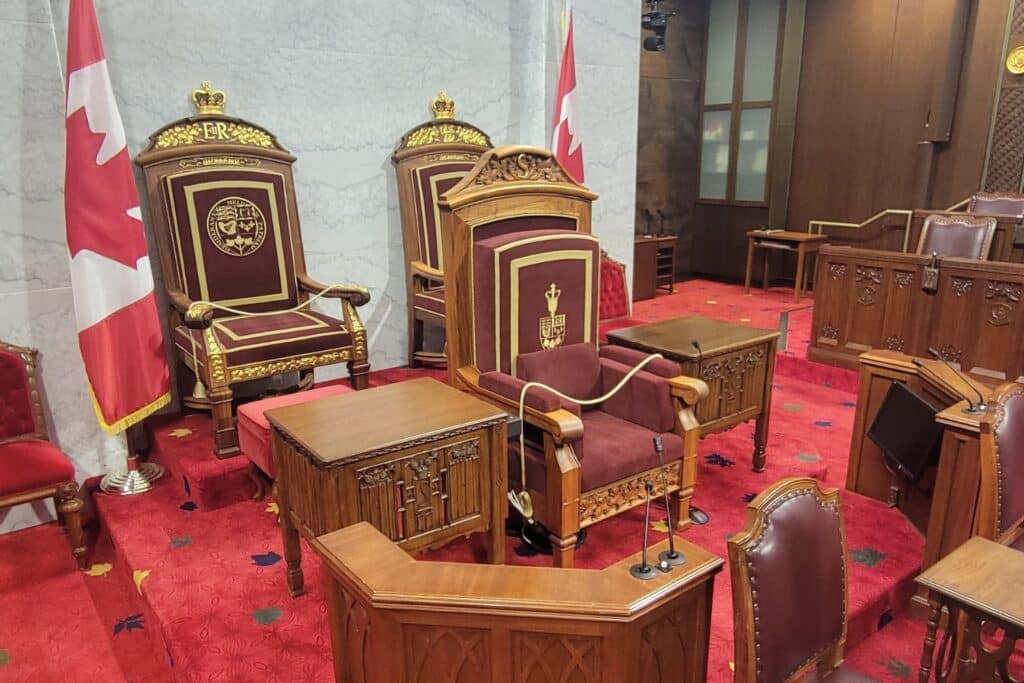
On May 27, King Charles will read the Canadian government’s speech from the throne. But how is it that the King of the United Kingdom is outlining the priorities of the Canadian government? And what should Christians think about this from a Christian worldview?
This historic moment is an opportunity to reflect on ways that the office of King Charles points us to the greater lordship of King Jesus. But before we get into all the reasons for that, we need a quick civics lesson on how Canada’s government actually works.
Wikipedia describes Canada’s government as a “federal parliamentary constitutional monarchy.” That’s quite a mouthful, but let’s break it down.
Canada’s government structure
“Federal” simply means that Canada has both a national government and provincial/territorial governments, each with prescribed powers.
“Parliamentary” refers to the presence of political representatives of the people in the government. Members of Canada’s 343 ridings elect representatives to the House of Commons to represent their riding, and each province has Senators to represent the province as a whole. Both bodies have the power to enact laws for our country. Historically, the elected House of Commons and the unelected Senate were intended to check the power of the monarch (which we’ll get to in a second).
“Constitutional” refers to the fact that there is a fundamental set of laws that our government must adhere to, laws that are very difficult to change. Canada’s constitution includes the Constitution Act, 1867, the Constitution Act, 1982, the Charter of Rights and Freedoms, and unwritten conventions that stem from British parliamentary tradition.
Which brings us to the monarchy. Although we almost exclusively rely on the House of Commons – the prime minister, cabinet ministers, and the rest of the members of Parliament – for governance, the Constitution Act, 1867 states that “the Executive Government and Authority of and over Canada is hereby declared to continue and be vested in the Queen.” In other words, the day-to-day power of the government is in the hands of the monarch (the King or Queen, depending on who is in power). The monarch has a Privy Council to advise him or her on Canadian policy. The monarch is also the Commander-in-Chief of “the Land and Naval Militia, and of all Naval and Military Forces.”
Since the monarch resides in the United Kingdom rather than Canada, the Constitution gives the monarch authority to appoint a representative in Canada, called the governor general. This appointed person is to exercise the monarch’s authority in Canada. Officially, it is the governor general who summons and calls together the House of Commons in the monarch’s name and dissolves Parliament and calls an election. The governor general officially has the power to veto any bill passed by Parliament on behalf of the monarch, as a bill must receive royal assent before it can become law. Within two years of the passage of a bill, the monarch has the power to withdraw royal assent for the bill, annulling the law.
On paper, the monarch and his representative have enormous power, vestiges of when England was ruled by a monarch with near absolute power and when Canada was simply a colony of Great Britain.
In practice, though, the monarch and the governor general almost never overtly exercise their power. Generally, they follow the advice or will of the prime minister. The last time a governor general refused to follow the advice of the prime minister was when Governor General Lord Byng refused to call an election for Prime Minister William Lyon Mackenzie King in 1926. This caused a constitutional crisis. That’s because the unwritten constitutional convention that the monarch and his representative follow the will of the elected House of Commons clashes with the powers bestowed on the monarch by the written constitution.
Two types of kingship
Since the monarch is rarely present in our Parliament, King Charles’ upcoming speech from the throne is an opportunity to reflect on ways that his role points us to the greater lordship of King Jesus.
First of all, both are kings. God describes Himself as a king, not a prime minister, premier, president, chancellor, or secretary. Monarchies have fallen out of fashion in human governance (with only 43 countries around the world having some sort of monarch as a part of their government) and very few monarchies hold absolute power today – for good reason. King Charles is one of the few monarchs left in the world and practically holds little power. King Jesus, however, rightly holds absolute power.
Second, both King Charles and King Jesus are the rulers over many nations, including Canada. While King Charles is the official head of state over 15 nations in the British Commonwealth, Jesus is the King of all kings and the Lord of all lords.
Third, both hold their authority by right rather than by popular election. King Charles holds the throne by right of birth today, although his ancestors claimed that they ruled by divine right. Barring extraordinary events, Charles will only lose the throne in death, passing it off to his progeny. Jesus holds his authority by the divine right of being the Son of God and the natal right of being the Son of David. And since He is eternal, He will never pass that title on to anyone else.
Fourth, both have thrones. There is an actual throne reserved for his majesty in the Senate. It is from this throne than the king gives his speech from the throne (hence the name). But above this throne is another. Our King, as we read in great detail in Revelation 4, also sits on a throne, one that is far more awesome and majestic than the red and gold chair in the Senate.
Fifth, both trigger elections. Officially, the monarch and his representative (the governor general) call elections and dissolve Parliament. Our God, in his providence, also direct the affairs of men and directs not only the timing of elections but also the outcome. We confess that “all things, in fact, come to us not by chance but by his fatherly hand” and that “all creatures are so completely in his hand that without his will they cannot so much as move” (Heidelberg Catechism Q&A 27-28).
Sixth, both give approval before any law is passed in Canada. The monarch or his governor general must give royal assent to every law passed by the Canadian parliament and even has the power to rescind laws shortly after their passage. In God’s providence, no bill is passed by Parliament can become law without God’s will and he has the power to revoke any human law at any time. While constitutional convention dictates that the governor general must give royal assent to any law passed by Parliament, God is under no such compulsion.
And finally, both are increasingly forgotten monarchs. Only a quarter of Canadians know that the king is Canada’s formal head of state. Canadians forgetting that King Charles is their earthly king reflects the much greater problem of Canadians forgetting that God is their heavenly King. In both cases, Canadians’ focus on choosing our own governments can cause us to forget about authorities that are above us by right. There will be no day of reckoning when every Canadian will be forced to acknowledge the kingship of the British monarch, but there will eventually be a day when “every knee will bow, in heaven and on earth and under the earth, and every tongue confess that Jesus Christ is Lord, to the glory of God the Father” (Philippians 2:10-11).
So, if you see King Charles reading the speech from the throne, be reminded that it isn’t your local member of Parliament, Prime Minister Mark Carney, Governor General Mary Simons, or even King Charles who ultimately determines and presides over our government. That distinction belongs to our God, a fact that gives us comfort and hope through the failings of earthly governments. And it is a reality that our politicians should recognize as well. In fact, our politicians should be doubly humble for they have two kings greater than themselves over them: King Charles and King Jesus.
Justin Trudeau has reached the end of his tenure as Prime Minister of Canada. At nearly 9.5 years, he is the seventh longest serving Prime Minister in Canadian history and has certainly made his mark on the country. Toward the end of the Harper government, we scored how well the Conservatives had performed on ten key issues that ARPA engaged with at the time. The Harper Conservatives averaged a C. Today, we’re going to grade Trudeau on his time in office.
Here’s how our grading system works:
- Any positive action by Trudeau (e.g. the Canada Child Benefit) gives him a higher grade and any negative action taken (e.g. legalizing euthanasia) lowers his grade. Attempted action counts in the grade, even if that action was later reversed or a proposed bill did not pass.
- Leaving good policies in place (e.g. a strong law on prostitution) favours a higher grade but failing to reform bad policies (e.g. no protections for pre-born children) lowers the grade.
- Regardless of any new laws or policies passed, increasing rates of something evil (e.g. more euthanasia deaths) lowers his grade and decreasing rates of something evil (e.g. fewer abortions) increases his grade.
Let’s get grading!
Euthanasia
Grade: F
A new form of killing – euthanasia and assisted suicide – became legal in Canada under Justin Trudeau. Prior to 2015, euthanasia and assisted suicide were illegal in Canada. They were forms of homicide (murder) according to Canada’s Criminal Code. The Supreme Court’s ruling in Carter – striking down Canada’s euthanasia ban – landed the issue in Trudeau’s lap. But Trudeau failed to act decisively to protect the lives of vulnerable Canadians. His government passed Bill C-14 in 2016 as Canada’s first ever legislation that permitted euthanasia, with broad and ill-defined eligibility criteria.
A few years later, when a Quebec court struck down part of this new law in Truchon, Trudeau failed to even try to defend his own government’s euthanasia law by appealing this decision. Instead, his government showed a complete disregard for the lives of vulnerable Canadians and went on to expand eligibility for euthanasia even further than the court required, proposing to allow people whose sole underlying condition was a mental illness to access euthanasia in 2023.
Thankfully, even the Trudeau government realized that extending euthanasia to the mentally ill was going too far, at least for now. His government delayed this extension by one year in 2023 and then by a further three years in 2024. However, his government lacked the resolve to entirely cancel this planned expansion of euthanasia.
On Trudeau’s watch, 15,343 people died by euthanasia in 2023 alone (the latest year that we have data for), making it the fifth most common cause of death, behind only abortion, malignant neoplasms (e.g. cancer), heart disease, and accidents. Euthanasia accounted for nearly 1 in every 20 deaths in Canada in 2023.
Abortion
Grade: F
Justin Trudeau, without a doubt, has been the most vocally pro-abortion Prime Minister in Canada’s history.
Even before he became Prime Minister, as leader of the Liberal party Trudeau required that all Liberal candidates must be pro-abortion. No openly pro-life candidates were permitted to run under his banner, despite many former members of Parliament urging Trudeau to reconsider. “The firm position of all previous Liberal Leaders,” the former MPs wrote, “including Pierre E. Trudeau, has been that, on moral issues, Liberal Members of Parliament were able to vote according to their respective consciences.” Not so under Justin Trudeau.
Trudeau’s Liberals also defeated three pieces of pro-life legislation under his leadership – Bill C-225 (pre-born victims of crime), Bill C-233 (sex-selective abortion) and Bill C-311 (pre-born victims of crime). Canada is still the only democratic country in the world that has no legal restrictions on abortion. Under Trudeau’s tenure, Canada also promotes abortion overseas and provides generous funding to domestic abortion groups.
This lack of legal protection for the pre-born means that rates of abortion have remained tragically high during Trudeau’s tenure. By the best figures we have, 100,104 abortions occurred in 2015, the year Trudeau assumed office. That equated to 14.4 abortions per 1000 women aged 15-44 in Canada. In 2022 (the latest year that we have data for), 97,211 abortions were recorded, equivalent to 12.9 abortions per 1000 women aged 15-44.
Trudeau also oversaw changes to the Canada Summer Jobs program in 2017, denying federal funding for summer student jobs to any organization whose “core mandate” did not respect “reproductive rights,” though he later reversed this change. His government also stated their intent to revoke the charitable status of pregnancy centres, and this policy was only stalled by his resignation as Prime Minister and the prorogation of Parliament.
In Vitro Fertilization and Surrogacy
Grade: C-
The Trudeau government has generally taken a stance of inaction toward IVF and surrogacy. The Assisted Human Reproduction Act, which regulates IVF and surrogacy in Canada, was introduced in 2004, well before Trudeau’s tenure. Other than clarifying regulations made by the Minister of Health, the primary substance of the law has remained unchanged under Trudeau.
A Liberal MP introduced Bill C-404 in 2018 to decriminalize paying for sperm or egg donations for surrogacy. Prime Minister Trudeau said it was an important discussion to have, but the bill never made it to a vote.
In 2022, in line with a 2021 election platform promise, the federal government expanded the Medical Expense Tax Credit to include more expenses related to surrogacy. By doing so, they increased incentives for engaging in surrogacy. Likewise, the government incentivized sperm and egg donation through tax credits related to donation and for fees paid to fertility clinics and donor banks.
The federal government does not track rates of IVF or surrogacy. But Canadian fertility clinics reported 150 surrogacy births in 2015, and 249 births in 2017. The Canadian Fertility and Andrology Society reported 7,609 live births through IVF in 2022, compared to 6,903 in 2017.
Sex/Gender
Grade: F
One of the first bills proposed by the Trudeau government was Bill 16, a bill that added “gender identity” and “gender expression” as prohibited grounds of discrimination in the Canadian Human Rights Act. It also made hate “based on gender identity or expression” an aggravating circumstance in the Criminal Code’s hate speech provisions. This legislation legally entrenched gender ideology’s claim that human identity is not based on our biological sex/gender but in our self-perceived gender identity.
A few years later, Trudeau passed a national conversion therapy ban through Bill C-4. While normally it takes months if not over a year to pass legislation, this draconian bill was passed in a mere 10 days (thanks to the support of the Conservative party). The legislation claims that Christian views of gender and sexuality, where God created human beings to embrace the sex/gender that God has given them, are “myths and stereotypes.” It formally banned “any practice, treatment or service” that tried to change someone’s sexual orientation, gender identity, or gender expression or even change someone’s behaviours in these matters. Although to date no one has been charged with violating Canada’s conversion therapy bans, this bill clearly targets a Christian view of gender and sexuality.
The federal government’s endorsement of gender ideology is helping a growing number of Canadians identity as LGBTQ+. Statistics Canada claimed that over one million Canadians identified as LGBTQ2+ already back in 2018, with 255,100 gay men, 150,600 lesbian women, 161,200 bisexual men, and 332,000 bisexual women. The 2021 census, which boasts that “Canada is the first country to provide census data on transgender and non-binary people” revealed that 100,815 Canadians (0.33% of population aged 15 and older) identify as transgender or non-binary.
Prostitution and Human Trafficking
Grade: B
Trudeau’s government did very little when it came to prostitution and human trafficking. In this case, however, that is a good thing. Canada’s current prostitution law, passed by the previous government, is one of the greatest political wins we have seen this century. The Protection of Exploited Persons and Communities Act (PCEPA) balances social disapproval, prevention, and punishment for prostitution with the need to help exploited women and girls to escape prostitution. Despite calls from within his party and the progressive movement more generally to legalize or decriminalize prostitution, Trudeau preserved PCEPA.
However, he did let important programs and strategies lapse under his watch. The Measures to Address Prostitution Initiative (MAPI), a partnership between the federal government and social organizations to help women escape prostitution, expired in 2020 and was not renewed. Canada’s National Strategy to Combat Human Trafficking also expired in 2024 and was not renewed, despite bills (C-308 / S-263) proposing that this strategy be maintained.
The prevalence of prostitution and human trafficking is difficult to know. The victims (and, of course, the perpetrators) of prostitution and human trafficking often do not report these crimes to police. We ultimately want zero cases of prostitution and human trafficking. A low or decreasing number of cases of prostitution or human trafficking could mean that that these crimes really are decreasing. Conversely, they could mean that fewer people are reporting these crimes or that the police are not bothering to adequately enforce Canada’s laws. Seeing many instances of prostitution or human trafficking reported in data could be a sign that the police are doing their job well in prosecuting these crimes or victims escaping from prostitution in greater numbers.
That said, the number of reported instances of prostitution-related offences tended to increase over Trudeau’s time in office. The number of reported instances of men purchasing sex rose from 343 in 2015 to 395 in 2023. Meanwhile, the number of pimp-related offences (materially benefitting from prostitution, procuring new women and girls for prostitution, and advertising prostitution) grew from 152 in 2015 to 259 in 2023.
Pornography
Grade: C
The early days of the Trudeau government saw little attention to the public health crisis of pornography. One Parliamentary committee examined the issue, but it mainly recommended more gender-based analysis in government decision-making.
However, the issue of pornography burst into the public spotlight after a 2020 New York Times exposé on the Canadian pornography companies Pornhub and Mindgeek. In response to this expose, the Trudeau government and many private MPs and Senators set about to try to crack down on pornography in Canada.
Bill S-210 attempted to restrict young persons’ access to pornography. Bill C-270, the Stopping Internet Sexual Exploitation (SISE) Act, would have prohibited the production, distribution, or advertisement of non-consensual pornography or pornography of minors. Bill C-412 would have prohibited the distribution of deepfake pornography and required internet companies to create more tools to allow parents to monitor and control what their children see online, including pornography. Bill C-63, the otherwise problematic Online Harms Act, would have required internet companies to crack down on certain types of pornography and given the government greater tools to combat pornography.
All of these pieces of legislation were good attempts to combat pornography in Canada. Unfortunately, Trudeau failed to prioritize passing them and all four bills died on the order paper when Parliament was prorogued. Canada has no better (but no worse) laws on pornography because of Trudeau.
Marriage and Family
Grade: C
Trudeau made no changes to Canada’s marriage laws. No-fault divorce was legalized in 1986, and same-sex marriage in 2005. Polygamy remains illegal.
However, Trudeau did make some big moves on the family front that incentivized families to have more children. He took the Harper-era Universal Child Tax Benefit, which gave cash back to families based on how many children they had, and repackaged it as a much more generous Canada Child Benefit. Previously, parents would receive up to $1,920 for each child under the age of 6 and $720 for each child between the age of 6-17. The Canada Child Benefit provides a maximum of $7,787 for children under 6 and $6,570 for ages 6 through 17.
Trudeau also established a national childcare program, with the goal of establishing $10-a-day non-parental childcare by 2026. We have argued that this is a bad policy move because it encourages parents to spend less time with their children, encourages parents to see children more as a burden than a blessing, ignores parents who choose to care for their children themselves, and is objectively not as good as parenting in the home.
The percentage of children aged 0-5 in some sort of institutional daycare increased under the last few years of Trudeau’s leadership. In 2019 (the first year Canada began collecting data on childcare), around 31% of children aged 0-5 went to daycare compared to 34% in 2023. However, more parents also chose to stay home with their children, with 44% of children being cared for by a parent at home in 2023, compared to only 40% in 2019.
Marriage rates continued to decline over Trudeau’s years in power. According to Cardus’ Canadian Marriage Map, in 2016 65.8% of families included married couples, 17.8% common-law couples, and 16.4% single-parent families. By 2021, the percentage of families that consisted of married couples declined to 64.6%, and common-law couples increased to 19.0%. (The percentage of single-parent families remained steady) The number of same-sex couples increased from 72,880 in 2016 to 95,440 in 2021.
Finally, the fertility rate declined significantly from 1.60 children per woman in 2015 to 1.26 in 2023.
Corporal Discipline
Grade: B
Section 43 of Canada’s Criminal Code permits parents to use force to correct a child, within limits. That section has been regularly under attack, with advocates seeking to criminalize any and all physical discipline of children. During Trudeau’s time as Prime Minister, three different bills were introduced with this intent (two by Senators, and one by an NDP MP). Bill C-273, the most recent attempt, died with the prorogation of Parliament.
Canada’s existing law on corporal discipline is appropriate, and despite various attempts by Parliamentarians, the Trudeau government did not advance changing the law as a priority.
Fundamental Freedoms
Grade: F
Aside from the attacks on freedom of speech in Bill C-16 and Bill C-4 (as discussed above in the section on sexual orientation and gender identity), Trudeau’s government was intent on restricting speech in all sorts of ways. The government passed Bill C-11, the Online Streaming Act, which gave far more control over the internet to the government. It also attempted to introduce new hate speech restrictions through Bill C-63, the Online Harms Act. That bill would have criminalized not just words but even emotions. It would have increased the penalties for hate crimes to life in prison. It would have expanded the Canadian Human Rights Act hate speech offenses to cover everyone in the country. And it would have empowered the government to pre-emptively arrest people for speech crimes that they hadn’t yet committed. To its credit, the government did respond to criticisms of the bill, and thankfully, the Online Harms Act didn’t pass before Parliament was prorogued.
Freedom of conscience in health care could have taken a step forward with the passage of Bill C-418, Bill C-268 or Bill C-230, bills which would have given greater conscience rights for health care professionals not to provide euthanasia. Unfortunately, the bills did not pass. And we had grave concerns about federal COVID-19 vaccine mandates under Trudeau that ignored any conscientious objections.
Restorative Justice
Grade: B
The Trudeau government passed Bill C-5, which included some restorative justice elements. It removed certain mandatory minimum prison sentences to allow more flexibility for alternative sentences. Prison often makes things worse for people who have committed minor crimes, and the new law recognizes the importance of alternative options such as restorative and restitutive remedies, consequences also supported by Scripture. However, the bill also removed mandatory minimum penalties for more serious crimes that may be best punished by time in prison.
The rate of adults in federal prisons in Canada decreased from 51 per 100,000 in 2015-2016 to 40 in 2022-2023, but this data alone does not tell us much. Is this incarceration rate due to fewer crimes being committed, more restorative sentences being given out, or less enforcement of the law? Overall, Canada has a much lower prison population than the United States, but higher than many countries in Western Europe.
Summary
Overall grade: D
For the past nine and a half years, we have generally seen bad policy developments from the federal government, with a few exceptions.
Behind this negative policy trend is a more worrying one. Canada is becoming an increasingly secular society. The 2021 census reveals that only 53.3% of Canadians identify as Christians, down from 67.3% in 2011. Far fewer Canadians today are orthodox Christians who apply their faith to their politics. Despite the mention of God in our national anthem, in our constitution, and on our Parliament buildings, our governing institutions are increasingly rejecting God.
And so, while our country needs a new Prime Minister who will take action on abortion or repeal euthanasia or the conversion therapy law, what we truly need is a Prime Minister who will recognize the supremacy of God and faithfully fulfill his calling as God’s servant to reward those who do good and punish those who do evil (Romans 13:1-7).