If you pay any attention to public affairs in Canada, you already know that we live in a world that views Christianity negatively. To cite just one recent example, Canada’s public broadcaster ran a story decrying ARPA’s reception for MLAs at the BC Legislature, with MLAs on both sides of the political aisle finding it abhorrent that a Christian group would be welcome in the legislature.

But it hasn’t always been that way. Many Canadians likely remember a time when Christianity was viewed much more positively, or perhaps neutrally. At least, that’s the thesis of cultural critic Aaron Renn.

In 2024, Renn wrote Life in the Negative World: Confronting Challenges in an Anti-Christian Culture. The book describes three general views that that the culture has had of Christianity: the positive world, the neutral world, and the negative world.

In the positive world, Christianity had a privileged status in culture. Not everyone professed to be Christian, but most did. Christian norms dominated society. Even if people didn’t necessarily believe these norms in their hearts, a person generally needed to respect them to be recognized as a fine, upstanding citizen.

The neutral world describes the era when it was neither advantageous nor disadvantageous to be an orthodox Christian. Espousing Christian beliefs or practicing Christian morals didn’t make you more likely to be elected or earn a promotion, but it generally didn’t hurt your chances.

Finally, in the negative world, being a professed Christian and living out orthodox beliefs in public brings public hardship. Whether it is espousing a biblical view of sexuality and gender or opposing abortion, these beliefs can get you in trouble. In many sectors of society, particularly in the white-collar class of academia, media, or business, refusing to celebrate Pride, for example, can even imperil your job.

Shifts in the culture

Renn dates the positive world in the United States as pre-1994, the neutral world as between 1994 and 2014, and the negative world as 2014 to the present. While this dating is more of an art than a science, Renn notes certain events as potential key factors in the transitions. He considers the end of the Cold War and the clash of identities between atheist communism and Christian America, the decline of evangelical political power from its height in the Moral Majority of the 1980s, and the urban resurgence as key in the transition from a positive world to the neutral world. Then the “Great Awokening”, the rise of social justice and critical race theory, and the legal redefinition of marriage in the Obergefell decision, marked the transition from the neutral world to the negative world.

Renn writes for an American audience in an American context, but the story is similar in Canada, though Canada entered the negative world a decade earlier. The tipping point into the neutral world is arguably 1982, the year of the Canadian Charter of Rights and Freedoms. While the Charter did recognize the supremacy of God in its preamble, courts soon interpreted the Charter’s freedom of religion as freedom from religion, striking down the federal Lord’s Day Act as unconstitutional in 1985. A few years later, prayer in public schools was also removed. The year 1981 also coincided with the beginning of the precipitous drop in affiliation with Christianity. Although the decline began earlier, it really began dropping off in the 1980s. From 1951-1981, the percentage of Canadians who identified as Christian declined by an average of 2.2 percentage points per decade, but from 1981-2011 it declined by 7.4 percentage points per decade. After 2011, the decline of Christian affiliation accelerated further, dropping 14 percentage points from 2011-2021.

Canada arguably tipped into the negative world around 2012. That year, three provinces (Ontario, Nova Scotia, and Manitoba) added the term “gender identity” to their human rights laws. Over the next five years, every other province and the federal government followed suit, intensifying the culture war on the topic of gender. In the following year, Trinity Western University was denied accreditation for its law program over its community covenant’s requirement for chaste living. In 2014, Justin Trudeau announced that pro-life candidates would no longer be welcome in the federal Liberal party. In 2013, the Supreme Court of Canada struck down Canada’s anti-prostitution laws, and they struck down Canada’s euthanasia prohibition in 2015.

Canada is also further entrenched in the negative world than the United States. The United States boasts a far higher number of practicing Christians than Canada does. Approximately 30% of Americans attend a religious service around once a week, compared to only about 10% of Canadians.

In addition to Canada’s lower rate of religious practice, the Americans have had at least one term in the last decade of a federal government that slowed the decline into the negative world. Whatever you may think of Donald Trump, his administration respected traditional values (even if they weren’t explicitly Christian) far more than Justin Trudeau’s government. While Mark Carney doesn’t seem so intent on plunging Canada further into the negative world, he isn’t likely to nominate Supreme Court justices who will overturn previous court decisions on abortion or change policy to recognize only two sexes, as Trump has.

The call to Christians

The precise dating of the positive, neutral, and negative world is not Renn’s main concern. Rather, his purpose is to help Christians rightly understand the world we’re facing so that we can respond with the best strategy of engagement. Taking a 10,000-foot view, Renn encourages Christians to strengthen our personal, institutional, and missional strategies.

On the personal front, Renn commends obedience, excellence, and resilience. In the face of cultural hostility, we can be tempted to go with the cultural flow and compromise our beliefs, as many mainline Protestant Christians have. But we need to remain obedient to every word of Scripture. We need to be excellent in every human endeavour, using our excellence as a way to demonstrate the truth and goodness of Christianity. In particular, Renn encourages individuals to excellence in the intellectual world, raising up a new generation of academics, lawyers, politicians, journalists, preachers, and apologists who can go toe-to-toe with the best of their secular counterparts and defend the Christian faith. And we need to be resilient, picking vocations that minimize the risk of being fired for our beliefs and pursuing financial freedom as much as possible so that, if our jobs are threatened for standing up for our beliefs, we have the resources to make a principled stand.

We also need to build more and better Christian institutions, Renn says. Our churches, schools, non-profits, and businesses need to be built on integrity and avoid scandals that entrap both secular and Christian institutions alike. Renn stresses community strength, and the value of creating our own institutions (like schools) to incubate a Christian worldview. While Reformed Christians have excelled at this at the K-12 level in Canada, there is a dearth of Christian post-secondary institutions in Canada to continue this tradition in higher levels of education.

Additionally, Christians need to own and control their own institutions rather than piggyback on others. Whether that ownership is medium-sized businesses able to employ swaths of the Christian community or churches owning their own building outright to be less dependent on the whims of their landlords, Renn thinks ownership is crucial.

Renn’s final section on living missionally is the most applicable to ARPA’s work. With such hostility in the negative world, Renn knows that Christians will be tempted to retreat from public life and live their faith in private. He counsels against this, calling the Church to be a light. In a world where even men’s consciences and the law that is written upon their hearts no longer convict them of their sin, Christians need to spread the light of the gospel to the world. In an era where truth is relative and information is super-abundant, we need to be a clear voice of truth. Renn warns against disengaging or engaging recklessly with the culture around us but advises Christians to engage prudently.

That is what ARPA aims to do. Stemming from our love for God and neighbor, our mission is to educate, equip, and encourage Reformed Christians to political action and to bring a biblical perspective to our civil authorities. Our We Need a Law, Care not Kill, and Let Kids Be campaigns are designed to help Reformed Christians engage prudently on difficult issues, advocating for Christian principles in politically discerning ways. As one of those Christian institutions Renn talks about, we strive for excellence in intellectual work, training the next generation for engagement through ARPA school clubs, youth conferences, and internship opportunities. Despite the negativity towards Christianity in our world, we are committed to being honest, patient, and hopeful, knowing the battle is the LORD’s.

We hope that you continue to join us in this mission.

Theology used to be considered “queen of the sciences.” Universities recognized that God’s Word is the lens through which we rightly see the world and practice other disciplines. Today, theology has been dethroned in what are now secular universities. 

Robert Smith’s task in The Body God Gives: A Biblical Response to Transgender Theory elevates theology (and, by extension, what he calls theo-anthropology and theo-ethics) back to its rightful place. Recognizing that we look at God’s works through His words, he critiques how sexuality and gender have been warped in history and culture and searches Scripture to see what God’s intentions are. Where many other books that assess gender ideology are short (e.g. Affirming God’s Image by Alan Branch), secular (e.g. Irreversible Damage by Abigail Shrier), historical (e.g. The Rise and Triumph of the Modern Self by Carl Trueman), or written in laymen’s language (e.g. God and the Transgender Debate by Ryan T. Anderson), Smith’s book is a carefully researched theological, historical, and philosophical examination of the issue. 

Sexuality and Gender in History and Culture 

Smith spends his entire book refuting and debunking the central claims of transgender theory: “that the sexed body does not determine the gendered self” (3), that “everyone has an inner gender identity… [t]hat determines whether you are a man or a woman (or neither); and human societies are obliged to recognize and legally protect gender identity, not biological sex” (16-17). Those are the truth claims of gender ideology. 

Although he doesn’t quite use this language, Smith comes very close to accusing purveyors of gender ideology of idolatry. The “conviction that the attribution of qualities (like sex or gender) to human bodies has effect only through language… verges on the supernatural, effectively granting God-like, body-forming powers to human words” (139). Christians confess that only God can create ex nihilo, out of nothing, through his Word. Gender ideologues confess that human beings create everything out of nothing but their words. 

Smith chronicles the rise of feminist, transgender, and queer theory. He describes the influence of one of the original second-wave feminists, Simone de Beauvoir, who “effectively cemented the conceptual distinction between sex and gender” (102). He references John Money, a professor of pediatrics and medical psychology at Johns Hopkins University Hospital, who coined terms like “gender role” and “gender identity.” UCLA psychiatry professor Robert Stoller further differentiated between gender, gender role, and gender identity. Judith Butler, the famed third-wave feminist and queer writer, argued that, rather than sex being the foundation of gender, it is actually the other way around. Because we are all embedded in relationships, languages, and cultures, Butler argues, there are no objective realities, only constructs. For Butler, all reality – including how we think of sex – is filtered through this lens.   

In response, Smith argues that “the sexed body reveals and determines the gendered self, and as a consequence, should ground gender identity, guide gender roles, and govern gender expression” (14).  

If you’re struggling to keep up, you’re not alone. It may be far simpler – and more accurate – just to abandon all these terms and insist on one: sex. If the gender ideologues depend on language so much to keep their ideology afloat, why not cut them off at the knees and deny that there is anything other than sex? That is what Billboard Chris says when he tours cities around the world, wearing billboards with simple slogans like “children cannot consent to puberty blockers.” He simply proclaims that there are only two sexes, zero genders, and infinite personalities. 

Smith believes that it is advantageous to distinguish gender from sex, defining gender as “the culturally mediated set of conceptions, expectation, and roles with being either male or female” (152). While most of the physical manifestations of our sex are unalterable (e.g. our chromosomes or genitals), we have some agency over how we express our gender. Drawing a distinction between the two can soften what would otherwise be rigid gender stereotypes (e.g. only girls like pink). The distinction also recognizes that our interactions with other people shape how we practice our gender in a way that biological sex does not. Despite seeing advantages to differentiating between sex and gender, Smith is adamant that we must anchor our understanding of gender in sex. He writes, “Sex, then, is the foundation; gender is the construction that rests on (and can only rest on) that foundation” (167). 

Sexuality and Gender in the Bible 

After looking at what our contemporary culture says about sex and gender, Smith turns to the ultimate authority: the Bible. Smith confesses that “human knowledge is necessarily dependent on divine revelation” (43). He affirms what Reformed Christians confess in Article 2 of the Belgic Confession, that God reveals himself – and all truth – in two sources: “general revelation (i.e., God’s self-disclosure in his works) and special revelation (i.e., God’s self-disclosure in his words)” (45). Since we see the truth most clearly in God’s Word, and cannot interpret general revelation without it, His Word must be our primary guide.  

Smith devotes several chapters to unpacking what the opening chapters of Genesis say on the topic “because of the foundational significance of these chapters for the Bible’s sexual anthropology” and “because of the way in which the other acts of the biblical drama build on and interact with these chapters” (174).  

Smith starts by asking how being created male and female reflects the image of God (Gen. 1:27). His answer is that “sexual dimorphism is the mode of the divine image, rather than its meaning” (205). In other words, the fact that human beings are male and female are two different ways of expressing the same image of God. 

Just because males and females both bear the image of God, however, doesn’t mean they are the same. The phrase “a helper fit for him” in Genesis 2:18, Smith explains, means more like “corresponding” to him, literally “like opposite him.” This correspondence between the sexes is obvious in how human reproductive systems are designed to fit and function together or how the different parenting styles of mother and father both uniquely provide something to their child. Although Smith doesn’t go into detail about how this differentiation works out in the actions of men and women, he does note that the man is “primarily turned toward ‘the world of things’ and the woman primarily turned toward ‘the world of persons’” (237). 

Smith also emphasizes that “sexed embodiment is foundational to personal identity” (209) and that “to be human is to be embodied and to be embodied is to be sexed” (215). This emphasis is needed because gender ideology falls prey to a form of Gnosticism which suggests that two parts of the human person – the body and the soul – can be in tension or even conflict with one another and that it is possible for a male soul to inhabit a female body. Despite recognizing that someone can genuinely feel that way, Smith argues from Scripture that it is impossible. We are “integral personal-spiritual-physical wholes” (219) and cannot be at war with ourselves.  

Thus, not only is our gender founded in our sex, but so too is our gender identity. This identity is not something chosen by man but received from God. “The central finding of this book” is that “God’s desire for my gender – that is, whether I should perceive and present myself as a man or a woman – is revealed by the design of my body” (275). “By this measure, medical transitioning is ethically indefensible (277). 

Sexuality and the Marriage Relationship

Smith explores the meaning and mystery of marriage as well. After Genesis 1 and 2 describe the creation of male and female, the final verses of Genesis 2 describe the marriage of man and woman. While noting that “the Old Testament has no technical language for marriage or marrying” (247), the institution of marriage is obvious in the description that “a man shall leave his father and his mother and hold fast to his wife, and they shall become one flesh” (Genesis 2:24). This becoming “one flesh” is a descriptor of sexual intercourse, but as the apostle Paul notes that one can become one flesh with a prostitute (1 Corinthians 6:16), Smith notes that the only proper place for “one flesh” relationships is within marriage. 

Thus, marriage is by definition heterosexual. “Marriage” between members of the same sex not only violates the creational pattern in Genesis 1 and 2 and the various commands against homosexuality across the Bible, but also the “eschatological marriage of Christ and the church” (264). Human marriage is ultimately a picture of the relationship between Christ and his church. 

But, of course, mankind didn’t remain sinless in their created gender and sexuality. Smith compares the devil’s original temptation of Eve to the “transgender temptation”: “(1) doubt about the goodness or reality of one’s sexed body; (2) resentment regarding the fact or appearance of one’s body; (3) unbelief regarding the rightness of the God-given body or one’s ability to be reconciled to it; (4) desire for a different body or to be a different sex; and (5) disobedience in the form of cross-gender identification or cross-sex presentation” (292).  

God’s curses on humanity at the Fall are also gender specific. Women would have pain in childbirth and wives would rebel against the authority of husbands (Genesis 3:16). And men, who Smith says are “primarily turned toward ‘the world of things’” (237), will have burdensome toil in their dominion over the ground. 

Moving forward in the biblical story towards the redemption of human gender and sexuality, Smith discusses how biblical laws (such as Deuteronomy 22:5’s prohibition against cross dressing and 23:1’s exclusion of eunuchs from the assembly of God) aim to guard against gender confusion and mutilating the body, with obvious application today. Likewise, Paul’s denunciation of the “effeminate” in 1 Corinthians 6:9 and discussion of head coverings and hair styles in 1 Corinthians 11 also point to the fact that “Christians are to ‘do gender’ (particularly, but not only, in public worship) in a way that signals their grateful recognition of both God-given sex differences and the particularity of their own biologically determined sex” (346). Rather than working against creation, Smith repeats several times that “our present task is to work with the grain of creation” (321).  

Finally, in the consummate life to come, Smith re-affirms our sexed identity. While marriage and arguably sexual intercourse will be absent from heaven (Matthew 22:30), Smith argues that we will retain our sexual and gender identity in the resurrection as these facets are core to human existence. “We may be confident not only that fallen gendered stereotypes will disappear but also that true gendered archetypes will remain” (365). This contrasts with some queer theologians who try to argue that we will be androgynous, sex-less beings in heaven. 

Conclusion 

The Body God Gives is important reading for any Christian who wants (or needs) to have a solid biblical and philosophical response to gender ideology. By surveying what our culture says about gender and sexuality and examining what the creation-fall-redemption-consummation narrative of Scripture says, Smith brings clarity to an issue that so many people today are confused about. “The sexed body reveals and determines the gendered self and, as a consequence, should ground gender identity, guide gendered roles, and govern gender expression” (14). 

During the 2024 U.S. election campaign, Vice President JD Vance was widely condemned for calling various Democrats “a bunch of childless cat ladies” and for saying that people without children lack a real stake in the country’s future.

While there is no need to insult childless people, the reality is that marriage and family formation are critically important for individual and societal wellbeing. It’s a point we need to talk about more in Canada.

Andrea Mrozek and Peter Jon Mitchell, staff at the Canadian think tank Cardus, reenergize the Canadian conversation about marriage and the family with their new book I…Do? Why Marriage Still Matters. They say that, “This book is ultimately an effort, using social scientific research, to initiate a conversation about reimagining what marriage is and why it still matters.”

Mrozek and Mitchell hope to promote a public conversation about marriage and highlight its importance in a world where marriage has become “nice but wholly unnecessary.” Highlights include clear social scientific research, helpful frameworks for understanding different views of marriage, and a brief prognostication on the future of families. Some reflections on the natural foundations of the family would round out the book, but the authors seemed intentionally focused on summarizing evidence while leaving aside religious or philosophical arguments about the nature of the family.

Research

A recent survey found that over half of Canadians believe marriage is unnecessary and nearly half think that marriage has become obsolete. But God’s design of marriage is the foundation for family life, and stable families are the foundation of the surrounding community. Significant social problems have been linked with broken families. Mrozek and Mitchell convincingly show, using social-scientific research, that marriage is best for men, women, children, and society as a whole.

Married men are much more likely to remain involved in family life. Marriage also increases happiness, health, and financial well-being. Marriage is also important for children, as children do best when they grow up with a married mother and father.

By contrast, cohabitation before marriage increases the risk of divorce. Risk of abuse for children greatly increases if they live with unrelated adults. Men from separated common law relationships are less likely than divorced men to keep contact with their kids. Overall, 23% of couples in Canada live in common law relationships, though that number is skewed by exceptionally high rates in Quebec, where 36% of couples live common law.

Frameworks

The book explores two very different conceptions of marriage: the soulmate model and the institutional model. The soulmate model is individualistic and looks for emotional satisfaction from marriage. It looks for someone to “complete me.” Permanency is secondary. Soulmate marriage, then, results in a more fragile commitment.  In the soulmate model, the wedding itself becomes a platform for self-expression.

Mrozek and Mitchell emphasize marriage as an institution. Institutions, they write, are “a bundle of formal and informal rules, social norms, legal and natural rights, and obligations.” Institutions help to mitigate certain problems and involve much more than personal self-fulfillment. They meet needs outside of the control of any one person. Sociologist Brad Wilcox writes of the institutional model that it “seeks to integrate sex, parenthood, economic cooperation, and emotional intimacy into a permanent union.” The institution of marriage meets the needs of individuals, family, and society.

How our society views marriage isn’t just an academic question. It has real consequences. In a brief section on same-sex marriage, the authors note that without a soulmate model of marriage, where marriage is mainly about love and companionship, our society would not have contemplated same-sex marriage because it would not fit into marriage as an institution. The redefinition of marriage illustrated the societal shift to considering the ‘rights’ of adults in relationships rather than considering the needs of children for stability found in homes with a married mother and father. Such a shifting framework opens the door to allow other forms of marriage such as polygamy as well.

The book also contrasts the cornerstone view with the capstone view of marriage. The average age of marriage in North America today is just over thirty for men and just under thirty for women. The cornerstone view of marriage is one where those who get married seek to build their lives around marriage. Earlier marriage is a foundation on which to build a family, acquire joint assets, and more. By contrast, the capstone view sees marriage as coming after you’ve achieved certain career and financial milestones. Many factors contribute to declining marriage rates in North America, but the authors note that, “If marriage is viewed as a destination rather than a starting point, it will remain out of reach for some who desire it.”

Looking Ahead

Mrozek and Mitchell argue that Canada needs to rebuild a healthy marriage culture. Canadian politicians are especially reticent to discuss the importance of marriage and the family, even when compared to politicians in other individualistic countries like the US and UK. Addressing marriage and the family through public conversations is an important part of prioritizing the institution. Additionally, the predominant view of marriage in Western culture has shifted dramatically away from the institutional and cornerstone views. But marriage is not only taught through conversations, whether by politicians or anyone else. The authors note that “healthy marriage is caught as much as taught. It needs to be modeled in order to thrive.” Parents need to see themselves as the first teachers who show their children what healthy relationships look like.

Despite the obvious benefits of marriage, which are laid out clearly in the book, the authors admit that marriage is rarely perfect or easy. They acknowledge difficulties even within good marriages and the tragic reality of bad marriages and divorce. They write: “We shouldn’t look for marriage stories in the rom-com or Disney fairy tale section; rather, marriage is more like a Tolkien-style adventure. Happy-clappy, romanticized versions of marriage are proving to be inadequate in the face of the inevitable challenges and hardships couples face.” They go on to note that “‘here be dragons’ is a better leitmotif for telling a better story about marriage than ‘you complete me.’” The challenging adventure then leads to more growth, strength, and fulfillment. This perspective complements an institutional model of marriage, where there are duties and obligations, and the institution is not simply for self-fulfillment or meeting one’s own needs.

With regard to public policy, the authors caution humility about its limits in forming a healthy marriage culture. The state does not have the primary responsibility for improving marriage and family, but it does have an important role to play. While not providing many clear policy prescriptions, the authors say, “the state needs to have a clear rationale concerning how it defines marriage and where and why it asserts itself in this domain.” Mrozek and Mitchell also think policymakers should participate in public conversations about the benefits of marriage.

The Foundations of Marriage

The authors say up front that “while we come to the topic of marriage as Christians, we do not make theological arguments in the book.” Instead, they are trying to use social scientific evidence to help readers understand the importance of marriage as a public good.

This is a helpful clarification and an understandable approach to persuading a broader, non-Christian audience.  However, the authors could have taken a little more care in how they present the nature of the institution of marriage. They rightly say that marriage is not a government creation, but elsewhere they imply that society created the institution of marriage. For example, they write, “Humans are wired for pair bonding. The idea that vulnerable men and women need each other in different ways is a central reason why human beings created a way of living together that we would eventually call marriage.” The problem with emphasizing the societal component is that if society created marriage, society can also uncreate it or fundamentally change it, as many are trying to do today. While society may profoundly shape people’s perception of marriage, it cannot fundamentally change the institution of marriage.

Rather, marriage was created by God as an institution before government (or society as we know it) existed. That is ultimately the reason why marriage and a biblical family structure work best; God created it to work that way. This has further implications for policy proposals and conversations about other issues such as divorce or same-sex marriage. It allows us to have a clear indication of right and wrong, rather than simply better and worse.

Conclusion

Social science evidence for marriage is valuable in helping Christians, Canadians, and policymakers understand what works best. The facts and research also help us make a public case for supporting marriage and the natural family structure. But we also need to understand why marriage works. We want policy to move in a direction that is best for those around us, and it is no coincidence that God’s design is what works best. Rather, God’s design and what works best always go hand in hand.

Stable families are critically important, not just to the members of a particular family, but to society as a whole. I…Do? includes helpful discussions about the reasons for the decline of marriage and clearly outlines why we need to revive the conversation about marriage and family. Canadian culture and policymakers would do well to pay attention to the importance of marriage and its impact on so many other issues in our society.

Ed promos the Christian Citizenship Guide at a recent stop. Get your copy today! [email protected]

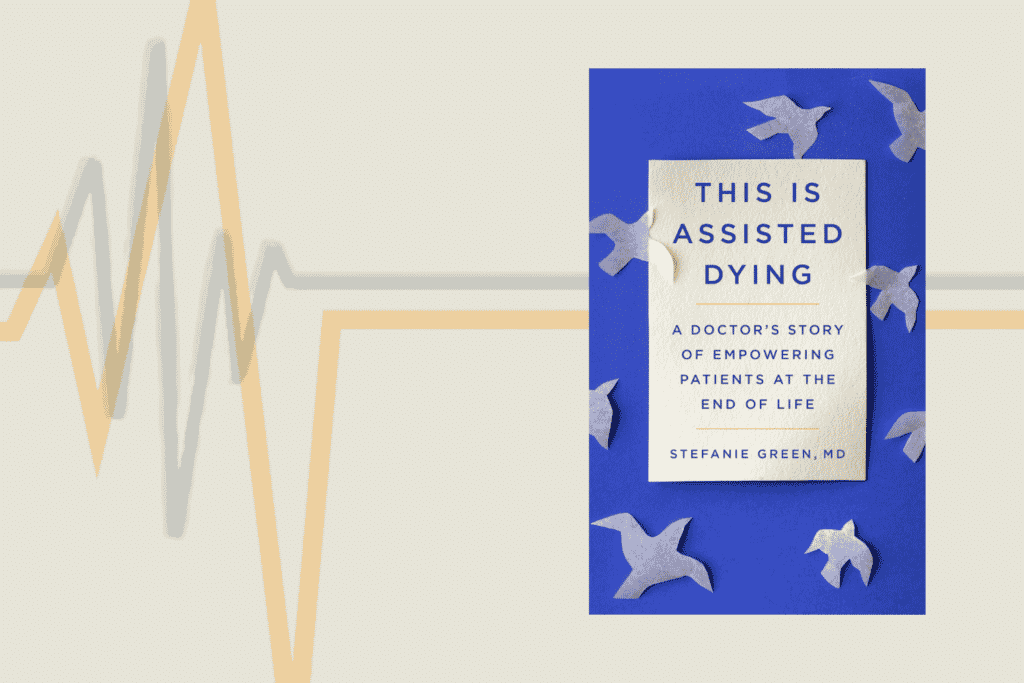
One of Indigo’s “most anticipated books of 2022” was This is Assisted Dying, a memoir by euthanasia provider Dr. Stephanie Green. This shows how entrenched the culture of death has become, that readers were eagerly anticipating this book. Having followed the progression of euthanasia in Canada very closely, we were curious to read this firsthand account of a doctor who has dedicated her career to promoting and providing euthanasia.

Dr. Green is a euthanasia provider in Victoria, BC. She previously practiced maternity and newborn care until euthanasia, which she refers to as MAiD (Medical Assistance in Dying), was legalized in Canada. At that time, she shifted her focus to providing euthanasia full time.

This is Assisted Dying is the story of Dr. Green’s first year providing euthanasia. She takes the reader on a journey to the most intimate situations her patients face and explores the vulnerability of patients at the end of life. She tells the stories of patients who are suffering terribly and want desperately for it to end and portrays herself as helping people by ending their suffering. Green is very focused on wording things in a certain way so that it doesn’t sound too much like she is killing a person. She calls the euthanasia procedure a “delivery,” viewing it as delivering a person to their death, just as she delivered newborn babies in her previous practice. She claims she is “empowering the person, not the disease.”  (pg 52)

Green paints a seemingly beautiful picture of how patients can “choreograph their death,” reflective of a culture that is obsessed with control over every aspect of their life from conception to death. She asks the reader to imagine a scenario: 

“What if you could decide, at the end of your life, exactly when and where your death would happen? What if instead of dying alone, in the middle of the night, in a hospital bed, you could be at home at a time of your choosing? You could decide who would be in the room with you, holding your hand, or embracing you as you left this Earth. And what if a doctor could help ensure that your death was comfortable, peaceful, and dignified? You might never look at death the same way again.” (pg 1)

A significant factor in all euthanasia discussions is this concept of dignity. Green’s research showed that the most common reason to request euthanasia was loss of autonomy and the loss of a sense of dignity. This stems from a viewpoint that does not include God, where people believe their dignity comes from how they perform and are perceived in this world. Where there is no concept of inherent dignity, there is also no sense of purpose in suffering.

One point that keeps coming up throughout the book is Dr. Green’s determination to operate within the law. She did not provide euthanasia before it was legal, and she is very determined to follow whatever regulations are currently in place. This begs the question, though – what happens when the law permits assisted death for more and more patients? Does the law determine what is right, or are there cases where her conscience would not allow her to provide euthanasia, such as a patient suffering from mental illness, or a minor?

In reading this book it seems possible that Dr. Green would indeed have a point where she would not support certain patients receiving euthanasia. However, additional research reveals her part in a recent submission to the Special Joint Committee on Medical Assistance in Dying in which they outline a protocol to euthanize even infants under the age of one. It seems that there is no end to the Canadian Association of MAiD Assessors and Providers’ (of which Dr. Green is a member) willingness to provide euthanasia. If a patient wants to be killed (or their parents want them euthanized, in the case of minors), any life is fair game when they view themselves through a lens of compassionate helping.

Dr. Green’s book is a good example of how well-intentioned people can go awry if they don’t have a strong foundation in God’s truth. This is Assisted Dying dresses euthanasia up in emotional language to deceive the reader into thinking that having doctors kill suffering patients is an act of compassion. Do not be fooled. Recognize instead how neglecting the biblical concepts of inherent dignity and sanctity of life has a devastating effect on the most vulnerable among us, and be renewed in your determination to stand against the expansion of euthanasia in Canada.