November 29, 2021

For immediate release

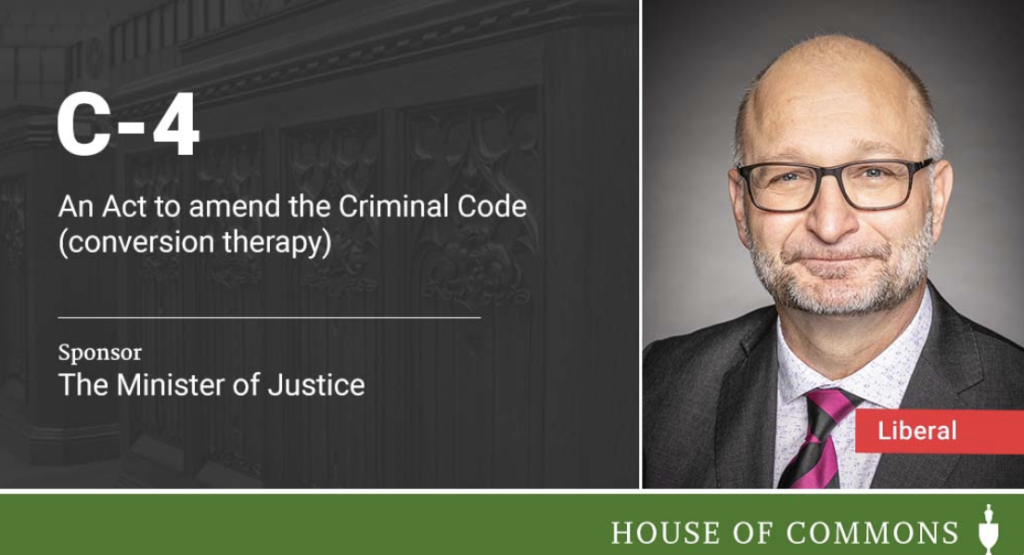
Ottawa, ON – Earlier today, Justice Minister David Lametti tabled Bill C-4, an act to criminally ban the practice of conversion therapy. The bill will criminalize counselling for LGBTQ+ Canadians who want to reduce unwanted “non-heterosexual behaviour.”

“This law will hurt LGBTQ+ Canadians as well as those questioning their gender identity,” said André Schutten, director of law and policy with ARPA Canada. “It will deny them the broad range of choices for counselling and spiritual support that are freely available to all other Canadians. In a word, this bill is discriminatory.”

During debate on this bill’s predecessor, many legal and religious organizations urged MPs to be mindful of the lack of consensus in Canada on how best to treat gender dysphoria, to not criminalize body affirming counseling, to clearly define the term “conversion therapy,” to listen to those who have de-transitioned or desisted from a transgender identity, and to encourage a full exploration of comorbid conditions underlying a patient’s gender dysphoria before initiating invasive medical treatments.

Bill C-4 goes even further than the Liberals’ previous attempts to pass a conversion therapy ban. The previous bill would have allowed a heterosexual teen to get help reducing their unwanted sexual impulses (a porn addiction, for example) but would have criminalized a gay or lesbian teen for pursuing similar help. Bill C-4 proposes that this now be extended beyond children and minors so that even adults in the LGBTQ+ community will not be allowed to pursue counselling they desire.  

Schutten expects Bill C-4 to receive vigorous debate as it makes its way through the House of Commons. “Bill C-4 defines conversion therapy so broadly that I expect members of the LGBTQ+ community, religious groups, medical professionals, and feminists will unite as unlikely cobelligerents in urging amendments to this bill.”

In the last Parliament, the Justice Minister refused to make common-sense amendments that would have clarified the law, made the bill constitutionally sound, and satisfied the concerns expressed by a diversity of groups, while still prohibiting conversion therapy. “Minister Lametti insisted on putting partisan politics ahead of good law by keeping the definition overly broad and vague,” said Schutten. “It is up to this Parliament to fix that and turn this poorly drafted bill into a strong piece of legislation that a wide spectrum of Canadians can support.”

ARPA Canada will be working with MPs, including the House of Commons Standing Committee on Justice and Human Rights, to urge amendments that will improve and clarify this bill.

– 30 –

ARPA (Association for Reformed Political Action) Canada has a mission to educate, equip, and encourage Reformed Christians to political action. We also take a biblical perspective directly to our elected leaders and the courts.

ARPA is non-partisan and does not promote or oppose any party.

André Schutten is available for further comment. He can be contacted at [email protected] or 1-866-691-2772

For immediate release – Ottawa, ON
June 22, 2021


Senate amendments needed to make conversion therapy law one that LBGTQ+, feminist, and religious groups can all support

A majority of MPs voted in favour of Bill C-6 today, pushing the bill to criminalize “conversion therapy” into the Senate. No organization in Canada opposes the principle of banning coercive or tortuous therapies. However, Bill C-6 defines conversion therapy so broadly that some members of the LGBTQ+ community, religious groups, medical professionals, and feminists have spoken out against the bill, urging amendments.

“We support a bill banning conversion therapy, but not this bill, because it bans more than conversion therapy,” said André Schutten, a constitutional lawyer and ARPA Canada’s Director of Law and Public Policy. “Experts in law and medicine, and advocates from a wide variety of groups across this diverse country are rightly concerned about the impact this bill will have on reducing the availability of psychological and spiritual help for those struggling with deep existential questions.”

ARPA Canada condemns coercive practices designed to alter a person’s sexuality through pain, pharmaceuticals, surgery, or shaming rituals. But C-6’s definition of conversion therapy goes well beyond these archaic practices, capturing counselling and psychological support for those who struggle with gender dysphoria, as well as spiritual counselling around questions of sexual ethics and identity.

“The Justice Minister refused to make common-sense amendments to the legislation that would have clarified the law, made the bill constitutionally sound, and satisfied the concerns expressed by feminist groups, LGBTQ+ advocates, and religious leaders while still prohibiting conversion therapy. Minister Lametti insisted on putting politics ahead of good law by keeping the definition overly broad and vague. Sadly, a majority of MPs went along with it today,” explained Schutten.

“We are now looking to the Chamber of Sober Second Thought to make simple amendments to the definition in the bill so that parents don’t risk five years in jail for asking a counsellor to help them work through gender dysphoria issues with their child.”

Many feminist organizations (including Alberta Radical Feminists, Alberta Women’s Advocacy Association, Canadian Women’s Sex-Based Rights, Pour les droits des femmes due Quebec, We the Females, and the Women’s Human Rights Campaign) urged the Standing Committee on Justice and Human Rights to adopt amendments to ensure supports remain in place for girls in an overly sexualized world. ARPA Canada and many other legal and religious organizations made substantially similar requests. They urged MPs to be mindful of the lack of consensus in Canada on how best to treat gender dysphoria, to not criminalize “non-affirmative” psychotherapy, to clearly define the term “conversion therapy,” to listen to those who have de-transitioned or desisted from a transgender identity, and to encourage a full exploration of comorbid conditions underlying a patient’s gender dysphoria before initiating invasive medical treatments.

“We have been so encouraged to see the number of faith leaders who have met with their MPs to explain why C-6 needs to be improved. And it has been particularly encouraging to see that this concern is held by a wide spectrum of Canadians, regardless of their faith or worldview,” added Schutten. “Sadly, this government, with the support of most other MPs, chose to ignore these concerns. It isn’t only parents and pastors who are going to be hurt by this. This bill will hurt LGBTQ+ Canadians the most. It will deny them the broad range of choices for counselling support that are freely available to other Canadians. It is now up to the Senate to turn this sloppy bill into a strong piece of legislation that protects vulnerable children and that a wide spectrum of Canadians can support.”

– 30 –
ARPA Canada’s brief to the Standing Committee on Justice and Human Rights is available here. A summary of recommendations from Canadian feminist groups is available from ARPA Canada upon request.
André Schutten is available for media interviews today and tomorrow. He can be contacted directly at 
[email protected] or 613-297-5172

Pastor Rodney Vermeulen shares some of the challenges of ministering to those experiencing gender and sexual confusion and how Bill C-6 will impede this work.

Pastor Tim Schouten shares his concerns with Bill C-6 and why he will keep bringing the gospel to those experiencing confusion about their sexuality.

It’s been nearly 15 years, but abortion is going to be debated in the House of Commons again! This week’s Quick Updates includes this, a number of other updates on Bill C-6, and a special announcement from Elyse!

Pastor Paul Dirks speaks about the intentional ambiguity of the language in Bill C-6 and how it poses a threat to his work as a pastor in his church.

Pastor Paul Dirks speaks about the intentional ambiguity of the language in Bill C-6 and how it poses a threat to his work as a pastor in his church.

Painting London pink, Christian engagement in the forgotten level of government, a Manitoba update, and praying about Bill C-6

Painting London pink, Christian engagement in the forgotten level of government, a Manitoba update, and praying about Bill C-6

In the past number of months, ARPA Canada has met with dozens of lawmakers to discuss our concerns with Bill C-6, An Act to Amend the Criminal Code (conversion therapy). At numerous times during those meetings, I outlined a fictitious scenario to make this more real. The scenario went like this:

“Imagine that I have a 9-year-old son and he recently came home from school expressing that he thought he was a girl trapped in a boy’s body. He wants to go to school in girls’ clothes. Rather than affirm his thoughts, I told him that God had made him a boy and that, although his feelings he had were not uncommon, his mother and I would continue expressing our love for him as our son. A few weeks went by and he again expressed similar thoughts. We assured him that he was a boy, our son, and asked if he wanted to go and see the Pastor to chat about it some more.”

At this point, I would ask the lawmaker if Bill C-6 (when passed into law) would criminalize my actions. The responses varied depending on who we were meeting with, but they ranged from, “I certainly hope not!” to “Well, I’m not sure, but what you’ve outlined sounds like child abuse.”

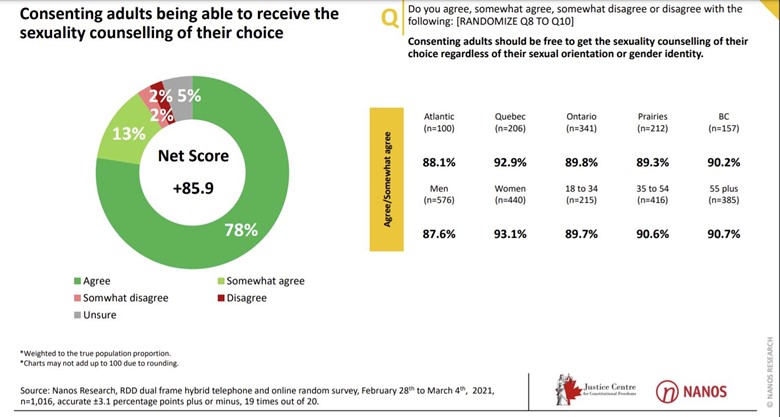
This varied response was also reflected in a recent national survey conducted by Nanos Research for the Justice Centre for Constitutional Freedoms. The survey covered a number of aspects of counselling regarding sexuality (for both adults and children).

When asked about their views on the legality of counselling for minors, Canadians are divided relatively evenly, with slightly over a third consistently opining that such counselling should be legal, just under a third judging that it should be illegal, and about one third consistently saying they were unsure.

From a Christian worldview perspective, it is disheartening that so few Canadians support counselling for questions about gender and sexuality. Yet, as you can see from this slide, there are still slightly more Canadians who believe that these forms of counselling for minors should remain legal, and the fact that one third are unsure should certainly be a reason to be cautious about prohibiting this counselling entirely.

The survey also asked participants for their views regarding sexual counselling for consenting adults. As you can see from the slide below, the results for this question were much clearer – a strong majority of Canadians agree that consenting adults should be able to get this form of counselling, regardless of their gender identity or sexual orientation.

ARPA Canada believes that Bill C-6 is hugely problematic for a variety of reasons. We agree that conversion therapy, as properly defined, has no place in Canadian society. But this bill is so broad in its scope that it threatens to criminalize counselling that, as this Nanos survey show, Canadians either support or hesitate to regulate.

As Bill C-6 is scheduled to be debated again during the week of April 12th, please also know that in the coming weeks we will have numerous action items associated with it. You can find out more about this topic and these action items here.

May God graciously prevent our country from criminalizing counselling for children who are struggling with unbiblical desires or identities and for consenting adults seeking the counselling of their choice.


Mike Schouten is the Director of Advocacy for ARPA Canada