IMG_7390**UPDATE: The Justice Committee decided to leave section 176 alone after receiving overwhelming response from the public and our supporters. We are very thankful for this development.**

The Standing Committee on Justice and Human Rights is currently studying Bill C-51. This bill is meant to clean up Canada’s Criminal Code by removing outdated, unconstitutional, and redundant provisions. Much of the discussion of the Committee has been on one particular provision – clause 14 of the Bill proposes to remove section 176 of the Criminal Code. That section prohibits obstructing a religious official or disturbing a worship service. You can see ARPA’s analysis of section 176 here.

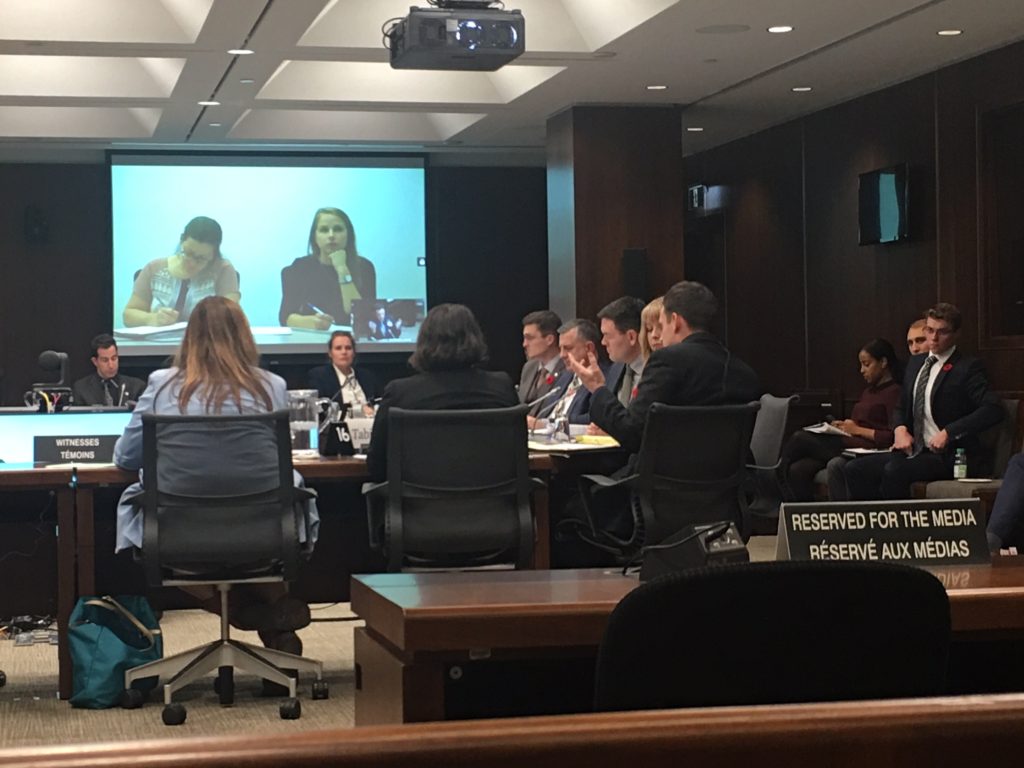
ARPA’s Director of Law & Policy, André Schutten, presented ARPA Canada’s concerns to the Standing Committee on October 30th together with articling student Tabitha Ewert. You can listen to the audio here. In his presentation, he explained that what happens in a religious service is different in kind than other gatherings. The preaching of the gospel, praise and worship are deserving of special protections.

He went on to address whether section 176 is redundant by giving an analogy. Our Criminal Code prohibits not only assault, but also different types of assault including sexual assault. The fact that sexual assault could be charged under a general assault provision is no reason to remove it. We recognize that it is different than general assault and worthy of special denunciation. The same is true for disrupting a worship service. We may tolerate demonstrators interrupting a university lecture for a time, but treating a worship service in the same manner would be detrimental to the religious community.

André also mentioned an open letter to the Justice Minister urging Parliament to keep section 176 that has been signed by representatives of various Muslim, Jewish, Sikh, Buddhist, Coptic, Catholic and Protestant communities, including representatives of Reformed communities. You can read that letter here. Religious communities across Canada are concerned about losing this explicit protection of their worship services and are unsure that other provisions will suffice.

ARPA also provided a thorough written submission to the Committee. It includes proposed amendments to section 176 to update some of the language and tailor it more closely to the objective of protecting religious worship. On Wednesday, November 8th, the Committee will conduct a clause by clause analysis of the bill at which time they will determine whether to keep section 176, amend the section, or scrap it altogether. Please take the time to send this EasyMail to your Member of Parliament, (it will be automatically copied to members of the committee and to the justice minister) asking them to keep or amend section 176.

ARPA’s Director of Law and Policy, André Schutten, appeared before Parliament’s Justice Committee last week, arguing against a change to the Criminal Code.

As part of a new law called Bill C-51, the government wants to remove a section of the Criminal Code that expressly prohibits anyone from interfering with a religious service that’s in progress, and also protects members of the clergy from being harassed or interfered with on their way to or from a religious service.  The government argues that this kind of behaviour is already forbidden in other sections of the Code -the sections prohibiting mischief and harassment, for example – and that disrupting a religious service is really no different than a protest against a public rally at a park. But in his appearance before the Committee, André Schutten argued that disrupting a religious service is substantially different “in kind” from other kinds of protests. An example, he said, would be if someone were to suggest other amendments to the Criminal Code, like simplifying the law against assault.  “We already have assaults prohibited in Section 265; (why don’t we) get rid of sexual assault (as) prohibited in Sections 271, 272, and 273?”  Schutten said he expected the Committee would disagree with that because there’s “something different ‘in kind’ with sexual assault… therefore we need both provisions to be in the Criminal Code, because we’re deterring two different things.”  While he acknowledged his hypothetical situation wasn’t a perfect analogy, he insisted the example is analogous to the notion that disruptions to “religious services are different ‘in kind’ from (disruptions to) a university lecture or a rally in a public park.”

The Committee is considering whether to take that section out of Bill C-51 this week; you can send your MP and Committee members an EasyMail on this subject at this link.

https://staging.arpacanada.ca/c51easymail

Today we’re asking for your help to remind Parliament to protect the church so that the Gospel can be preached without interference, without any protesters disturbing worship. Bill C-51 looks to remove section 176 of the Criminal Code that protects our worship services. Use EasyMail to tell the Justice Committee and Justice Minister to keep 176: https://staging.arpacanada.ca/c51easymail.

For more information on ARPA Canada, visit: https://staging.arpacanada.ca/.

Colin Postma of the Association for Reformed Political Action (ARPA) Canada provides updates on what’s happening this week.

For more information on ARPA Canada, visit: https://staging.arpacanada.ca/.

A Calgary MP has launched an official House of Commons e-Petition on Bill C-51. That’s the law we told you about earlier this summer on Lighthouse News. It would specifically repeal Section 176 of the Criminal Code, which makes it a crime to disrupt any worship service, or to assault or prevent anyone from conducting such a service.

Conservative MP Tom Kmiec isn’t buying the various arguments the government is using to defend the new law. The government says the issue is already covered in prohibitions against causing a disturbance, uttering threats or intimidation, or inciting hatred. Kmiec says he has a problem with the logic behind that thinking. “Why would you want to do something four different ways when you can do it just one way, which is Section 176?” He also discounts government arguments that the section is obsolete, citing a recent case in Ottawa where a woman was charged in a case where a Catholic church service was disrupted and a statue of the virgin Mary was vandalized.

Kmiec says the change also doesn’t make sense in a context where Parliament has just passed another law toughening penalties specifically for mischief against religious properties if that mischief is motivated by hatred. In fact, he says, Statistics Canada data shows that more than a third of reported hate crimes in Canada were motivated by hatred of a religion, and repealing Section 176 would remove valuable protection for faith leaders and assemblies.

The petition would need a minimum of 500 signatures to be formally introduced into the House of Commons; the petition almost hit that threshold within the first week of being posted. Kmiec is hoping for a minimum of 7,400 signatures to at least match the numbers of a campaign from the BC Humanist Society, which is seeking to remove laws against blasphemy from the books. Kmiec says it is critical that “people of different faiths (show that they) take their faith and the disruption of their ceremonies very seriously.”

You can sign the petition at www.keep176.ca.

As we told you a few months ago on Lighthouse News, the federal government is making a move to eliminate so-called “zombie laws”. These are essentially old laws which are no longer in effect. The most common reason for their obsolescence is that they’ve been struck down by the court. While those laws are technically still on the books, they have become unenforceable, so they need to be removed to reflect that reality. But earlier this month, the federal Liberals introduced a second bill to eliminate some other old laws, and one of those eliminations could have an impact on every single pastor, and every single church, mosque, synagogue, or Sikh temple in the country. This is a completely separate bill from the one we discussed back in March. On the feature today, ARPA’s Law and Policy Director, André Schutten, on what the government is doing with this latest bill.

LN: Andre, let’s start with some background on the difference between these two bills.

AS: So they have a zombie law [Bill C-39] already and that one targets all these old Criminal Code provisions that were ruled unconstitutional, right? And so, I’m not really sure what the government’s up to. It might be that they’re trying to pass other stuff through this one and they use that description as cover. So C-39, which is also that – unconstitutional provisions, right – it’s “An Act to amend the Criminal Code (unconstitutional provisions) and to make consequential amendments to other Acts” from the Minister of Justice. So that one is the zombie law one. So I don’t know what else they’re trying to do with C-51, but I imagine that what they’re trying to do is they’ve got this cover going on, and they’re saying “Look! All we’re doing is cleaning up the Code again, and we’re just taking care of anything that’s probably unconstitutional.” But what they’re doing with that is they’re also taking out sections that aren’t unconstitutional; that are actually good sections (but) they just don’t feel like debating them.

LN: And that brings us to the central issue here. Right now, the Criminal Code says you can’t harass or assault a clergyman or minister in connection with him performing his duties, on the way to or from a worship service for example. And… you can’t disturb or interrupt a worship service while it’s underway. That is specifically addressed in the Criminal Code. But section 14 of the new zombie law, Bill C-51, specifically moves to eliminate that part of the Criminal Code.

AS: Yeah, so this one clause – Clause 14 – is key to that. Clause 14 is the one that removes protections for worship services. Whether that’s Christian worship services or Islamic or Jewish or Hindu or Sikh worship services; it’s written very broadly and says that anyone who disrupts these worship services is “guilty of a criminal offence.” And that’s a good provision to have, and yet they’re removing it, for no apparent good reason anyway.

LN: ‘I’m looking at that clause and I looked at it initially and I went: “Wow. This is really big.” And then I got to thinking about it and in the government’s defense – and I’m not defending the government, but just to play devil’s advocate for a minute – what’s the last time this provision was ever used? I mean, this is an ancient law that said you’re not allowed to disrupt a church service. Could the argument be made that being a multicultural, pluralistic society, church services aren’t special enough to require a specific clause in the Criminal Code to protect the conduct there?

AS: So, in reviewing some of the transcripts from the House of Commons on debate on this, Mr. Tom Kmiec – he’s a Member of Parliament from Alberta – he pointed out that this section has actually just been used a couple of weeks ago right here in Ottawa, where somebody has been charged under this provision. So in that sense, it is still a “live” section of the Criminal Code; it is being used.

And I think what’s driving the desire to remove this section from the Criminal Code is an attitude that a religious service is no different than a university lecture for example. And why should we give special protection to religious ceremonies if we don’t give it to, you know, a university lecture? And you can imagine, right, it’s been in the news; professor Jordan Peterson for example tried to give a lecture at McMaster University, the University of Toronto, (and) elsewhere, (and) he gets shouted down by protestors, right?

And so some people might say, “Well why – if we’re not gonna give criminal law protection to Jordan Peterson to give his lecture – why would we give it to a minister to give his sermon?” And I’d say that fundamentally the two are very, very different. A university lecture is one thing, but a religious service is something at a much different level. It’s something much more profound going on. And whether you’re Christian or not, I would say that protection ought to be there for a Muslim service – like a prayer service as a mosque – or it should be there for a Jewish service at a synagogue, or at a Christian service at a church. And I think that the government should not be afraid that this section is in any way unconstitutional; it certainly never has been ruled unconstitutional. So we should keep it.

And we need it in today’s society. Again, thinking of the Jordan Petersons of this country that get shouted down (while) giving a lecture, it’s not that hard to imagine that we might one day see people disrupting – in big ways – Christian services where orthodox teaching is being preached from the pulpit.

LN: Is this a fundamental shift in Canadian society? I mean, here we have on the one hand a government that pushes through (Bill) C-16, (that) says you have to use whatever pronouns somebody says they want to be described as, and on the other hand they’re removing this historical context of protection for religious services. It seems to me that there’s a fundamental reshaping of society going on here.

AS: Yeah, I think so. Absolutely. It seems to me there’s this fear of our Christian heritage. There’s this fear of our Christian past. And while I would say it’s absolutely true that the history of this particular section does have to do with Christianity and the Christian faith and protecting church services, that doesn’t mean that it has no value today. Even though we are definitely not a Christian nation anymore, we definitely should be protecting (the) Christian faith but also, again, other faiths should be protected in this respect as well.

And the counter-argument might be made that “Well, you know, we took out those sections but don’t worry; there’s still a section about criminal trespass,” right? So people can be charged under criminal trespass. But that, again, shows a total ignorance of what a worship service is. Now I can’t speak for the Jewish faith or the Muslim faith or the Sikh faith, but certainly for the Christian faith, our worship services are public events. It’s a public worship service. So, you know, we can’t exactly criminally charge protestors who come to a church service if we’re so public about our worship. Our worship is open to the public; we want other people to be able to come. They’re welcome in our church buildings. We want them to hear the Gospel. We want them to get to know Jesus Christ. But yeah, if they’re going to be disruptive and so on then we want to be able to also have the criminal law protection to make sure that that doesn’t happen. So we see ignorance of the Christian faith here, we see the ignorance of our history here. We see ignorance of the possible risks to not just the Christian faith but to all faiths with the approach being taken here. And I think that’s problematic all around.

LN: Is there anything we can do stop C-51? I mean, how do you mount a legal challenge on something that takes something away? It’s kind of a complicated piece.

AS: Indeed. We can’t exactly make a claim that – I don’t think – that we have a constitutional right to this provision. At the same time, we can make the argument that there is no constitutional reason to remove this provision. And so, certainly we are going to apply to the Standing Committee on Justice and Human Rights – that’s where this bill is now – so that’s the Committee stage in the House of Commons, and we’re going to lobby to get that Clause 14 removed. We haven’t looked at the rest of the bill yet, so there might be good parts in the rest of the bill, I’m not going to condemn the entire bill, but this one clause – clause 14, which removes protection for our pastors and our worship services – definitely has to be cut out of that bill.

Take Action: Send an EasyMail letter to share your concerns about Bill C-51 with your MP


churchDid you know that Canada’s Criminal Code (section 176) prohibits obstructing a “clergyman or minister” from “celebrating divine service or performing any other function in connection with his calling” or disturbing “an assemblage of persons met for religious worship”?

That prohibition might not be there for long. A new government bill, Bill C-51 (which has passed its second reading and has been referred to committee), would delete these prohibitions from the Code. Would that mean removing legal protection for churches or ministers? Not exactly.

What is Bill C-51?

Bill C-51 is meant to clean up the Criminal Code – not make any big changes. The idea is that anyone should be able to read the Code and know what is illegal. With that aim, this bill removes unconstitutional provisions, cleans up the wording of others, and removes outdated provisions such as prohibitions on dueling, pretending to practice witchcraft, and setting off a stink bomb.

Where Bill C-51 does make substantive change is around sexual assault offences particularly around the requirement for consent.

However, tucked away in clause 14, this bill removes section 176 of the Criminal Code.

What is Section 176?

First, section 176 prohibits obstructing a minister who is performing a religious ceremony. Second, it prohibits disturbing an assembly (whether the purpose of the assembly is religious, moral, or social). Finally, it prohibits disturbing the order or solemnity of a meeting (again whether the purpose of the meeting is religious, moral or social).

For example, in the 1990s a disfellowshipped Jehovah Witness came to a service with protest signs, talked to congregants as they arrived (causing one elderly woman to leave), and knocking at the doors during the service (R. v. Reed, [1999] B.C.J. No. 2868). His sentence was 3 years probation.

It was used also in 2005 when a dinner put on by a Christian group was interrupted by protesters. The speaker had to leave the podium and the event could not continue until police arrived (R v Geoghegan, 2005 ABPC 255). The protester was ordered to pay a $500 fine.

Most recently, charges were laid on June 9th of this year against a woman who is alleged to have entered an Ottawa church screaming and causing damage to a religious statue.

Why remove Section 176?

So, why remove section 176? The answer to that question is unclear.

When asked during an exchange in the House of Commons, Liberal MP Marco Mendicino (Parliamentary Secretary to the Minister of Justice) asserted that each provision Bill C-51 proposes to remove is either unconstitutional, redundant, or obsolete.

However, there has been no court ruling that section 176 is unconstitutional, nor does it appear to be obsolete given that it has been used just this month.

That leaves the argument that it is redundant.

Is Section 176 redundant?

There are a couple of Criminal Code prohibitions that may capture the same activity as section 176.

Specifically, section 175 prohibits causing a disturbance in a public place by screaming, swearing, or singing, among other things. “Public place” here means any place open to the public and would include churches. The main question is what constitutes a disturbance. The Supreme Court has said a disturbance is “something more than mere emotional upset or annoyance…[and] must cause an externally manifested disturbance of the public peace” (R. v. Lohnes, [1992] 1 S.C.R. 167).

Disturbance has the same meaning under section 176. There might have been a time when section 176 captured more specific acts than section 175, whether it be shouting idolatry during a service (Girt v. Fillingham, 1901) or singing loudly while a minister is speaking (Matthews v. King, [1934] 1 K.B. 505). However, there are not any recent examples that would clearly distinguish the application of sections 175 (causing a disturbance in a public place) and 176.

Other redundancies would depend on the severity and type of conduct. More serious conduct might constitute causing mischief by interfering with use of property (section 430) or assault (section 265). Less serious conduct, such as trespass or nuisance, might fall under provincial or municipal laws.

Should we be worried?

Removing this provision does not create open season for disrupting churches or any other place of worship. There is other protection afforded by the Code. The removal of this provision will not allow assaults on ministers or violent protests in temples, but the question is how it will impact borderline instances. What about the disgruntled individual yelling as the service starts? What about the protesters who bring offensive signs outside a mosque? When do these activities cross a line into becoming disturbances? Section 176 directs a judge to consider the context: did the alleged disturbance take place in an assembly with a religious, moral, or social purpose? Bill C-51 would remove the explicit direction to judges to take the particular setting into account.

As it is now, under both sections 175 and 176, what constitutes a disturbance is a very fact specific analysis with reference to the context. Swearing or yelling on a street corner will likely not be a disturbance, but the same conduct in another setting might be. The benefit of having section 176 is that it makes clear that protection of assemblies (rather than just the general public) is beneficial. It sends a message that communities should be able to gather for religious, social or moral purposes without fear of disruption either from individuals or disagreeing communities.

Furthermore, while we enjoy relative peace between religious groups in Canada, that has not always been the case, nor should we assume that it will continue. The tension between Roman Catholics and Protestants in Canada’s early years might well have justified section 176. As Canada welcomes more people of diverse faiths and conversations around controversial cultural issues increases tension, it is likely that we will have greater need for section 176, not less, in the coming decades.

While section 176 might be more symbolic than substantive in the government’s view, ARPA Canada sees much value in keeping section 176. In a climate where it seems like hostility to religious groups is growing, it is preferable to have explicit protections and to keep section 176 in the Criminal Code.


easymail_logo

If you agree with our assessment, send your Member of Parliament a note of concern, urging amendment to Bill C-51. While the rest of the bill is commendable, we recommend removing clause 14 so as to preserve section 176 of the Criminal Code. You can use the EasyMail below, which will Cc the Minister of Justice as well as the members of the Standing Committee of Justice which is studying the bill over the summer and into the fall.

Concerns with Bill C-51

As always, edit it as you like, and please be respectful. Thank you!