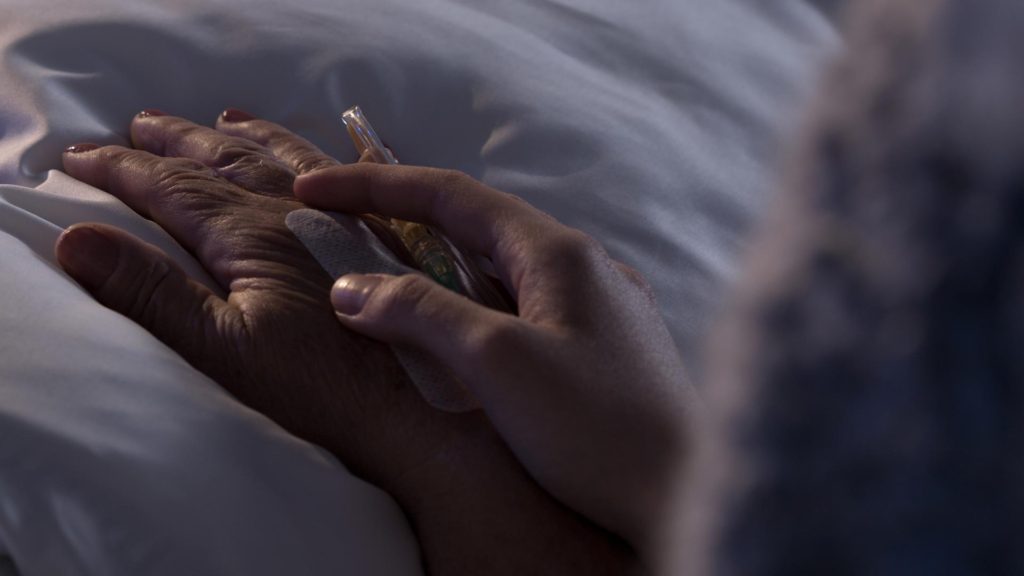
The Senate has started Committee hearings on Bill C-277. That’s a private members bill from Sarnia-Lambton MP Marilyn Gladu which calls for the establishment of a national palliative care strategy in Canada.

Gladu kicked off the Committee hearing last week by talking about several components of the bill, including the notion that there is a need for better training in palliative care across the country. She says there are only about 20 palliative care specialists in Canada today, and with an aging population, the need for about 600. “But it’s not just the specialists,” she told the committee. “At the General Practitioner level, in some cases they don’t even get two months of palliative care training, and nurses are graduating with no palliative care training. Home care and hospice workers sometimes don’t have a level of training they need, and in rural and remote communities, many times it’s family members that are giving palliative care.” It’s time, she said, to “provide that training and set some standards in that area.”

ARPA’s Colin Postma sat in on the Committee hearing. He says it appears that just like in the Commons, the Bill will receive all-party support in the Senate, although there’s no word on when it will come back to the Senate Chamber for a final vote.

There was an emotional debate in the Senate last week about language and choice of words. On the feature this week, we present an edited version of that debate, which started when Manitoba Senator Don Plett rose on a point of order.

—-

Senator Plett: Yesterday in this chamber, a senator in her maiden speech, her first speech in the Senate, accused me of bigotry… To attribute such a serious charge as bigotry to the phrase “these people” is preposterous, and I will read what I said so that we are all clear. This was in reference to Senator Wetston’s speech last week. I had a question, and the question was this:

“When you talk about gender parity, and there is a male who identifies as a female, or a male who identifies as no gender, or an ethnicity that identifies as no ethnicity, where do we put these people in the realm of gender parity?”

When proponents of the legislation I was asking about said, “These people have waited long enough,” or “These people deserve equal protection under the law,” I trust that the senator would not insinuate that those comments were of a bigoted nature.

Colleagues, this is not about me. This is about this chamber and the comments that were disparaging to this chamber….

Hansard is a public document in which our grandchildren – yours and mine – and future generations will have the opportunity to read about the important work we have done in this chamber.

It bothers me tremendously that my grandchildren and my great grandchildren will read that I was accused of bigotry on the chamber floor.

Your Honour, pursuant to Rule 6-13: All personal, sharp or taxing speeches are unparliamentary and are out of order.

Accusing someone of bigotry is a personal attack of the highest order, and, as such, Your Honour, it is my assertion that these comments in fact were out of order.

Senator McPhedran: Your Honour, thank you for this opportunity. I’m very sorry to hear that Senator Plett feels that I called him a bigot. I did not. My comment was addressed to a practice that can slip into many a debate, either here or elsewhere, of othering, and the damage that can happen when that becomes a practice. I’ve reviewed both the language that Senator Plett used last week that I referred to, and some of the other comments of some other senators who have expressed concerns about transgender rights, such as impact on their ability to use a bathroom, impact on their ability to express themselves.

And…I wanted to be very clear that it was as much tone as it was word. To my ears, I heard othering.

I then went on to indicate that it “can be” – I did not say that it “was” in this instance – an indicator of bigotry. And that, in a very general statement, was what I intended.

Then I went on to say that bigotry does not belong in an inclusive constitutional democracy.

Again, my intention was a general statement. What I was trying to do was to bring my own perspective as a human rights specialist, wanting to respect individual senators and the debate but also wanting to make a general observation about language that can slip into a damaging territory, perhaps not even with intent.

Senator Plett, what I would like to say to you, though, senator-to-senator, is that I do regret the experience that you’ve had from my words, and I hope that the clarification that I’m offering as to the general nature of my comment will be helpful in reducing the hurt that you’ve expressed.

Senator Daniel Lang: Colleagues, I’ve been listening to the debate. We had better cut to the chase here. I think Senator Pratte said it very well. It’s very easy to watch a senator being attacked personally and to sit here and rationalize why another senator would do this.

Quite frankly, what’s happened is totally unacceptable. I would ask, as a senator, to my new friend, Senator McPhedran, to stand up in her place and withdraw her remarks.

Senator McPhedran: Let me just say that the general point I was making about othering can stand without reference to any individual senator, that the language that is othering can be understood as an indicator of bigotry, and bigotry has no place in an inclusive democracy. I’m certainly prepared, given what I’ve heard from Senator Plett, to ask if any reference to Senator Plett could be removed — that would be the first two sentences — and leave a general statement about language that is othering.

I hope that that will be experienced as sufficient to make it clear that there is no evidence in the words that I spoke yesterday that I called Senator Plett a bigot. I did not.

– – – – – – – – – – – – – – – – – – – – – – – – – – – – – – – – – – – – – – – – – – – – – – – – – – – – – – – – – – – – – – – – – –

That debate happened last Wednesday. On Thursday, Senate speaker George Furey issued his ruling…

– – – – – – – – – – – – – – – – – – – – – – – – – – – – – – – – – – – – – – – – – – – – – – – – – – – – – – – – – – – – – – – – – –

The Hon. the Speaker George Furey: I know that we do give some leeway to new senators, particularly in their first speech. However, the remarks alluding to Senator Plett were outside the bounds of acceptable parliamentary debate. They were hurtful and inappropriate.

The language in Senator McPhedran’s speech of February 14 can, in the context it was used, be characterized as unparliamentary. The point of order is well founded. I strongly urge Senator McPhedran to avoid offensive personal language. Colleagues, let us continue to engage in respectful debate and avoid, at all times, personal attacks.

The transcript above is of the debate as we edited it for time on the program.  Many more things were said, and the full debate can be found online at the Senate Hansard website.

For the debate on Wednesday, click here.

For the full text of the Speaker’s ruling, click here.

In both instances, you’ll need to scroll down the page to “Orders of the Day.”

Support C-277

action-bg-palliative-careLast year the Supreme Court of Canada overturned hundreds of years of legal, medical, and moral precedent, when it struck down the Criminal Code prohibitions on assisted suicide in the Carter case.  The Supreme Court gave Parliament the task of creating a system in which some people may kill others in some circumstances.

On June 17, Bill C-14 became law after bouncing back and forth between the Senate and House of Commons.

This law formally legalized euthanasia and assisted suicide in Canada.

While the law was being crafted, we were able to engage with this policy debate in a huge way. With your help and by God’s grace, our message resulted in some positive changes to the law and helped mitigate the evil that was being endorsed by many Canadians. (more…)

Marilyn Gladu, MP for Sarnia-Lambton spoke on May 31, 2016 at a press conference for her private member’s bill,

Marilyn Gladu

Bill C-277, “an act providing for the development of a framework on palliative care in Canada.” This timely bill comes in response to the lack of palliative care available in Canada and the lack of any palliative care provisions in government’s C-14 euthanasia legislation which is moving quickly through Parliament. This Private Member’s bill emphasizes the Liberal government’s commitment to the “importance of extending access to palliative care to all Canadians in the context of physician-assisted death.” With that in mind, Bill C-277, instructs the ministry of health to work with palliative care professionals and provincial leaders in health to apply national palliative care standards.

At the press conference Miss Gladu emphasized how there are only 200 hospices across Canada. Such a low number signifies the need for universal palliative care options. The framework provided in this bill would provide a definition for palliative care, identify the training needed for palliative care professionals, ensure consistent access to palliative care in Canada and consider amending the Canada Health Act to include palliative care as a guaranteed healthcare option. Additionally, the act would outline periodical report releases from the Minister of Health, highlighting any concerns or recommendations for the framework of palliative care. These several initiatives are very similar to ARPA’s emphasis on the need of providing palliative care as a third option for those who are suffering from irremediable terminal illnesses.

(more…)