The Senate has wrapped up debate on Bill C-16. That’s the law that purportedly entrenches protections for transgendered people into the Criminal Code and the Canada Human Rights Act by adding the terms “gender identity” and “gender expression” to the list of grounds upon which discrimination would be banned. Supporters – including media coverage at the CTV website – claim that the bill simply means that trans-gendered people will now have the same human rights protections as everyone else. However, opponents have long argued that transgender people are already protected equally in law (on the basis of sex, sexual orientation and disability). Furthermore, many experts are worried that the change in law will infringe on free speech by specifically mandating that everyone use various gender pronouns, irrespective of how they perceive the gender issue. The final Senate vote on the bill was 67 to 11. The bill is now law.
In Ottawa, the Senate debate on Bill C-16 is starting to wind down. This is the bill that would entrench protections for transgendered people into the Criminal Code and the Canada Human Rights Act by adding the terms “gender identity” and “gender expression” to the list of grounds upon which discrimination would be banned.

Alberta Senator Betty Unger tried to make an amendment to the Bill in earlier debate, which suggested that the idea of “gender identity” could not be separated from “gender expression.” She says people who are “expressing a trans persona would only do that if they truly felt they should.”

The amendment, she says, would ensure that we couldn’t have people claiming to be trans-gendered who really are not, and as such, it would have incorporated “protection for trans people, because it would have ensured that only genuine trans people should be allowed into gender-specific space(s)”, such as bathrooms or shower rooms. The amendment was defeated.

Unger says the bill also mandates the use of various pronouns on the gender spectrum, and imposes penalties on people who refuse to use those pronouns. That’s raised concerns about infringement on freedom of speech and freedom of conscience, including powerful testimony at the Senate committee hearing by experts like Dr. Jordan Peterson. “In seeking to protect rights,” Unger says, “this bill will endorse and impose a belief system that many Canadians just simply do not share.”

A final Senate vote on the bill is now expected by the end of this week.

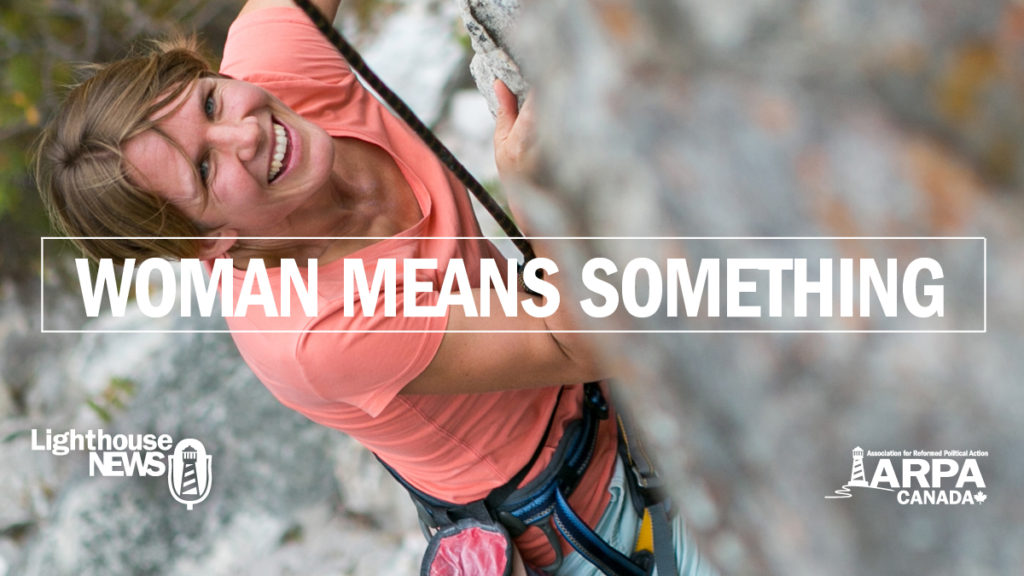
There was an unusual scene in New Westminster, BC earlier this month. It happened on Sunday, March 5th, when a group of people decided to protest outside the New West Community Church, a church that has been tied to the Woman Means Something campaign we reported on a few weeks ago. It’s a campaign against Bill C-16, the law that would add gender identity and gender expression to the prohibited grounds for discrimination under the Canada Human Rights Act and the Criminal Code.

Paul Dirks is the pastor of that church. He says when they heard that the protestors were coming, they decided to put out the welcome mat, providing coffee, donuts, chairs, and canopies to shelter the demonstrators from the elements. The move got mixed reactions. “At first,” Dirks says, “most of the protestors did not want to come to our side of the street.” However, he tried to make himself available to speak to protestors and answers their concerns and questions. Initially they declined, but eventually, a woman knocked on the door of the church saying she wanted to talk, so he went outside. “The woman who came to get me – I greatly respect her and her boldness to do that – we’re actually still having some good conversation.” Dirks says fundamentally, this was about showing that disagreement doesn’t have to result in confrontation. “People are often going to get involved in adversarial kinds of relationships when it comes to things that they have strong convictions about, and we want to present the way of Christ, which is reaching out to others even when we have strong disagreements. This is just the kingdom ethic of Christ, (and it’s) what we want to do.”

On the feature this week, a conversation with Pastor Paul Dirks of New West Community Church in New Westminster, a suburb of Vancouver. Pastor Dirks and his congregation have started what they’re calling the “Woman Means Something” campaign. It is a response to Bill C-16, a federal law to add the terms “gender identity” and “gender expression” to the list of grounds under which discrimination will be prohibited in the Criminal Code and the Canada Human Rights Act.

LN: Pastor Dirks, can you give us a brief summary of what your campaign is, and what you’re hoping it’ll do?

PD: Yeah. We were kinda late to the table in understanding Bill C-16 in that it had already passed the House of Commons. It was about four months ago that this came across my plate, and we just kind of got – myself and a couple of others – got excited about the need to oppose Bill C-16 from a women’s rights and protections perspective. So the campaign of course is “Woman Means Something”, and the idea is that even though this bill is well-intentioned in regards to trans individuals – wanting to protect them and their rights – that it inadvertently pits gender-based rights against sex-based rights, and that the people that are going to suffer the most in that are gonna be women and children. Really, we’re seeing the erasure of women’s protections and even (their) very identity under law taking place before our very eyes.

LN: So you’ve received some flak for this position. There has been press coverage – in the New Westminster Record for instance, (and also on some of the pro-trans blog sites and such) – they’re arguing that you’ve got the approach wrong, and that what’s underlying this is the idea that you’re trans-phobic. What do you do with accusations like that?

PD: You know, whenever I hear that, I always make sure that I say “Listen, I love trans people, and I love de-trans people.” (Editor’s note: “De-trans” describes those who want to undo their “gender transition”.) De-trans individuals are starting to become more and more prevalent in social media, (and they’re) going to show up eventually in the medical literature. These are people that are in many cases opposed to the mass media trans narrative, especially when it comes to transitioning children, but even more broadly than that. You know, I love them, I love trans people, and it just seems to me like labeling somebody as trans-phobic is the easy way out instead of wrestling with the actual arguments and the logic that comes behind campaigns like ours.

LN: The campaign poster that I saw says “Prime Minister Justin Trudeau – in order to be a feminist, you have to believe that “A Woman Means Something”. Why did you decide to choose this particular angle?

PD: We essentially wanted to use Mr. Trudeau’s very vocal feminism to try to raise awareness of the problem of Bill C-16, which is the erasure of women’s identity. Recently I had a conversation with Senator Mitchell – I’m very thankful for that opportunity – and I asked him about women’s identity and the value of women. And he wanted no part of that conversation, which is just so ironic, that these people that claim to be feminists can’t say what it is that is either unique or invaluable about women. You know, the kind of ideology that’s behind Bill C-16 as well as Bill C-16 itself means that we cannot define gender anymore. We can’t define women. Which then leads to all sorts of problems with having a “women’s movement”, “women’s protections”, “women’s sports”, or having “women’s anything”, once you can’t define what the word “woman” means.

LN: Now we both know that the Bible is very distinctive in many respects as far as women are concerned. The idea of being created in the image of God and thus equal before Him kind of set Christians apart from the secular morality that really has no sound foundation for respecting women (or anybody). It also sets us apart from many of the world’s other religions, some of which relegate women to the status of property; certainly to a status that’s subservient to men. Now saying that, are you concerned in any way about emphasizing the “feminist” aspect of this, particularly when feminism has become so closely tied to the abortion movement?

PD: You know, I think that this is how politics works. You look around to those who are allies, you try to work with them. And you know we’re clear on where we stand on other issues. For instance, when I have either a radical feminist or even a lesbian radical feminist that comes in and is willing to work with us in our organization and in the campaign – willing to write articles or whatever it is – I’m very upfront about who I am as the organizer of the campaign. I mention that I don’t support gay marriage. You know, I mention that I’m a social conservative. And we know that there’s opposition between these two groups over human rights and unborn rights, and this is something that means a lot to me. And yet I’m finding that, right across the political spectrum, people are willing to work together on this issue. Because if you think about it, it means nothing less than the entire rollback of women’s rights; you know, everything that’s been accomplished over the last fifty or hundred years.

LN: Part of the reality with Bill C-16 is that it’s already passed the House, and is now before the Senate. The opposition to the bill is starting to increase to the point where Senators aren’t even engaging directly with constituents on this anymore, they’re just telling their staff to take messages. And some of the candidates in the Conservative leadership race are starting to come out against C-16 now; they’re starting to see problems with it, even though some of them voted in favour of it when it came before the House. So the fundamental question is: “Is there time to turn this issue around?”

PD: One of the reasons I’m so hopeful is because of some of the new data that’s coming out (with respect to the de-trans movement). This is a real problem for the mass media trans narrative. In the literature, rates of regret for transition are small; 3 percent, maybe even lower than 3 percent. And also, the follow-up to transition (is) also very low. You know, 40 to 50 percent cannot be followed up afterwards. And I think that until recently, the supposition has been that those who could not be followed up were doing reasonably well, and now it’s coming to light that hiding in this non-followed-up group are tremendous amounts of people that are not satisfied with transition. That it hasn’t helped their gender dysphoria. And I think we’re gonna start to see this reflected in the medical literature over the next couple of years as people grapple with huge amounts of people coming forward saying these things. So I think the tide is turning. I think we are either moments before – or maybe at the peak of – the turn of a tide, and I think that now is the time for people to make their voices heard on this issue.

LN: Beyond C-16, do you have any thoughts on how Christians – how the Church should approach the whole issue of transgenderism?

PD: I think that we need to offer the hope that exists from the Bible, and I think that the Bible’s prescriptions for sex and gender – whether it’s rooted in Genesis 2 or Ephesians 5 – I think these are the solutions for people. The Bible’s message for men and women and for those wrestling with the brokenness that exists in this world is there for anybody who wants to seek and find. And the church needs to be open to that, and not scared of engaging.

Keep showing the love of Christ. Sometimes it’s not always easy. There’s all sorts of people that tell me that I can’t possibly love a trans person while opposing a Bill that is for their rights. But we do this with courage and with truth and grace. And we need that mix as we do it courageously.

If you have not read ARPA’s main article on Bill C-16, we encourage you to read it first. There you will also find links to EasyMail letters on this topic. If you have already emailed your MPP, you can use this FAQ to assist you as you follow up with an additional email or phone call.

What is Bill C-16?

Bill C-16 is a federal, government-sponsored bill titled “An Act to amend the Canadian Human Rights Act and the Criminal Code”. The amendments add gender identity and gender expression to the list of prohibited grounds of discrimination in the Canadian Human Rights Act.

Bill C-16 also amends the Criminal Code to extend the protection against “hate propaganda” to any segment of the public that is distinguished by gender identity or expression. The bill would also make bias, prejudice, or hate “based on gender identity or expression” an aggravating circumstance when it is a motivating factor in a crime.

Why does the government say this bill is needed?

According to the speech by Justice Minister, Hon. Jody Wilson-Raybould, at the time she introduced C-16:

“The bill addresses a fundamental issue of equality and human rights, the discrimination and hate crimes experienced by trans and gender diverse Canadians… their life journeys are often more challenging, as they have to overcome misunderstandings, prejudice, and hostility because of their gender identity or expression. With the bill, we unequivocally say that Canada can do better… Bill C-16 reflects our commitment to this diversity and provides for equality and freedom from discrimination and violence for all Canadians, regardless of their gender identity. With the bill, we say loudly and clearly that it is time to move beyond mere tolerance of trans people. It is time for their full acceptance and inclusion in Canadian society.”

What stage is the bill at and how did it get there?

As of February 16th, 2017, Bill C-16 is at second reading in the Senate. This means the Senate is debating the Bill before voting on whether to send it to committee to study it further. If the bill passes second and third reading in the Senate, it will become law.

In late 2016, the bill sailed through the House of Commons with little discussion. The committee that was supposed to study it (the Standing Committee on Justice and Human Rights) rubber stamped it, not bothering to call witnesses to speak to it.

What is unlawful discrimination according to the Canadian Human Rights Act?

It is discriminatory to terminate or to directly or indirectly refuse to employ an individual on the basis of a prohibited ground of discrimination. Similarly, it is discriminatory to deny access to goods, services, facilities, accommodation or tenancy generally available to the public on the basis of a prohibited ground of discrimination.

The Canadian Human Rights Act currently precludes discriminatory practices based on race, national or ethnic origin, colour, religion, age, sex, sexual orientation, marital status, family status, disability or conviction for an offence for which a pardon has been granted or a record suspension has been ordered.

Provincial human rights legislation applies to most services, employment, and housing providers, but the Canadian Human Rights Act applies to federally regulated entities like the military, shipping, aviation, and telecommunications.

What is “hate propaganda” according to the Criminal Code?

“Hate propaganda” in the Code includes three offences: advocating genocide (s. 318), public incitement of hatred (s. 319(1)), and willfully promoting hatred by public statements (s. 319(2)).

“Genocide” means killing members of any identifiable group with intent to destroy in whole or in part, or deliberately inflicting on any identifiable group conditions of life calculated to bring about its physical destruction.

Public incitement of hatred means inciting hatred against any identifiable group by communicating statements in any public place where such incitement is likely to lead to a breach of the peace.

Wilfully promoting hatred is a broader offence, consisting of willfully promoting hatred against any identifiable group by public statements.

“Identifiable group” in the above offences means any segment of the public distinguished by colour, race, religion, national or ethnic origin, age, sex, sexual orientation, or mental or physical disability.

What’s wrong with prohibiting discrimination and hate?

There is nothing necessarily wrong with prohibiting discrimination or prohibiting the promotion of hatred that targets a person’s identity. Canadians (particularly Christian Canadians) cannot tolerate truly hateful and harmful actions against other Canadians. The problem with Bill C-16 is that it enshrines into federal law a concept (gender identity) that, as predominantly understood today, is confused and harmful. (See ARPA Canada’s policy report for the medical evidence on this claim.)

Is a vote against C-16 a vote against protecting transgender people from violence?

No. We can protect all people against bullying, harassment, violence, and discrimination without embedding contentious, unscientific, “progressive” gender ideology in law.

The Criminal Code prohibits violence, threats of violence, and criminal harassment.

The Code also prohibits advocating genocide, publicly inciting hatred, and willfully promoting hatred. However, these offences are all predicated on the victim group being an “identifiable group” listed in the Code.

They do not need to be. There are other groups of people we could think of against whom hatred or even genocide could be advocated. People who eat meat. Vegetarians. The wealthy. The poor. The homeless. Conservatives. Liberals. Marxists. Etc.

Instead of adding “gender identity or expression”, a better option may simply be to cut the list of “identifiable groups” and allow judges to determine contextually whether an identifiable group was being targeted.

Having a general “promoting hatred” offense (s. 319(2)) may be unwise, given that it is up to the state (the legislature and judges) to determine what constitutes hatred and what groups are protected against it. Promoting hatred with intent to cause a breach of the peace (s. 319(1)) is a more sensible offence. The same is true with regard to promoting genocide, since the prohibition is aimed at expression that directly promotes criminal actions.

Is a vote against C-16 a vote against protecting transgender people from discrimination?

No. The Canadian Human Rights Act prohibits discrimination on the basis of characteristics that define every human being, such as sex, age, race, and religion.

We all have a race, sex, age, and religion (even if we’re atheists or agnostics). But do we all also have a “gender identity” that might be different from our sex? This is what proponents of gender identity ideology believe. We disagree. Gender identity and expression has more to do with behaviour than innate characteristics.

Some say that religion is unlike the other “identifiers” listed in human rights legislation. In one sense, that is true. One’s religion and religious practices may be considered a “choice” in a way that one’s sex, age, or race plainly is not.

Canadian human rights law says people should not be discriminated against in receiving services, housing, or employment simply for being Christian, Muslim, agnostic, or whatever (leaving aside good faith religious requirements in hiring, such as hiring a pastor). However, one’s religious practices may raise legitimate concerns for, say, an employer, whose duty is then to reasonably accommodate.

The trouble with gender identity or expression is that it involves behaviours that may be rooted in a psychiatric disorder. How is an employer to accommodate such behaviour?

What may be considered illegal by a human rights tribunal goes far beyond what we would consider to be objectively mistreating people. According to the Ontario Human Rights Commission, illegal conduct could include:

This bill doesn’t harm you. Why are you concerned about C-16?

The bill does harm Canadians because it limits the fundamental freedoms of expression, religion, and association, without improving the lives of people who struggle with gender identity disorder. And it may cause certain risks to vulnerable groups, such as women in a women’s shelter.

The Ontario Human Rights Commission (OHRC) Policy on Gender Identity says that the notion that there are only two genders is “ignorant and confused”. Bill C-16 embeds this dangerous and mistaken line of thinking in our federal law. In reality, it is the notion that there are more than two genders (some today believe there are 30+ genders) that is ignorant, harmful, and confused.

The OHRC does not enforce human rights legislation, but its policies influence the way legislation is interpreted by the human rights tribunals. We can expect the Canadian Human Rights Act to be interpreted in a similar manner if Bill C-16 passes.

Does Bill C-16 impact children?

Absolutely. Bill C-16 signals that the new “truth” is that gender is fluid and that a person’s fundamental human right includes the right to express a gender identity that is different than their biological sex. As detailed in our policy report on gender identity, this view is divorced from biological fact and social reality, and does harm to children, particularly children struggling with their gender identity. The very ones Bill C-16 claims to protect are the most harmed by this legal shift.

Can I do anything?

You sure can! Our Senators are debating this bill right now. Click here to read more about it. Click here to find the phone numbers of Senators and a script to use when calling a Senator to express your concerns. And you can send one of these three EasyMail letters to contact your MP and the Senators representing your province.

Bill C-16 sailed through the House of Commons late last year. The committee that is supposed to carefully review every piece of justice legislation didn’t even bother examining the bill.

It has now been passed on to the Senate. The House of Commons and Senate have recessed until the beginning of February, so now is the time for us speak up and ensure that Bill C-16 does not also rush through the Senate without careful and thoughtful scrutiny.

Read our first post about Bill C-16 ‘Transgender Rights’ here.

On a mountainBill C-16, introduced by the Liberal government, seeks to amend the Canadian Human Rights Act to outlaw discrimination on the basis of “gender identity” and “gender expression”. If passed, C-16 will also amend the Criminal Code to prohibit “hate propaganda” about people based on their gender identity or gender expression.

If you came to one of our tour presentations this past fall, you will understand why this bill may have good intentions but will cause lasting harm. In fact, the people it will hurt the most are transgendered youth.

ARPA’s Policy Report on Gender Identity addresses the nuances of this issue, including the complexities of intersex conditions (biological conditions at birth) and gender dysphoria (a psychiatric condition). Our Report explains that there is no evidence that the difficulties associated with transgender identification – including higher rates of suicide and attempted suicide, overall mortality, and the need for psychiatric care – are alleviated by affirming alternative gender identities in those with gender identity issues.

The people it will hurt the most are transgendered youth.

Bill C-16 sailed through the House of Commons late last year. The committee that is supposed to carefully review every piece of justice legislation didn’t even bother examining the bill.

It has now been passed on to the Senate. The House of Commons and Senate have recessed until the beginning of February, so now is the time for us speak up and ensure that Bill C-16 does not also rush through the Senate without careful and thoughtful scrutiny.

The time to act is now, before this hurtful legislation becomes law. It takes just 10 minutes to write an Easymail, and 15 minutes to call three Senators. That’s just 25 minutes out of your week to love our vulnerable neighbours, particularly transgender youth, by graciously and compassionately speaking about the truth of how God designed us.

We’re challenging each of you to do two things:

  1. We’ve created a draft email for you at easy.staging.arpacanada.ca with some arguments against Bill C-16. Pick the letter that corresponds to your province and send it off. Each of the senators who represent that province will be copied on your email automatically.

You can find links to the Provincial EasyMail letters below:

  1. Emails can so easily be ignored, but phone calls can’t. We are challenging you to call three of the senators from your province using the phone script below. The discussion will likely vary, but this will help you with some of the discussion. Find the phone numbers for the Senators in your province below the script. If you’re uncomfortable calling a Senator directly, just leave a voicemail after hours!


YOU: Hello, my name is {name} and I’m just calling in regards to a Bill that is coming before the Senate shortly, Bill C-16.

Assistant: Ok, I’m afraid the senator isn’t available right now, can I pass a message along?

YOU: Yes, I would just like to express my concern that Bill C-16 will not help people struggling with gender identity issues. I’ll give you a couple reasons if you don’t mind.

Assistant: Go ahead

YOU: Many doctors, including some Canadian doctors, are concerned about what happens when the government gets involved in a controversial topic like gender dysphoria. We don’t even understand the long-term effects of surgery or hormone therapy and other methods. But now, this bill would seek to muzzle those with concerns about it. I’m particularly concerned how it will negatively affect children and youth with gender dysphoria and limit the help that’s available to them. I would encourage the Senator to vote against it.

Assistant: Well I appreciate your thoughts on this, I’m not sure where the senator will stand on this issue, but I’ll be sure to pass along the message.

YOU: Thank you very much.


ALBERTA
Name Affiliation Phone Number Email
Douglas Black Non-affiliated 613-996-8757 [email protected]
Elaine McCoy Non-affiliated 613-995-4293 [email protected]
Grant Mitchell Non-affiliated 613-995-4254 [email protected]
Scott Tannas Conservative 613-943-2240 [email protected]
Claudette Tardif Liberal 613-947-3589 [email protected]
Betty Unger Conservative 613-996-7420 [email protected]

BRITISH COLUMBIA      
Name Affiliation Phone Number Email
Larry Campbell Non-affiliated 613-995-4050 [email protected]
Mobina Jaffer Liberal 613-992-0189 [email protected]
Yonah Martin Conservative 613-947-4078 [email protected]
Richard Neufeld Conservative 613-947-4055 [email protected]
Nancy Greene Raine Conservative 613-947-4052 [email protected]
Yuen Pau Woo Non-affiliated 613-995-9244 [email protected]

MANITOBA      
Name Affiliation Phone Number Email
Patricia Bovey Non-affiliated 613-995-9176 [email protected]
Raymonde Gagne Non-affiliated 613-943-4323 [email protected]
Marilou McPhedran Non-affiliated 613-996-2106 [email protected]
Donald Plett Conservative 613-992-0180 [email protected]
Murray Sinclair Non-affiliated 613-995-0234 [email protected]

ONTARIO      
Name Affiliation Phone Number Email
Salma Ataullahjan Conservative 613-947-5906 [email protected]
Lynn Beyak Conservative 613-996-8680 [email protected]
Gwen Boniface Non-affiliated 613-995-9193 [email protected]
Anne C. Cools Non-affiliated 613-992-2808 [email protected]
Tony Dean Non-affiliated 613-996-2312 [email protected]
Nicole Eaton Conservative 613-947-4047 [email protected]
Art Eggleton Liberal 613-995-4230 [email protected]
Tobias C. Enverga Jr. Conservative 613-943-1945 [email protected]
Linda Frum Conservative 613-992-0310 [email protected]
Peter Harder Non-affiliated 613-995-0222 [email protected]
Colin Kenney Liberal 613-996-2877 [email protected]
Frances Lankin Non-affiliated 613-995-2795 [email protected]
Sarabjit Marwah Non-affiliated N/A [email protected]
Don Meredith Non-affiliated 613-996-8572 [email protected]
Lucie Moncion Non-affiliated 613-996-2224 [email protected]
Jim Munson Liberal 613-947-2504 [email protected]
Thanh Hai Ngo Conservative 613-943-1599 [email protected]
Victor Oh Conservative 613-943-1880 [email protected]
Ratna Omidvar Non-affiliated 613-943-4330 [email protected]
Kim Pate Non-affiliated 613-995-9220 [email protected]
Bob Runciman Conservative 613-943-4020 [email protected]
Howard Wetston Non-affiliated 613-995-9197 [email protected]
Vernon White Conservative 613-996-7602 [email protected]

Take Action: Use one of the three EasyMail letters to share your concerns with your MP before C-16 sails through the House of Commons

Bill C-16, if passed, will amend the Canadian Human Rights Act to outlaw discrimination on the basis of “genderrainbow_flag identity” and “gender expression”. It would also amend the Criminal Code to prohibit “hate propaganda” about a group of people distinguishable by their gender identity or gender expression. And it would make bias, prejudice or hate “based on gender identity or expression” an aggravating circumstance when it is a motivating factor in a crime.

The bill limits the fundamental freedoms of expression, religion, and association, without improving the lives of people who struggle with gender identity.

Sadly, the House of Commons Committee reviewing the Bill chose to forego public input on the bill. Thankfully, it has not yet gone to third reading in the House of Commons. So there is still time for you to act and to be heard by MPs. (If the bill passes in the House, it will have to be reviewed and passed by the Senate, and ARPA hopes to be able to present to the Senate Committee.)

Christian response

As Christians we must strive to be fair, honest, and kind in our dealings with our neighbours, including our employees, customers, and tenants (human rights law applies to services, employment, and use of commercial or residential space).

We detest violence, bullying, and harassment. We affirm the equal dignity of all persons, a dignity rooted in our status as image-bearers of God, not in human autonomy or self-definition. We are created as image-bearers of God, male and female.

We can protect people against bullying, harassment, and violence without embedding contentious, unscientific, “progressive” gender ideology in law.

We simply cannot affirm that everyone has “the right to define their own gender identity” and to have others affirm them in that. We do not consider “behaviour that reinforces traditional gender norms” (leaving out bullying and other cruel treatment) to be ignorant or confused. Refusing to use “non-binary” gender pronouns such as “ze, zim, zer” is not bullying or harassment. We cannot set aside the truth that people are male or female. It would be unloving to do so.

ARPA’s Policy Report on Gender Identity addresses the nuances of this issue, including the complexities of intersex conditions (biological conditions at birth) and gender dysphoria (a psychiatric condition). Our Report explains that there is no evidence that the difficulties associated with transgender identification – including higher rates of suicide and attempted suicide, overall mortality, and the need for psychiatric care – are alleviated by affirming alternative gender identities in those with gender identity issues.

You can find links to EasyMail letters below:

Read on to learn more about the content and ramifications of Bill C-16.

Bill C-16 and Human Rights Law

The Canadian Human Rights Act, which Bill C-16 will amend if passed, applies to federally-regulated industries and activities, such as banking, aviation, and shipping. (Provincial human rights statutes apply to most employers, service providers, and housing providers.)

Human rights laws in Ontario, Alberta Nova Scotia, Newfoundland, P.E.I., Northwest Territories, and B.C. were recently changed to include gender identity and gender expression as prohibited grounds of discrimination. If Bill C-16 passes, it will apply gender identity/expression protections to federally regulated activities and would put political pressure on Yukon Territory, Nunavut, Newfoundland, and New Brunswick to also add gender identity and gender expression to their human rights statutes.

With gender identity and expression added to human rights statutes, those who refuse to affirm “progressive” gender ideology risk being penalized.

“Gender identity” refers to a person’s “sense of being a woman, a man, both, neither, or anywhere along the gender spectrum”, irrespective of one’s sex at birth. And “gender expression” is “how a person publicly presents their gender”, including “behaviour and outward appearance such as dress, hair, make-up, body language and voice” and “a person’s chosen name and pronoun”.

The Ontario Human Rights Commission (OHRC) Policy on Gender Identity says transgender people “should be recognized and treated as the gender they live in” and “have access to washrooms, change rooms and other gender specific series and facilities” based on their gender identity, and be free to dress according to their “expressed gender”. Failure to satisfy these requirements can result in financial and other penalties such as requiring gender identity sensitivity training in the workplace.

The OHRC Policy says that the notion that there are only two genders is ignorant and confused and that transgender people suffer as a result of this ignorance and confusion. Bill C-16 embeds this dangerous and mistaken line of thinking in our federal law.

In reality, it is the notion that there are more than two genders (some today believe there are 30+ genders) that is ignorant and confused. It is not based on science, but ideology. Our lawmakers should not be enforcing such ideology through law.

What may be considered illegal by a human rights tribunal goes far beyond what we would consider to be the objective mistreatment of people. According to the OHRC, illegal conduct could include:

The OHRC does not enforce human rights legislation, but its policies influence the way legislation is interpreted by the human rights tribunals. We can certainly expect the Canadian Human Rights Code to be interpreted in a similar manner if Bill C-16 passes.

While so-called transgender rights have already been added in several (but not all) provincial human rights statutes, if Parliament votes against this bill – or even if a sizeable, vocal, and articulate group of dissenters emerges within Parliament – it would encourage the kind of thoughtful reflection and articulate opposition that is too often lacking in response to the “progressive” agenda.

Bill C-16 and Criminal Law

It is a criminal offence to wilfully promote hatred against an identifiable group by communicating statements, other than in private conversation.

“Identifiable group” means “any section of the public distinguished by colour, race, religion, national or ethnic origin, age, sex, sexual orientation, or mental or physical disability.” Bill C-16 would add gender identity and gender expression to this list.

“Hatred” in section 319 of the Criminal Code refers to a most extreme emotion that belies reason and implies that those individuals are to be despised, scorned, denied respect and made subject to ill treatment on the basis of group affiliation. An accused must be shown to have subjectively desired the promotion of hatred or to have foreseen the promotion of hatred as substantially certain to result from his communication.

The accused can rely on the following defences:

The threshold for a conviction for wilfully promoting hatred is high and there are several robust defences. Consequently, Bill C-16’s changes to the Canadian Human Rights Act will likely have more of a practical impact than its change to the Criminal Code.

Still, there is a legitimate concern that these changes to the Criminal Code will have a chilling effect on freedom of expression by posing a risk of prosecution for those who would vigorously and vocally oppose progressive gender ideology. Questioning the propriety of this law is not equivalent to defending the promotion of hatred.

Please send your MP a message: