A behind-the-scenes look at recent changes to family law in Ontario
By John Sikkema
Oh. I’m a zombie, raised by zombies.
That’s what I learned at an Ontario Bar Association (OBA) event earlier this year called “The All Families Are Equal Act: Celebrating and Understanding the Legislative Changes.” The event was a “professional development” seminar – something lawyers must attend from time to time to keep their law license. These things usually have dull names like “Recent Changes in Corporate Tax Law” or “A Primer on Real Estate Litigation”. But this session, the OBA notified us, was to be a celebration of recent changes to Ontario family law. They even had free booze.
Yet it wasn’t terribly celebratory.
Sure, the panelists – a judge, a professor, and four lawyers – were fairly pleased with Bill 28, which removed the terms “mother”, “father” and “natural parents” from Ontario statutes and provides for “family formation” via “pre-conception parentage agreements” and “surrogacy agreements” with up to four unmarried, unrelated “intended parents” contracting to share “parentage” of a child yet to be conceived via artificial reproduction.
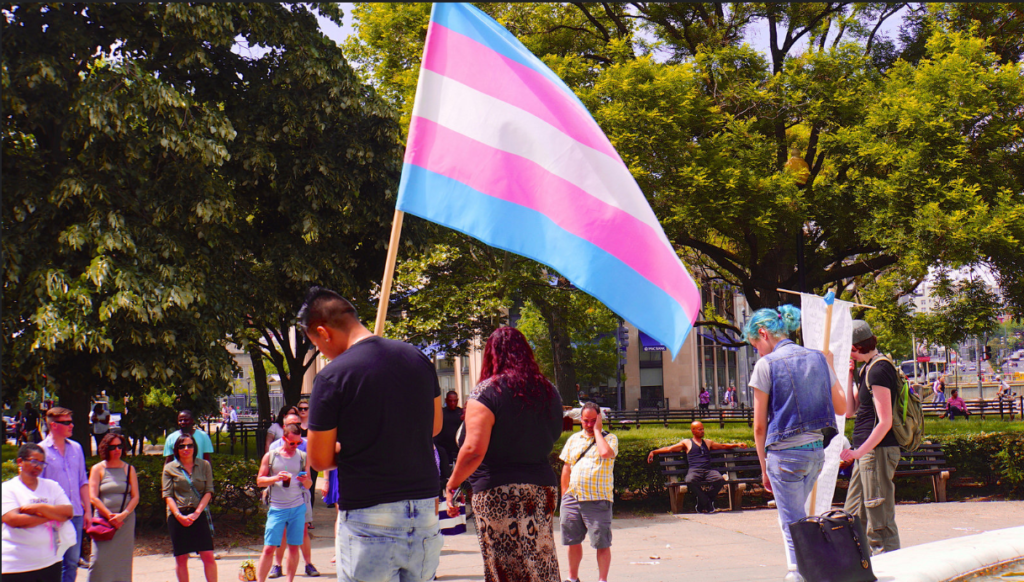
But according to one presenter, Professor Rachel Epstein, “we are haunted” by the traditional family. We’re still bombarded with images of Dad, Mom, and children in movies and TV shows. This old version of “family” is still prominent in people’s minds. And apparently, that’s a problem. (The photo is from the professor’s presentation.)
Another presenter, lawyer Joanna Radbord, who worked with the government on Bill 28, said that while the bill takes us a long way towards reconceptualising parentage and family, it still “privileges biology” in certain ways, and as long as biology is privileged, alternative families cannot be truly equal. How does the law “privilege biology”? While Bill 28 makes biology far less important, Ms. Radbord believes there is still work to be done:
We have a vastly improved regime now, of parentage, that has reconceptualised what it means to be a parent. So whereas […] it was about relationships of blood or adoption or declaration of parentage by court order, now it’s really about pre-conception intention.
So long as parentage is about biology, LGBTQ families are always going to be looked at as inferior, as less than, that we’re missing something, how sad there isn’t this biological relationship. We haven’t completely departed from biology with the new legislation […].
The new parentage regime is also not as functional as I would’ve liked. […] Where there is sexual intercourse, biology continues to matter in a way that if you took a really functional approach to family, that wouldn’t have been adopted. But, outside circumstances of sexual intercourse there is respect for the fact that, where you have the lesbian couple who has used even a known sperm donor, or even in situations of sexual intercourse where you have a contract, that a donor is a donor and not a parent.
This is the worldview behind Ontario’s new law – that a “functional approach” to parentage should displace biology – and it’s hardly considered newsworthy.
The banality of judicial bias
There was also a judge on the panel. You might think she’d be a measured, reasonable voice among the cheerleaders for this bizarre bill. You’d be wrong.
In 2016, Justice Chiappetta presided over the case that spurred the introduction of Bill 28. That case was brought by several lesbian and gay couples, along with a group of four adults – two men, a woman, and an a-gender person. They were seeking declarations of parentage but also challenging the lack of default recognition of them as parents in Ontario law.
In 2007, for the first time, a “declaration of parentage” was granted to allow a person to become a legal parent to her same-sex partner’s child without formally adopting (AA v BB, ONCA). That made things easier. However, since natural parents need neither adopt nor apply for a declaration of parentage, the applicants before Justice Chiappetta argued that the law was still unjust towards same-sex couples and others who prefer alternative parenting arrangements.
Justice Chiappetta remarked:
It made no sense to me from a lay person’s perspective why the goodness of these people who were working together to produce children to people who truly wanted them, had to go through this process in order to be declared what everyone else knew they were: parents.
What I think her honour meant to say is that she knew intuitively that the people before her in court were parents because they identified as parents. But these people couldn’t all have been involved in “working together to produce children”, if you know what I mean. Rather, the group included people with no biological connection to the children in question, but who wished to be legally recognized as parents without having to adopt or apply for a declaration of parentage.
The judge then described her delight in presiding over this case:
From the moment I read the first word on that application, I got inspired. […] I knew right away that the applicants wanted action, [they] really didn’t want, you know, […] a big trial and then finally a decision that something is unconstitutional. They wanted action. And so we got together the next day at the case conference and the government explained that they couldn’t file their response because this was a very complex matter. […] I wasn’t as receptive [laughs] as perhaps some other people would be. We said ‘no, it’s not really that complex, give us your response.’
[…] And the government did need some time to figure out how this impacted the other legislation. And the lawyer to my left [Joanna Radbord] […] worked very well with government to effect change.
And fast forward to – to this day the most inspirational day that I’ve ever had as a judicial officer – the two parties came together with a proposed settlement that involved the government actually admitting that law, certain aspects of it, was unconstitutional and agreed to take specific time-sensitive steps to change it.
Rather than defend the democratically enacted law, the government’s lawyers, no doubt under the Liberals’ instructions, simply admitted defeat. This raises questions of democratic legitimacy (since the Attorney General can, by failing to defend a law in court, ensure that law’s demise without a vote in the legislature), which I won’t get into in detail here.
The judge continued to describe the moment when the government agreed to work with Joanna Radbord to change the law according to a set timetable:
I always call it my Oprah moment because I was able to […] look at the unique families in front of me – and when I say unique families, I mean we had two women who were parents, two men who were parents, we had a family of four, two men, a woman, and a person who didn’t identify as a man or a woman who was with the child at the moment – I was able to stand up and say, ‘by the way, you’re a parent, and you’re a parent and you’re a parent, you’re all parents!’
And it was such a celebration of the evolution of the law that should have been at that place many years ago. And I wanted to specifically talk to all of you as lawyers in the room, to tell you that this is an example of how you can effect change, how you can evolve the law.
You know, as judges our job is to apply the law, and once in a while we get those cases where we can push it forward. But your job is to change the law. […] So when you talk about this Act, celebrate how far we’ve come, realize that it’s only a first step, and understand from your own personal perspectives, your own professional perspectives, that you have the power to evolve our laws in the way that they should be evolved.
Here is a judge celebrating “the evolution of the law”, declaring that it “should have been at that place many years ago” and saying that Bill 28 “is only a first step”. Her comment about judges getting cases where they can push the law forward also raises an important question that she did not answer: what principles distinguish cases in which a judge must apply the law from those in which the judge may or ought to change the law?
She tries to couch her activist stance with her comment that it’s really the lawyer’s job to change the law, rather than the judge’s. But a lawyer has no power to change the law, at least not directly. A lawyer can only persuade those with power to do so, namely judges.
While Justice Chiappetta urged the government to work out a solution, she did not actually strike down the law in question. There was no need. The Liberal government had the pretext it needed for a radical revision of Ontario family law, which came to fruition in Bill 28.
Ignorance isn’t bliss forever
That pretext wasn’t questioned. The Opposition rushed to support the bill, apparently without considering the events, people, or philosophy behind it, or caring what Ontarians would think. In fact, it seems many MPPs would prefer that people simply not think about it at all.
Bill 28 passed four months ago with zero opposing votes. It’s hard to imagine such a radically left-wing social agenda going completely unopposed at the federal level, where at least a few vertebrate MPs remain. Maybe Ontario is more liberal than Canada as a whole. Or maybe we tend to pay too little attention to provincial politics. Ask Ontarians what they think about the All Families Are Equal Act and I’m pretty sure most will have no idea what you’re talking about. That seems to be what Progressive Conservative leader Patrick Brown is banking on. He seems to think that by only talking about hydro rates he can coast into the premier’s office. Perhaps he can. Perhaps he keeps the Christians and “so-cons” in his caucus silent by the carrot of electoral victory and the stick of party discipline.
But sooner or later, this agenda is going to get pushback. As more people feel the impact of recent legislative changes, more will call out MPPs for failing to stand up for “traditional” families and for the children who are “products” of preconception co-parenting contracts and will never know their real parents.
If parentage is defined by intent, then it’s as weak as one’s will. In that sense, the parent-child relationship is following the path towards what marriage has become: a voluntary arrangement at the pleasure of the parties. Of course, it has been harder to reconceptualize the parent-child relationship in terms of autonomy and choice. Your father and mother are your father and mother regardless of their intentions, or so you can’t help thinking.
But you are “haunted” by nature and history. The law cannot be based on such backwardness. Natural distinctions must be erased and natural bonds broken to make way for a world where everything, including family, is governed by pure individual choice.
Perhaps, after sacrificing too many children on the altar of autonomy, we will realize that ignoring God’s design to suit our own preferences can never bring about utopia. Maybe we’ll realize, eventually, that it’s good being “zombies” after all.
By John Sikkema
Bill 33 in 2012 (“Toby’s Act”), Bill 13 in 2012 (“Accepting Schools Act”), Bill 77 in 2015 (“Affirming Gender Identity Act”), Bill 28 in 2016 (“All Families Are Equal Act”), and now Bill 89 (“Supporting Children, Youth, and Families Act”): together these bills represent the swift advance of a left-wing social agenda in Ontario.
Bill 33 added “gender identity and gender expression” to Ontario’s Human Rights Code in 2012. Ontario was the first jurisdiction in North America to pass such a law. Bill 13 required public and Catholic schools to allow gay-straight alliances and to root out “homophobia”, “biphobia”, and “transphobia”. Bill 77 prohibited “reparative therapy” for minors struggling with issues of sexuality or gender identity disorder.
Bill 28 removed the words “mother” and “father” from Ontario law, while allowing people to become parents through “pre-conception parentage agreements” with up to four unrelated and unmarried adults. Bill 89, currently at committee stage, would among other things integrate gender identity and expression into child and youth services law.
Except for Bill 13, which the Official Opposition fought well, these bills received little scrutiny. Each stems from, at least in part, the newly orthodox gender ideology.
Before “the five”
Years before any of these bills, “trans” persons had significant legal protection against discrimination under the Human Rights Code. Of course, like everyone, they were protected against discrimination based on race, age, sex, religion, and so on, but as of the late 1990s, the grounds of “sex” and “disability” in the Code were interpreted to cover transgenderism and transsexualism also. Human rights tribunals protected people against job loss, unfair treatment, or harassment for asking to be called by a different name, use a different washroom, or dress in a “gender non-conforming” manner, over a decade before “Toby’s Act” passed in 2012.
What then could be the harm in adding “gender identity and gender expression” to the Human Rights Code? What harm could it do to explicitly require employers and housing and service providers not to discriminate against someone because of their “gender identity and gender expression”? If “cross-dressing” or “sex-change” surgeries or new pronouns make you uncomfortable, get over it. If a biological man wants to be treated as a woman, accommodate him (“her” if you don’t want to be sued). Such reasoning was used to placate (sometimes to shame) the sceptical, but fails to acknowledge the difficulties. It would be cruel to kick a tenant out of his apartment for wearing a dress, but how about asking a man to leave a woman’s shelter? What about not allowing a man to play on a women’s sports team? Such questions should not be dismissed offhand as fear mongering. Where the law requires the state and society to treat men as women or vice versa, depending on the individual’s “internal sense” of their gender and associated behaviours, legitimate concerns arise.
The short march from Toby’s Act to Bill 89
Two years after Toby’s Act (2012), the Ontario Human Rights Commission released its new “Policy on preventing discrimination because of gender identity and gender expression”, which beefed up its earlier policy from 2000. You’ve probably heard Professor Jordan Peterson and others criticize this Policy because of its restrictions on free speech. The advancement of this ideology in increasingly radical form has serious consequences, not only for freedom of religion and expression, but also for public health and even public finances.
Already in 2008, the Liberals announced that Ontario would publicly fund sex-change surgeries—elective procedures that do not improve mental or physical health outcomes for persons who experience gender identity disorder. Similarly, Ontario pays for puberty-blocking drugs and cross-hormone treatments, which can cause life-long sterility. Such treatments can cost thousands of dollars per person per year. Yet studies indicate that chemical and surgical impersonation of the opposite sex is associated with negative health outcomes and high suicide rates, even in parts of the world that are considered the most “trans affirming”.
Paul McHugh, Professor of Psychiatry at Johns Hopkins Medical School and former psychiatrist in chief at Johns Hopkins Hospital says, “The idea that one’s sex is a feeling, not a fact, has permeated our culture and is leaving casualties in its wake. The most thorough follow-up of sex-reassigned people—extending over thirty years and conducted in Sweden, where the culture is strongly supportive of the transgendered—documents their lifelong mental unrest. Ten to fifteen years after surgical reassignment, the suicide rate of those who had undergone sex-reassignment surgery rose to twenty times that of comparable peers.”
Adding the dubious concept of “gender identity” to the Human Rights Code, which is unnecessary in order to protect trans people from discrimination or harassment, set the stage for more aggressively pushing gender ideology through government policies and institutions.
Not content to fund “sex reassignment” surgery and cross-hormone injections, MPPs voted unanimously in 2015 to prohibit alternative treatment methods for gender identity disorder. Bill 77 went from second reading to Royal Assent in only three months. It dictates medical policy in the name of political correctness, removing good options for parents and children. One such option was renowned child psychiatrists like Dr. Kenneth Zucker and Dr. Susan Bradley, who believe that encouraging children to be comfortable with their birth sex helps prevent long-term psychopathological problems. Dr. Zucker was removed from his Toronto clinic following Bill 77. More than 500 researchers and clinicians signed a petition in support of him. No matter.
Is affirming a child’s transgender identity, socially conditioning them in that identity, and chemically and surgically altering their bodies to align with that identity the best path? Or is the approach of Dr. Zucker and Dr. Bradley, preferred by many parents, better? How can that even be determined reliably when government brings the hammer down on the latter’s methods? In any case, should the government not defer to parents and doctors to determine the best path?
Gender ideology goes to school
Meanwhile, transgenderism and transsexualism are being normalized in public schools. Bill 13 (2012) defined bullying in a manner that focused on “power imbalance” between bully and victim based on factors including gender identity and expression. It also mandated that school boards promote a positive school climate inclusive of all students, “including pupils of any “race … sex, sexual orientations, gender identity, gender expression, age, marital status, family status or disability” and that boards (including Catholic boards) permit LGBT-positive clubs to be active in their schools and to use the name “gay-straight alliance”.
School boards now cite Bill 13 and Bill 33 (2012) as the basis for their policies. The Toronto District School Board’s policies are typical:
- “[S]chool board and school staff are expected to challenge gender stereotypes and integrate trans-positive content into the teaching of all subject areas […].
- School board and school–based curriculum leaders must integrate trans‐awareness and trans‐ positive advocacy training into staff professional development curricula. Librarians must acquire trans‐positive fiction and non‐fiction books for school libraries and encourage the circulation of books that teach about gender non‐conforming people.”
- “School leaders should make an effort to hire and retain transgender and gender non‐conforming staff. TDSB policy and Provincial legislation requires school board leaders to ensure staff are educated in gender diversity, advocacy and anti‐transphobia education, in challenging gender stereotypes, and in using gender neutral and inclusive language.”
- “A school should never disclose a student’s gender non-conformity or transgender status to the student’s parent(s)/guardian(s)/caregiver(s) without the student’s explicit prior consent.”
- “All students have a right to safe restroom facilities and the right to use a washroom that best corresponds to the student’s gender identity, regardless of the student’s sex assigned at birth.”
- “All students, including transgender and gender non‐conforming students have the right to be addressed by a preferred name and pronouns […]. This is true regardless of whether the student has obtained a legal name or sex designation change.”
- “Employees who wish to use pronouns other than the masculine or the feminine (such as ‘ze’, ‘hir’ and ‘they’) need to be accommodated equally.”
- “School staff must ensure students can exercise their right to participate in gender segregated sports and physical education class activities in accordance with each student’s gender identity.”
Pushing the idea that gender varies independent of sex and that children may fall anywhere along a gender spectrum confuses children. Gender ideology is liberalism in the extreme. Freedom is good, but the freedom to define your identity necessarily has limits. You cannot (yet) identify as disabled if you are not, or as a different age or race or species than you in fact are, and expect the government and society to affirm it. Children have a limited capacity for exercising autonomy. How they self-identify will inevitably be shaped by what they are taught.
Given how recent the policy changes in this area are, particularly in schools, there is a lack of reliable data and long-term studies on their impact. There are, however, credible reports that more children are struggling with identity issues. In November, the National Post reported that doctors are seeing a steady increase in referrals for young children experiencing gender dysphoria. The Independent in the UK reported last year that the latest figures from the Gender Identity Development Service (GIDS) in the UK, for example, revealed that the number of children referred to GIDS increased from 94 in 2009-2010 to 969 from April to December of 2015. New “gender clinics” are opening throughout the U.S. and Canada.
Children should be taught that all persons have dignity and intrinsic worth. All people are equal. Nobody should be bullied, mistreated, assaulted, or harassed. But that does not require affirming transgenderism as healthy and good, any more than respecting members of another religion requires teaching children that all religions are true and good. It does not mean we should teach boys that they can be girls, girls that they can be boys, or both that they can be both or neither. Ontario’s human rights tribunals first began protecting trans persons on the ground of disability. Gender dysphoria (recently changed from “gender identity disorder”) is still listed in the DSM-5 psychiatric diagnostic manual. We don’t need to affirm a disorder as normative in order to treat those who have it with dignity and respect.
What causes this disorder is not well understood, but environmental factors can doubtless play a role. Teaching tools such as the “Gender Unicorn” for very young children are disorienting. Might such policies cause a rise in gender dysphoria among children? New educational resources tell children that what is important is “gender identity”, which does not need to match biological sex. “Only you know whether you are a boy a girl,” the Gender Fairy, a “trans-positive” book tells children. “No one can tell you.”
Gender ideology comes home
This brings us to the Liberals’ Bill 89, the “Supporting Children, Youth, and Families Act”. This government apparently takes its cues for child services law from the Gender Fairy. Replying to questions on the bill, which adds gender identity and expression as factors to be weighed in determining a child’s best interests, Ontario’s Child and Youth Services Minister, Michael Coteau, said, “I would consider that a form of abuse, when a child identifies one way and caregiver is saying, no, you need to do this differently.” Don’t tell your son he’s a boy. That’s up to him (her, them, or zir).
“Abuse is abuse is abuse,” Minister Coteau says. “If a child is being abused, it can come in many different forms. If it’s abuse and if it’s within the definition, a child can be removed from that environment and placed into protection where the abuse stops.” What definition is he talking about? Neither the current Child and Family Services Act nor Bill 89 define abuse. Rather, the term appears in the provision that describes a “child in need of protection”. A child in need of protection includes a child who has suffered emotional harm where there are reasonable grounds to believe that the harm resulted from the actions, failure to act, or pattern of neglect on the part of the parent or caregiver. It also includes a child at risk of suffering mental or emotional harm whose parents or caregivers do not provide treatment. But what if the parents find the state-approved “treatments” inappropriate or harmful? What are they to do?
If a child’s bests interests are determined in part by their sexual orientation or gender identity, can people who would not affirm a child’s trans identity or approve of certain kinds of sexual behaviour expect to be treated fairly when it comes to fostering or adopting? These are reasonable questions. (Just ask a foster parent you know.)
ARPA has heard from some MPPs that they intend to support Bill 89 for two reasons. First, because it’s about protecting children (who could be against that?). Second, because it brings the Child and Family Services Act into line with the Human Rights Code. While both may appear to be good reasons at first glance, both are mistaken. ARPA recently ran two articles our website explaining why, which you can read here and here. If you haven’t yet read the basics about Bill 89 and the issues it raises, I suggest you begin here.
Going forward
Bill 89 should be stopped, unless amended. Of course, it’s a government bill. Government bills tend to pass when the government has a majority of seats in the legislature. Still, it is worth criticizing and opposing. Meaningful scrutiny of and opposition to government bills today can begin to lay the foundations for better policy tomorrow.
Politics requires coalitions to get things done. No doubt, the coalition of those supporting bills like the aforementioned five include not only true believers in gender ideology, but also those persuaded that legislating “trans rights” is compassionate, those afraid of being labeled bigots for their views, and those who would simply rather not talk about social issues.
ARPA’s Gender Identity Policy Report for Parliamentarians explains the issue through a framework founded on principles of grace and truth. The Report’s recommendations, which involve reversing several recent enactments, are recommendations for lawmakers acting as lawmakers. Ultimately, founding law and policy upon a mistaken anthropology is neither compassionate nor just. Sex and gender are not independent of each other. But gender dysphoria calls for a compassionate response.
There is plenty that individuals and civil society organizations can do to love transgender people. I suspect that many employers – including Christian employers – would be happy to hire them. I also happen to think it should be left up to employers, particularly small business owners, to decide if they want to hire or continue to employ a trans person, or any other person. I’ve worked for family businesses, for example, where children are often helping or hanging around the worksite. For such business owners, I doubt their concerns would have much to do with how an employee sees himself, but rather with his behaviour.
Could your workplace accommodate a man who wants to be addressed with feminine pronouns, dress as a woman, and use the women’s washroom, for example? Perhaps it could and would. Maybe people should be free to decide. Requiring everyone to accommodate transgender expression under threat of financial penalties or more (such as mandatory sensitivity training and new workplace policies), all based on the view that not affirming one’s gender identity is a human rights violation, is an overreach, an ideological (you might say religious) imposition. Still, we should ask ourselves: how are we being a living example of Christ’s love to our transgender neighbours?
Transgenderism remains rare. Many people will not know anyone who openly identifies as transgender. But if you do or in case you will, here is some practical advice for loving your neighbour from Denny Burk, a Professor of Biblical Studies.
Bill 28 passed its final vote a few weeks ago with the official support of all parties, although a large portion of the Opposition caucus was absent from the vote. The bill, which makes major changes to Ontario family law, will take effect in January. ARPA Canada strongly opposed this bill. You can read our articles What’s a Family Anyway? and FAQ on Ontario’s Bill 28 to learn more about the bill.
Unfortunately, the Progressive Conservative Opposition decided not to do their job of questioning the government’s intentions with this bill and the bill’s likely effects on children. The final vote tally was 79-0.
This was a loss for Ontario, but from a grassroots activism standpoint, there were some big highlights from this campaign that we’d like to share with you.
You shared our articles and videos on social media.
You called MPPs.
And, going above and beyond, you even purchased close to 100 radio ads.
You sent over five hundred emails about Bill 28 through our EasyMail system. You shared our articles and videos on social media. You called MPPs. And, going above and beyond, you even purchased close to 100 radio ads.
Radio ads
Alongside our usual videos and easy mail campaigns, our radio ads were something new. As Bill 28 was being rushed through the legislature, very few people were speaking out about it. Then four ARPA chapters in Ontario – Hamilton, Niagara, London, and Oxford – placed radio ads on local radio stations that criticized the bill. Close to 100 ads were aired in a one-week window before the final vote on November 28.
The Public Response
Your ads created a buzz. One radio station account manager voiced her approval for the ad via email, due to concerns about how the bill would impact adoption. Another station offered to discuss Bill 28 on their morning show free of charge and promoted ARPA’s resources on its Facebook page. We have heard reports from across the province that the ads triggered numerous discussions of Bill 28 both on an individual level, in the media, on talk radio, in local newspapers, and even in the legislature. Though the impact of this campaign is somewhat difficult to quantify, it clearly succeeded in bringing Bill 28 into the public eye when otherwise it might have been totally ignored.
A public school teacher in Hamilton wrote to us in response to the radio ads, saying:
“I would love to have an intelligent discussion about the legal, social, and practical definition of family. I am able to do this with my high school students I teach; however, I foresee great difficulty in having any form of rational discourse with a bigoted lobby group promoting an agenda of hate and misinformation… Please respect that these are all of God’s people, and that he loves all of them. I hope that you can find it in your heart to love them too.”
This teacher did not respond to our invitation for further discussion. We are glad that this teacher was forced by the ads to engage with his students on the realities of Bill 28, rather than being able to advocate for it unchallenged.
Loving our neighbour is precisely the reason we opposed this bill and cannot simply let it go by. This bill will cause harm – particularly to children. As we explained in What’s a Family Anyway?:
The law provides no registry for recording a child’s natural father or mother. Children conceived by donors of “reproductive material or an embryo” or by “insemination by a sperm donor” may never learn who their natural parents are […]
Children born into these new “family” arrangements are much more likely to be the objects of disputes and litigation before and after birth, and throughout their childhoods.
As a result of your calling and emailing your MPPs, sponsoring radio ads, and discussing it with your neighbours and co-workers, Bill 28 became much more visible. With the recent election of MPP Oosterhoff and his voicing of concerns about the bill, the Legislature was no longer able to pass Bill 28 quickly and quietly.
Many news reports included descriptions of what the bill does that were seriously lacking, basically parroting misleading government talking points. For example, from the National Post: “Bill 28, which enshrines equal parenting rights for LGBTQ Ontarians, passed unanimously.” However, the fact that they covered the story at all is thanks to your hard work!
Looking to the future
We discussed the broad implications of Bill 28 in the articles mentioned earlier: What’s a Family Anyway? and FAQ on Ontario’s Bill 28. We’ll start with the negative, and then mention a few things we can do about it.
Some major implications of Bill 28’s passage are:
Marriage and even common law relationships are further devalued in law, as a couple is considered no more legitimate or desirable a foundation for a family than an arbitrary number of adults bound to each other by nothing more than a contract in which they agree to co-parent a child yet to be conceived.
The law facilitates and legitimizes separating children from their natural parents from the time they are born, without providing for any record of who the child’s natural parents were. This is unhealthy for children, who have a natural desire to know where they came from. Knowing one’s natural parents is important for health and identity reasons. Sometimes, tragedies prevent this, but Bill 28 separates children from natural parents by design.
Children who are the shared objects of up to four unmarried and unrelated “parents” are more likely to experience disruption, stress, and confusion in their lives than children raised by a committed couple living together.
The law encourages surrogacy, which commodifies both women and children. Surrogacy makes a woman’s reproductive organs objects than can be used and rented. It risks causing disruption in the lives of children born through surrogacy and can even leave children vulnerable to trafficking. According to international law, surrogacy violates human dignity and children’s best interests.
So what should we do?
Love and pray for our families, that by God’s grace we as Christians might show, however imperfectly, that God’s design for families is good and right.- Defend the truth that marriage and family were designed and instituted by God. And while, in this fallen world, families sometimes fall apart through conflict or death, we cannot declare the “family” whatever we want it to be or try to eradicate it as society’s most basic institution.
- Study and raise awareness about the ills of divided families, of separating children from their natural parents, and of surrogacy.
- Encourage and work with lawmakers to enact laws that honour God’s design for families and guard against abuses of the vulnerable, such as those that occur when women (especially as surrogates) and children (as objects to be procured through outside “donors” or “reproductive material”) are commodified.
ARPA is exploring various options for a legal response to Bill 28. We will keep you informed of any developments.
- How will Bill 28 affect me and my family?
- Are “natural families” and “natural parents” really so important? What about adoptive parents?
- Isn’t the main purpose of the bill to simplify the process for both partners in a same-sex couple to be recognized as parents?
- Bill 28 facilitates having children through surrogacy. What’s the problem with that?
If you have not read ARPA’s main article on Bill 28, we encourage you to read it first. There you will also find links to EasyMail letters on this topic. If you have already emailed your MPP, you can use this FAQ to assist you as you follow up with an additional email or phone call.
How will Bill 28 affect me and my family?
Bill 28 does not simply create or add new kinds of families. It redefines all families, present and future. By removing references to “mother”, “father”, “natural parents”, and “blood” relations from Ontario law, and by creating alternative, contractual “families” between multiple unmarried and unrelated adults and children conceived further to their “parentage agreements”, Bill 28 knocks family law even further off its foundations.
The bill gives the illusion of greater freedom. It gives people more “options” to choose from as they determine what a family is for them. But if the state can redefine the family and offer more “options” or “rights” by knocking family law off its foundations of marriage and blood relations, it can also take rights away. What will become of parental rights if a “family” is whatever the state says it is and a “parent” is whoever the state says is a parent? It’s hard to know, but it’s deeply disconcerting.
Do we care about our children and grandchildren’s understanding of who they are, what a family is, and why it’s important? Make no mistake, education policy and curriculum (among other government policies and programs) will fall in line with Bill 28’s radical changes to Ontario law. This is about more than immediate practical consequences to my parental rights or yours – it is about embedding a false understanding of who we are as human beings into the law.
According to a leading family law textbook, family law has traditionally been concerned with “the relationships between husband and wife and parent and child.” And, “The main subjects of family law have, therefore, traditionally been marriage, separation and divorce, property rights of spouses during the marriage and on marriage breakdown, support obligations of spouses to one another, the care and custody of children, support obligations of parents to their children, the intervention of the state in the parent-child relationship through child protection legislation, and the establishment of a parent-child relationship through adoption.” (Hovius on Family Law, 7th edition)
Bill 28 will impact many and likely all of these areas in the long term. It makes marriage, which our law and culture have been devaluing for decades, even less important in family law. Far less. Marriage-plus-children will no longer be the basic model (which the law of common law relationships and adoption reflect). Having children the way almost everyone in the world does will be considered in Ontario law to just be one way (and no more legitimate or desirable) among others to form a “family”. The “natural family” and “natural parents” are not to be favoured, promoted, or given primacy in law. Bill 28 rejects the very idea of a natural family.
Bill 28 declares all “families” – whatever voluntary arrangements the state deems worthy of the term – “equal”. So it renders marriage, common law relationships, and blood relations – the foundations for family law – unimportant in law. Of course people can still form families by getting married and having children under Bill 28. But the philosophy of Bill 28 is that you are not family because you are married or related by blood. (Hence the removal of references to relations “by blood” and to “natural parents”.) Rather, you are family if the law says you are. And if the law says you are family, your family is “equal” to all other families. If the state one day says you are not a family or you aren’t parents – even to your own biological children – what will you say?
Are “natural families” or “natural parents” really so important? What about adoptive parents?
Emphasizing the importance of biology and blood relations between children and parents sometimes raises questions about adoptive parenting. Properly understood, however, adoption does not undermine the “conjugal conception of parenthood” or the natural family, but affirms the good of both.
In an adoptive family, too, it is marital love that is the starting point for the family, Dr. Tollefsen explains. The mutual commitment of spouses to each other and the child is what initiates the familial relationship, whether the child is the biological fruit of marital love or grafted into that relationship of mutual love and commitment through adoption.
Adoption should not be understood as a way to remedy the “problem” of infertility. Rather, adoption is for the good of the child. Adoption integrates children into a family who would otherwise not have a family. Affirming the good of adoption does not require redefining the family. It does not require throwing aside conjugal union as the foundation of the family. Adoption ideally provides the child both a mother and a father (other considerations being equal). Placing the child with relatives is also desirable where possible – again, because blood relationships do matter.
We recognize adoption to be a good alternative for a child where the child’s natural parents are deceased or unable or unwilling to care for the child, but the law prioritizes and protects the child’s relationship with his or her natural parents and should continue to do so.
Even when children are adopted, we generally recognize the good of the child learning in time who his or her natural parents are, for health and identity reasons. Bill 28 does not provide for this.
Bill 28 designs a legal system that legitimizes and encourages deliberately bringing children into the world who are separated at birth from their mother and father and whose legal parents may have no relationship beyond the merely contractual. Adoption, conversely, is intended to provide a child with a family in place of the child’s natural parents where the latter are deceased, unable, or unwilling to care for the child, without denying the reality that the child does in fact have biological and adoptive parents (categories that Bill 28 erases).
Bill 28 may even make it more difficult for some couples to adopt children. If a couple holds the view that children do best when raised by a married mother and father (a view supported by the evidence), or even that children are better off with a married couple as parents than a group of four co-signors of a contract, their views would be plainly contrary to the “All Families Are Equal Act”. Consequently, it may be considered contrary to public policy to place adoptive children with people who hold such beliefs. See for example this story out of the United Kingdom.
Isn’t the main purpose of the bill to simplify the process for both partners in a same-sex couple to be recognized as parents?
Currently, if a same-sex couple wishes to have a child that is legally recognized as the child of both of them, they can either adopt a child together or one of the two can be the biological parent of a child with a third party. In the latter case, the non-biological parent of a same-sex couple has to apply to a court to be recognized as a legal parent, effectively legally adopting the child. Also, when a birth is registered in Ontario, the law requires parents to list a mother and a father. This means that same-sex couples cannot both be listed on the birth certificate.
With opposite-sex couples, conversely, the child’s mother’s husband or common law partner is presumed to be the child’s father, unless evidence is presented to the contrary. Both mother and father can be listed on the child’s birth certificate.
The differences are derided by some as discriminatory and unjust. In our view, however, the differences arise not from any irrational animus towards or mistreatment of LGBT persons, but from the real differences between opposite and same-sex couples and the reality that every child has a biological mother and father. One or both of the partners in a same-sex relationship must inevitably be an adoptive parent.
If the goal were simply to save same-sex couples the cost and inconvenience involved in having both partners recognized as legal parents, Ontario could simplify adoption procedures and provide additional support for parents going through that process.
But Bill 28 goes way beyond making things easier for same-sex couples. In fact, as explained elsewhere, it makes couples (opposite-sex or same-sex) far less important in family law overall, opening up alternative contract-based “families” between multiple parties who are not in a committed relationship or related by blood.
Bill 28 facilitates having children through surrogacy. What’s the problem with that?
Surrogacy is a difficult and complex issue, legally and ethically. If the Ontario government is interested in reforming the law of surrogacy, it should at least study the matter in depth and allow time for public input first. Here are some of the problems with surrogacy.
Essentially, surrogacy commodifies women and children. It makes a woman’s reproductive organs objects than can be used and rented. It risks causing disruption in the lives of children born through surrogacy. It can even leave children vulnerable to trafficking. According to international law, surrogacy violates human dignity and children’s best interests, as Adina Portaru (PhD in international law) explains:
Surrogacy under Bill 28 will likely cause substantial confusion and conflict.
Many persons might claim parental rights with respect to a child born out of a surrogacy agreement under Bill 28: the surrogate mother, the genetic mother (egg donor), the husband or common law partner of the surrogate mother (presumptions of paternity), the genetic father (sperm donor), and the four “intended parents” signatory to the surrogacy agreement.
Bill 28 encourages surrogacy and facilitates the establishment of families through “surrogacy agreements” with up to five parties – four “intended parents” plus the surrogate. This new form of family, which has no couple in a committed relationship at its core, depends on women agreeing to be “breeders”.
Other countries such as France, Finland, Iceland, and Germany, completely prohibit surrogacy, recognizing that even altruistic surrogacy can be exploitative and lead to serious conflict. Quebec law does not recognize surrogacy arrangements and does not enforce surrogacy contracts. France does not allow people who arrange to have a child through a surrogate to be recognized as the child’s parents at birth or to adopt the child.
Ontario would do well to at least have a legislative committee study why some jurisdictions have prohibited surrogacy while others have permitted and regulated it.
Ontario’s Bill 28, the so-called “All Families Are Equal Act”, is a radical bill. ARPA Canada’s John Sikkema and Colin Postma explain the implications of the bill and what you can do about it.
The Ontario government is fast-tracking a bill that, if passed, will fundamentally overhaul family law in Ontario. It is critical that we understand these changes and seize the narrow window of opportunity to share our concerns with our leaders before the legislation becomes law.
Bill 28, the Orwellian “All Families Are Equal Act”, removes the term “mother” and “father” from all Ontario law, to
be replaced with “parent”. The bill also eliminates the basic assumption of Ontario law that a child has no more than two parents. It eradicates the traditional categories of natural or adoptive parents and removes all references to persons being the “natural parents” of a child and to persons being related “by blood”. The French version replaces uses of the term “parent de sang” (parent of blood) with “parent de naissance” (parent of birth).
The bill allows up to four people to enter a “pre-conception parentage agreement” (PCPA) to be recognized as a child’s parents at the time of the child’s birth. It also allows up to four “intended parents” to enter a “surrogacy agreement” with a surrogate who agrees to relinquish parentage after the child is seven days old. The bill separates biological from legal parentage in these and other ways.
Under the bill, a child can have up to four “parents” at birth where two, three, or four parties agree in writing to be parents to a child yet to be conceived.[
The bill requires the “birth parent” (the “person who gives birth to the child”, not necessarily the biological mother) to be a party to a PCPA and therefore a legal parent. (This is not the case with surrogacy agreements, as explained further in the next section of this article.) If the child is to be conceived “without the use of assisted reproduction” (i.e. naturally), the law also requires “the person who intends to be the biological father of the child” to be party to the PCPA. If assisted reproduction is used, the biological father need not be a party to the PCPA.
In a PCPA, the spouse of the “birth parent” also need not be a party to the agreement (and thus not a parent to the child) if he or she provides written confirmation before the child is conceived that he or she does not consent to be a parent of the child.
This means that a child at birth can have four legal parents, one of whom is the child’s birth mother (but not necessarily biological mother), plus three other adults of no familial relation to the birth mother. It is possible that not one of a child’s 4 “parents” under a PCPA will actually be the child’s biological parent, since outside donors of “reproductive material or an embryo” can be used. It is possible that the “birth parent’s spouse” is not a parent to the child, while up to 3 other persons are.
(Note that none of the two to four parents in a PCPA is considered an adoptive parent; adoption is a separate matter.)
Surrogacy agreements
A “surrogacy agreement” as defined by Bill 28 means a written agreement between a surrogate and one or more persons respecting a child to be conceived by assisted reproduction and carried and borne by the surrogate in which the surrogate agrees to not be a parent of the child and the other parties agree to be parents.
Unless the surrogacy agreement provides otherwise, during the first seven days after a child’s birth, the surrogate and up to four “intended parents” share the rights and responsibilities of parents. Any provision of the surrogacy agreement respecting parental rights and responsibilities is of no effect after this initial seven-day period.
There can be up to four “intended parents” signatory to a surrogacy agreement, and the surrogate cannot be among them (if she were, it would be a PCPA). However, the surrogate legally has a presumptive “entitlement to parentage” which she can relinquish by consent in writing only after the child is seven days old. Even if she agreed beforehand in a surrogacy agreement to relinquish entitlement to parentage, that agreement is not binding.
It is only after a “declaration of parentage” is received from a court that the parties to a surrogacy agreement can actually become the legal parents of “the child contemplated by the agreement”. Such a declaration is not to be made until the surrogate provides consent in writing to the intended parents that the child becomes the child of each intended parent and ceases to be the child of the surrogate. A court can waive the requirement for the surrogate’s consent, however, if the surrogate is deceased, cannot be located, or refuses to give consent.
Any party to a surrogacy agreement including the surrogate may apply to a court for a “declaration of parentage”. The court may grant the declaration that the applicant request or “any other declaration respecting parentage of a child born to the surrogate as the court sees fit.” When it comes to whom a court will declare to be a child’s legal parents, “a surrogacy agreement is unenforceable in law”, although it can be used in court as evidence of an intended parent’s intention to be a parent or a surrogate’s intention not to be a parent. In every case, the court’s “paramount consideration” in making a declaration of parentage must be “the best interests of the child”.
Surrogacy agreements as provided for in Bill 28 mean that a child can have (seven days after the child’s birth) up to four legal parents, none of whom is the child’s biological father or mother or birth mother.
Further separating biological and legal parentage
We have already seen how “pre-conception parentage agreements” and “surrogacy agreements” separate biological parentage from legal parentage. But Bill 28 separates natural and legal parentage in other ways too. (Note that we are not talking here about adoption—a legal mechanism traditionally intended to provide a child with parents in place of the child’s natural parents where the latter are deceased or are unable or unwilling to care for the child.)
Bill 28 provides that a person who provides “reproductive material or an embryo for use in assisted reproduction” shall not, simply by being a biological parent, be recognized in law as a parent of the child, unless “the provision of reproductive material or embryo was for his or her own reproductive use.”
The law also allows a man to father a child by natural means, but to agree in writing before conception to not be a legal parent of the child. The law calls a sexual act intended to conceive a child further to such an agreement “insemination by a sperm donor”.
The law provides no registry for recording a child’s natural father or mother. Children conceived by donors of “reproductive material or an embryo” or by “insemination by a sperm donor” may never learn who their natural parents are or in the latter case, who their natural father is.
The many ways the bill is bad for children
Bill 28 commodifies children – objects to be produced and possessed.
Children have an innate desire to know who their natural parents are and should not be deliberately deprived of that knowledge. Children need stability in the home. A divorce between a child’s natural parents can be disruptive enough and can cause great distress to the child, damage their trust, hurt their performance in school, and so on. What about fights between up to four “parents”, none of whom ever married any of the others?
How can any of this be considered to be “in the best interests” of children yet to be born? Is this the legal framework into which people should intentionally bring children?
The bill also denies the reality of sexual difference. It removes the terms “mother” and “father” from Ontario law completely, reflecting the government’s view that there is no difference between a mother and a father and that a child does not need both.
The bill also completely discounts the important link between marriage, or even a long-term committed relationship between two people, and the healthy upbringing of children.
Under this bill, a child’s four parents could be tied to each other by nothing but a common desire to be a co-parent of a child, who is perhaps conceived in a lab with “reproductive material” from anonymous donors. The bill has the Orwellian title All Families Are Equal Act, but how is a “parenting” contract between up to four unrelated parents a family?
Of course, many children lack a mother or a father because of death or abandonment. But it is another thing entirely to design a legal system that legitimizes and encourages deliberately bringing children into the world without a mother or a father or even a relationship between the child’s parents that is more than merely contractual. And even if we call a parenting agreement between four men or women a family, it is not equal to the natural family, nor the adoptive family.
The bill makes children likely objects of litigation
Children born into these new “family” arrangements are much more likely to be the objects of litigation before and after birth, and throughout their childhoods. One can imagine several litigation questions that could easily arise.
When a child is born, is that child “a child contemplated by” the pre-conception parentage agreement or surrogacy agreement? Was the PCPA or surrogacy agreement properly formed? Were the essential terms properly understood and agreed upon by all parties? Did any of the parties sign under duress or undue influence? Did any of the parties rescind the agreement before “a child contemplated by” the agreement was conceived?
What if the biological mother and biological father decide, after conceiving a child, that they want the child to be theirs alone, despite having signed a pre-conception parentage agreement with two other persons before the child was conceived? Such a change of mind could occur shortly after conception, birth, or years later when disputes with the other “parents” arise.
What do shared “parental rights and responsibilities” between four “parents” (related or unrelated to each other) look like in practice? What about four “intended parents” and a surrogate? How can custody be fairly arranged between four different parents, none of whom are necessarily married to or otherwise related to any of the others? What happens when one or more of the four wants out?
There will be some degree of uncertainty wherever a surrogacy agreement is used. Surrogacy agreements are not binding in law. A surrogate may refuse to consent in writing to relinquish entitlement to parentage.
Even if the surrogate does relinquish parentage after the child is born, it is not difficult to imagine litigation occurring thereafter, with a surrogate arguing that her consent to relinquish parentage is not legally binding because she was under undue influence, duress, or was not of sound mind. And what if the surrogate is also the egg donor (i.e. the biological and birth mother)? There is no rule against that.
Bill 28 being fast-tracked to avoid scrutiny
Bill 28 passed first reading on September 29th, second reading on October 3rd, and was considered by the Standing Committee on Social Policy on October 17-18. All that is left is for it to receive clause by clause consideration on October 24 and 25 before it goes back to the Legislature for third reading and final vote before it becomes law. The fundamental building block of society, the most basic social institution – the family – must not be so totally redefined by an omnibus bill that is rammed through in a month.
The bill is obviously being fast-tracked intentionally to avoid public scrutiny.
We urge all Ontarians to contact their member of provincial parliament (MPP) to communicate your concerns immediately. Click here to see several EasyMail drafts, which we invite you to personalize and change as you like, and send to your MPP. And when you have done so, send a note to your friends and fellow church members, urging them to do the same. If you have an additional 10 minutes for this crucial issue, make a phone call to your MPP in a few days, asking if they have read your letter and asking them to do so before they vote. Find your MPP here.
EasyMail letters:
- Concerns with Bill 28 (letter)
- Bill 28 harms children (letter)
- Bill 28 undermines the family (letter)
- Bill 28 is insulting to women (letter)
Read our extended analysis of this Bill here.
The Ontario government is pushing through the radical Bill 28, called the “All Families Are Equal Act”, to totally redefine the family. In summary, this bill eliminates the word mother 17 times and father 23 times from provincial family law and creates 4 parents instead of 2. “Mother” is being replaced by “birth parent” or simply, “parent”. The most basic social institution, which has served the human community from time immemorial, ought not to be redefined in a rush like this omnibus bill is doing.
Shockingly, this bill is being rushed through by the Ontario Liberal Party with very little opposition from the Ontario PC Party and with nearly no reporting on it in the media. Bill 28 was only introduced on September 29th and has already passed both first and second readings and is now in committee stage. The committee heard witness testimonies on October 17th and 18th, and so this item requires urgent action.
WHAT YOU CAN DO
Contact Premier Kathleen Wynne to let her know that this change to family law is unacceptable. One quick phone call or e-mail will make a big difference when each of us takes a few moments to share our thoughts. Phone Ms. Wynne @ 416-325-1941, and/or email [email protected].
Ontario residents, please contact your MPP by phone or e-mail to let them know that you do not support this bill. Find your MPP here.